
























Lesson 19 · Opinions and Discussion
Giving Your Opinion in English
Learn clear, natural phrases for giving opinions in English, from soft to strong, and practice adding reasons and examples when you speak.
Sooner or later, someone asks you, "What do you think?" It might be about a film, a plan at work, or where to eat. Many learners know what they think but answer with one word, such as "Good." That ends the conversation.
A useful opinion has three parts: what you think, why you think it, and often an example. In this lesson you build all three, and you learn to choose how strong you sound.
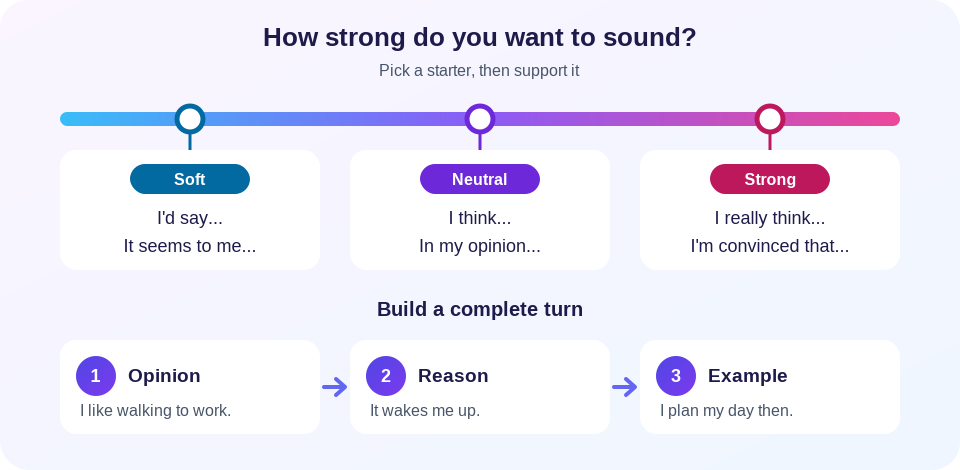
What you will learn
- Start an opinion in a soft, neutral or strong way.
- Add a reason and an example without long pauses.
- Ask other people for their views.
- Say that you are not sure, or have no opinion yet.
Choose your strength
The same idea can sound gentle or very certain. In many everyday and work situations, a neutral or soft start is a safe choice.
| Strength | Phrase | Example |
|---|---|---|
| Soft | I'd say... | I'd say the second design is clearer. |
| Soft | It seems to me that... | It seems to me that we need more time. |
| Neutral | I think... | I think the park is a good place to meet. |
| Neutral | In my opinion,... | In my opinion, the course is too short. |
| Strong | I really think... | I really think we should call them today. |
| Strong | I'm convinced that... | I'm convinced that practice matters most. |
"In my opinion" is correct, but it sounds a little formal. In relaxed talk, "I think" is very common. Do not say "According to me." English speakers use "according to" for other sources: "According to the timetable, the bus leaves at nine."
You can also say what kind of view it is: "Personally, I prefer mornings," or "From a student's point of view, the library closes too early."
Add a reason, then an example
An opinion without a reason can sound like a decision that nobody may question. A reason gives your listener something to answer.
Opinion:  I think walking to work is a great habit.
Reason:   The main reason is that it gives you time to wake up.
Example:  For example, I plan my day while I walk.
Useful links for reasons are "because," "since," "the main reason is that" and "one reason is that." For examples, use "for example," "for instance," "take my street" or "last week, for example."
You can finish with a short round-off: "So that's why I like it." This tells the listener that your turn is over.
Compare two answers to "What do you think of online classes?"
- Short: "They are good."
- Developed: "I'd say they work well for some people. One reason is that you save travel time. For instance, I can join a class right after dinner. On the other hand, I sometimes get distracted at home."
The second answer is longer, but each sentence is simple. You do not need difficult grammar. You need a clear order.
Ask for other views
Good speakers do not only give opinions. They invite them.
- "What do you think?"
- "How do you feel about that?"
- "What's your view, Ana?"
- "Do you see it the same way?"
- "I'd be interested to hear what you think."
Notice the difference between two questions. "What do you think?" asks for an opinion. "How do you think?" asks about your thinking process, so it is usually the wrong question here.
When you are not sure
You do not have to hold a strong view about everything. These phrases are honest and polite.
- "I'm not sure, to be honest."
- "I haven't really thought about it."
- "I can see good points on both sides."
- "It depends. If it's for a short trip, yes. For a long one, probably not."
- "Can I think about it for a moment?"
"It depends" is very useful, but finish the idea. Say what it depends on.
A model conversation
Sam: Our club might move the meetings to Saturday. How do you feel about that?
Lina: Personally, I'm not keen. The main reason is that many of us work on Saturdays. Omar does, for example. What's your view?
Sam: I can see both sides. Saturday gives us more time, but we could lose a few people.
"I'm not keen" means "I don't really like the idea." It is softer than "I hate it." Lina gives a reason, an example and then a question. That keeps the talk moving.
Practice method: one opinion, three versions
Take one question and answer it three times. First, give a soft version, as if you are talking to someone you have just met. Next, give a neutral version for a colleague or classmate. Last, give a strong version, as if you care a lot about the subject. Keep your reason the same, so that you can concentrate on the starter and your voice.
For example, for "Should shops open late?", you could move from "I'd say it can be useful" to "I think it's useful" and then to "I really think it helps people who work during the day." Record yourself if you have a device that can do it, and listen for long pauses before the reason.
Common mistakes
- "I am agree" or "I am think" are wrong. Say "I agree" and "I think."
- "According to me" is not natural. Say "In my opinion" or "I think."
- Do not stack starters: "In my opinion, I think" repeats itself. Choose one.
- To disagree with an idea after "I think", it is more natural to say "I don't think it's a good idea" than "I think it's not a good idea."
Try it
Say each answer aloud before you open the model.
Now speak for 45 seconds. Use the timer and the checklist.
Check your understanding
Quick check · 4 questions
of 4 answered You scored / 4 · perfect!
-
1. Which phrase gives the softest opinion?
"It seems to me" and "might" both soften the statement. -
2. Which sentence is natural English?
"In my opinion" is the correct phrase. "According to" is used for other sources. -
3. You have not thought about a topic yet. What is a good reply?
This is honest and polite, and it keeps you in the conversation. -
4. What should you add after "It depends"?
Listeners expect you to explain the condition.
Summary
- Pick a soft, neutral or strong starter to match the situation.
- Build your turn as opinion, reason, example, then a round-off.
- Ask "What do you think?" to include others.
- It is fine to be unsure. Say so clearly.
Track your progress
Create a free account to tick off lessons and pick up where you left off on any device.