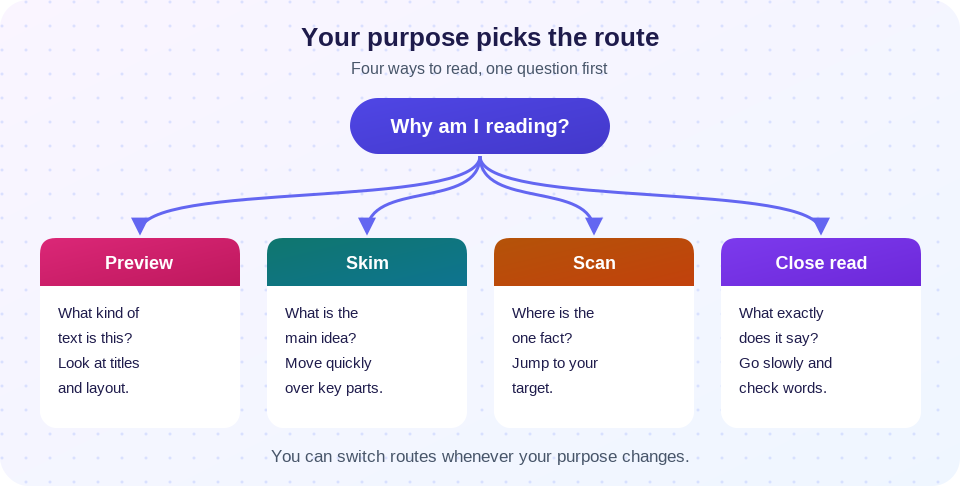
Learn to choose a reading strategy: preview a text, set a purpose, and decide whether to skim, scan or read closely in English.
Good readers do not read every text in the same way. You read a bus timetable, a message from a friend and a contract very differently. This chapter gives you a small set of strategies and shows you when to use each one.
The key habit is simple: before you read, ask "Why am I reading this?" Your answer tells you how fast to go, what to look for, and when you can stop.
Your purpose chooses the route, and you can change routes as you read.
Previewing means looking at a text before reading it properly. Check these things:
Title and headings. They name the topic and often the structure.
Source and date. Who wrote it, and when? An old notice may no longer be true.
Layout. A list, a table or a letter each suggests a different use.
Pictures and captions. They often show the most important idea.
First and last lines. Writers often introduce and then sum up the point there.
Suppose you see the heading "Library closed for repairs: where to return your books". Before you read another word, you can predict that the text will give a reason, some dates and a place for returns. Now your brain has empty slots waiting to be filled, and filling slots is much easier than collecting random sentences.
A heading such as Paying the fee can become "How much is the fee, and how do I pay it?" As you read, you look for the answer. If a section has no heading, invent a question from its first sentence.
Questions also help you notice when a text does not answer something. That is useful information: you may need to ask someone or look elsewhere.
English paragraphs often have one main idea, and it is frequently near the beginning. This is a tendency, not a rule. Some writers lead with a story or a question and give the main point later. Watch for signal phrases:
Close or cover the text and say what it was about in one or two sentences. Use your own words. If you cannot do it, you have found something to fix: reread the part that feels foggy. Then compare your result with your purpose. If you wanted one date and you have it, you can stop, even if half the page is unread.
A useful sentence to complete is: "The writer wants me to know that ..." If you can finish it, you have the main idea.
Subject: Saturday practice moved. Hi all, the main field is being repaired this weekend, so Saturday practice will be in the school gym. We start at 10:00 as usual. Bring indoor shoes, because outdoor boots are not allowed on the gym floor. See you there, Sam.
Purpose: Do I need to change my plans?
Preview: The subject line already says practice has moved.
Prediction: The message will give a new place and maybe a new time.
Close reading: Only the place changes. The time stays at 10:00. You need indoor shoes.
Summary in your words: Practice is in the gym at the usual time, and I need different shoes.
Notice that the word as usual matters. A quick reader might think the time changed too.
<style>body{font-family:system-ui,sans-serif;margin:0;padding:12px;background:#faf5ff;color:#1e1b4b;line-height:1.5}.card{background:#fff;border:1px solid #e0e7ff;border-radius:14px;padding:12px 14px;margin:0 0 10px;box-shadow:0 4px 12px rgba(99,102,241,.1)}button{font:inherit;cursor:pointer;border:1px solid #a5b4fc;background:#eef2ff;color:#1e1b4b;border-radius:999px;padding:6px 14px;margin:4px 6px 0 0}button.go{background:#4f46e5;color:#fff;border-color:#4f46e5}button.ok{background:#d1fae5;border-color:#059669}button.no{background:#fee2e2;border-color:#dc2626}button:disabled{cursor:default}input,select,textarea{font:inherit;padding:5px 8px;border:1px solid #a5b4fc;border-radius:8px;max-width:100%;box-sizing:border-box}.fb{margin-top:6px;font-size:14px;color:#334155}p{margin:6px 0}</style><divid="app"></div><script>const intro =[];const items =[{"q":"You want to find the price of a child ticket on a long museum page.","options":["Close read the whole page","Scan","Skim only the first paragraph"],"answer":1,"why":"You have one target, so jump to prices and numbers."},{"q":"A friend sends you a long article and asks whether it is about cooking or about farming.","options":["Close read every line","Learn all new words first","Skim"],"answer":2,"why":"You only need the general topic."},{"q":"You are about to take medicine and are reading the instructions on the label.","options":["Close read","Skim","Read only the title"],"answer":0,"why":"Small words such as not, before and after can change the meaning."},{"q":"You open an unfamiliar website and wonder whether it can help with your homework.","options":["Read every page","Scan for your own name","Preview"],"answer":2,"why":"Headings, source and layout help you decide quickly."}];functionel(tag, text, parent, cls){const node = document.createElement(tag);if(text){ node.textContent = text;}if(cls){ node.className = cls;}(parent || document.getElementById('app')).appendChild(node);return node;}functionbuildQuestions(parent){let right =0;let done =0;const total = document.createElement('p');
items.forEach(function(item, n){const card =el('div','', parent,'card');el('p',(n +1)+'. '+ item.q, card);const feedback = document.createElement('div');
feedback.className ='fb';const buttons = item.options.map(function(label, i){const button =el('button', label, card);
button.onclick=function(){
buttons.forEach(function(b){ b.disabled =true;});
buttons[item.answer].className ='ok';if(i === item.answer){ right++;}else{ button.className ='no';}
done++;
feedback.textContent =(i === item.answer ?'Correct. ':'Not this one. ')+ item.why;
total.textContent ='Your count: '+ right +' correct out of '+ done +' answered.';};return button;});
card.appendChild(feedback);});
parent.appendChild(total);}if(intro.length){const box =el('div','',null,'card');
intro.forEach(function(line){el('p', line, box);});}buildQuestions(document.getElementById('app'));</script>
Now complete each short plan with one word. The first letter is given as a hint.
Fill in the reading plan
<style>body{font-family:system-ui,sans-serif;margin:0;padding:12px;background:#faf5ff;color:#1e1b4b;line-height:1.5}.card{background:#fff;border:1px solid #e0e7ff;border-radius:14px;padding:12px 14px;margin:0 0 10px;box-shadow:0 4px 12px rgba(99,102,241,.1)}button{font:inherit;cursor:pointer;border:1px solid #a5b4fc;background:#eef2ff;color:#1e1b4b;border-radius:999px;padding:6px 14px;margin:4px 6px 0 0}button.go{background:#4f46e5;color:#fff;border-color:#4f46e5}button.ok{background:#d1fae5;border-color:#059669}button.no{background:#fee2e2;border-color:#dc2626}button:disabled{cursor:default}input,select,textarea{font:inherit;padding:5px 8px;border:1px solid #a5b4fc;border-radius:8px;max-width:100%;box-sizing:border-box}.fb{margin-top:6px;font-size:14px;color:#334155}p{margin:6px 0}</style><divid="app"></div><script>const intro =[];const items =[{"sentence":"Before reading, decide your p______.","accepted":["purpose"],"why":"Your purpose controls your strategy."},{"sentence":"To look at the title, headings and pictures first is to p______ the text.","accepted":["preview"],"why":"Previewing builds expectations."},{"sentence":"To read quickly for the main idea is to s______ it. (Four letters in total.)","accepted":["skim"],"why":"Skimming is for the gist, the general meaning."},{"sentence":"A guess about what comes next is a p______.","accepted":["prediction"],"why":"Check each prediction as you read."}];functionel(tag, text, parent, cls){const node = document.createElement(tag);if(text){ node.textContent = text;}if(cls){ node.className = cls;}(parent || document.getElementById('app')).appendChild(node);return node;}if(intro.length){const box =el('div','',null,'card');
intro.forEach(function(line){el('p', line, box);});}const rows = items.map(function(item, n){const card =el('div','',null,'card');el('p',(n +1)+'. '+ item.sentence, card);const input =el('input','', card);
input.setAttribute('aria-label','Answer '+(n +1));const feedback =el('div','', card,'fb');return{item: item,input: input,feedback: feedback };});const check =el('button','Check my answers',null,'go');const total =el('p','');
check.onclick=function(){let right =0;
rows.forEach(function(row){const typed = row.input.value.trim().toLowerCase().replace(/\s+/g,' ').replace(/\.$/,'');const good = row.item.accepted.some(function(a){return a.toLowerCase()=== typed;});if(good){ right++;}
row.feedback.textContent =(good ?'Matches. ':'Expected: '+ row.item.accepted[0]+'. ')+ row.item.why;});
total.textContent = right +' of '+ rows.length +' match the listed answers. The checker only compares text.';};</script>