
























Lesson 1 · How Comprehension Works
Course map: how to improve listening and reading
See the whole English listening and reading course, check your starting point, and plan a simple routine that builds real understanding step by step.
You can know a lot of English words and still feel lost when people talk quickly, or finish a page and wonder what it said. That is normal. Listening and reading are skills, and a skill grows when you practice its parts in a clear order.
This lesson is your map. It shows what the course covers, how the parts connect, and how to find your own starting point.
What you will learn
- What listening and reading have in common, and how they differ
- What each part of the course is for
- How to choose material at a useful level
- How to write a small, realistic study plan
Two skills, one goal
Both skills have the same goal: you build a picture of meaning in your head. You take in words, connect them to what you already know, and decide what the speaker or writer wants to say.
The differences matter too.
| Question | Listening | Reading |
|---|---|---|
| Who controls the speed? | Usually the speaker | You |
| Can you go back? | With a recording, or by asking | Yes, at any time |
| Where do words start and end? | You must work it out from sound | Spaces show you |
| Extra clues | Voice, stress, pauses, face | Titles, paragraphs, punctuation, layout |
When the speaker controls the speed, you have less time to solve problems. Reading gives you more time, so it is a good place to meet new words. Remember to learn how those words sound too.
The route through the course
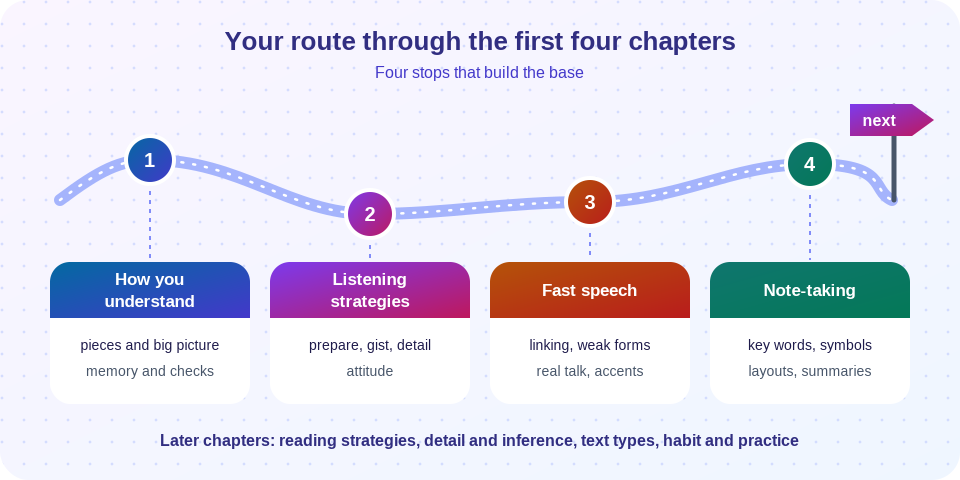
The course has nine chapters. These are the first four, which build the base.
- How Comprehension Works. What happens when you understand: top-down and bottom-up processing, words and background knowledge, memory, and noticing when you are lost.
- Listening Strategies. What to do before, during and after you listen.
- Understanding Fast Speech. Why natural speech sounds different from the words on a page.
- Note-taking. How to catch ideas without losing the thread.
The later chapters turn to reading strategies, reading for detail and inference, different text types, building a habit, and final practice. You can find them on the course page.
Find your starting point
A level label tells you only a little. It also helps to try real material and watch what happens. Choose a short audio clip with a transcript (a written copy of the words), and a short article on a topic you like. Then ask three questions about each one.
- Can I say the main idea in one or two sentences?
- Can I give two or three details that support it?
- Where did I get lost: at a word, a fast part, or a long sentence?
Use your answers to choose your next material.
| What happened | What it suggests | What to try |
|---|---|---|
| I understood nearly everything easily | Comfortable material | Use it for speed and enjoyment |
| I got the main idea but missed parts | Useful challenge | Study it closely |
| I could not say what it was about | Too hard for now | Choose a shorter or more familiar text |
You need both comfortable and challenging material. Comfortable material builds speed and confidence. Challenging material shows you what to learn next.
A worked example
Imagine a learner called Ana. She listens to a two-minute talk about city gardens. Afterward she writes: "People grow food in small spaces. I heard about roofs and schools. I lost the part about money."
This note is very useful. Ana has the main idea and two details. She also knows where she lost the thread. Next, she plays the money part again, then reads that part of the transcript. She finds that she knew every word, but some of them were joined together in speech. Her problem was connected sound, not vocabulary. Chapter 3 is written for exactly this.
Now imagine instead that the transcript showed three words that she did not know. Then vocabulary would be part of the problem, and playing the clip many more times would probably not teach her what those words mean.
Plan a small routine
A plan that you can keep is better than a big plan that you drop. Decide four things.
- When: attach practice to something you already do, such as breakfast or a bus ride.
- How long: start short, for example ten or fifteen minutes.
- What: one listening source and one reading source that you actually like.
- Check: after each session, write one sentence about the main idea.
Here is an example week. Change it to suit your life.
| Day | Activity |
|---|---|
| Monday | Listen once for the main idea, then once for details |
| Tuesday | Read a short article and summarize it |
| Wednesday | Study one difficult minute of audio with its transcript |
| Thursday | Read for pleasure without a dictionary |
| Friday | Listen again to Monday's clip and notice what is easier |
This course cannot hear you or measure your level. Some exercises compare your choices or typed words with an answer key, and that is all they do. All practice texts were written for this course.
Common mistakes
Only using very hard material. If you cannot follow anything, you have few clues to learn from. Only using background audio. Sound that plays while you think about something else gives you little focused practice. Counting minutes only. Also check that you understood something.
Try it
Choose the best next step for each learner.
Next, review the key ideas of this lesson.
Check your understanding
Quick check · 4 questions
of 4 answered You scored / 4 · perfect!
-
1. Which is a key difference between live listening and reading?
In live listening the speaker sets the pace. Both skills use background knowledge and involve main ideas. -
2. You get the main idea of an article but miss some parts. What is this article for you?
You understand enough to learn from the parts you missed. -
3. Why should you note where you got lost?
The place and cause of a problem point to useful practice. -
4. Which routine is the most realistic way to start?
Short, linked sessions are easier to repeat.
Summary
- Listening and reading both build meaning, but they give you different clues.
- The first four chapters cover comprehension, listening strategies, fast speech and note-taking.
- Test your starting point with real material: main idea, details, and where you got lost.
- Mix comfortable material with challenging material.
- Keep your routine small, regular and checked.
Track your progress
Create a free account to tick off lessons and pick up where you left off on any device.