
























Lesson 1 · Understanding the Test
TOEFL Preparation: Your Course Map
See the whole route through this independent TOEFL iBT tutorial: the four sections, the order of study, and how to practice each task honestly.
The TOEFL iBT is a computer-based test of English for study. Universities and other organizations use it to see how well you can read, listen, write and speak in academic and campus situations. This tutorial helps you learn what each task asks you to do and how to practice it.
This tutorial is independent. It is not made, approved or endorsed by ETS, the organization that owns the TOEFL test. All practice texts and questions here are our own. None of them are real exam material. The test format changed on January 21, 2026, so be careful with older books and videos.
What you will learn
- how the tutorial is organized
- what the first four chapters cover
- how to use the practice widgets
- which facts you must confirm on the official website
The route
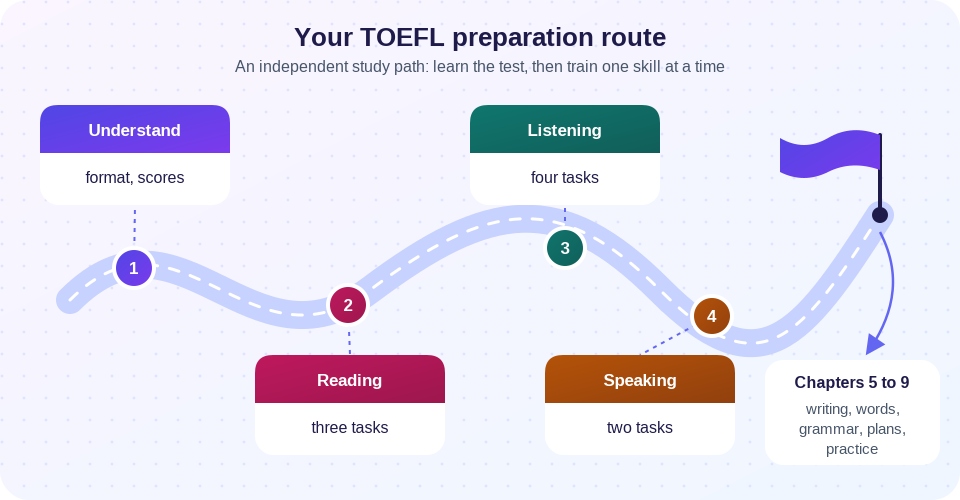
The first chapter explains the test: its four sections, its score scale and the way two sections adapt to you. The next three chapters train Reading, Listening and Speaking. Later chapters cover Writing, academic vocabulary, grammar, study plans, test day and mixed practice. You can find them all on the tutorial page.
Understand first
Train each skill
Then combine
| Chapter | Main question it answers |
|---|---|
| Understanding the Test | What will I see, and how is it scored? |
| Reading | How do I handle word gaps, everyday texts and academic passages? |
| Listening | How do I understand audio that I hear once? |
| Speaking | How do I repeat accurately and answer interview questions? |
How to study each lesson
Use the same four steps every time.
- Read the explanation. Find out what the task really tests.
- Follow the worked example. Cover the answer and decide for yourself before you read on.
- Do the practice. The widgets compare your choices with an answer key that we wrote.
- Record your mistakes. Write the reason for each one in a notebook.
A reason is more useful than a mark. "I chose the wrong option" teaches you nothing. "I chose it because it repeated a word from the text, but it changed the meaning" tells you what to watch next time.
An example of a useful error log
| What happened | Why | What to do next time |
|---|---|---|
| I missed a room change | I stopped listening after the first room number | Wait for words such as "actually" and "instead" |
| I chose the wrong word form | I wrote a verb where a noun was needed | Check the words around the gap |
| My spoken answer was very short | I gave an opinion but no reason | Add "because" and one example |
Keep the log short. Three lines that you read again next week are better than three pages that you never open.
What the practice can and cannot do
The widgets can check a multiple-choice answer or a typed gap. They cannot hear your voice, judge your pronunciation, mark your writing or predict your score. For speaking, you will use timers and checklists. You can record yourself on your own device and listen again, or ask a teacher or fluent speaker for feedback.
Some listening exercises have a Listen button that uses your browser's built-in computer voice. It may not work in every browser. A message tells you when it fails, and you can show the script instead. A computer voice is also not the same as the audio in the real test.
Check the official source
Test rules can change. Before you register, check the current format, timings, fees, identification rules, score reporting and test-day rules on the official ETS TOEFL website (ets.org/toefl). Also check what each of your universities or other organizations accepts. We compared the facts in this tutorial's early chapters with ETS material about the 2026 format, but the official site always has the final word.
Worked example: choose where to put your time
Mina reads articles in English easily, but she often loses the thread of a lecture, and she has never practiced speaking against a clock. She should still read the whole first chapter. After that, she can give more weekly time to Listening and Speaking, and keep Reading fresh with one short set. Her plan follows evidence about her own skills, not only the order of the chapters.
Her friend Tom has the opposite pattern: he chats comfortably but reads slowly. He moves through the same chapters and gives Reading more time. The route is shared, but the amount of time at each station is personal.
A first-week checklist
Before you move far into the tutorial, take care of five small jobs. First, open the official ETS TOEFL pages and bookmark them. Second, write down which organizations need your result and the dates that matter to you. Third, choose a notebook or a document for your error log. Fourth, decide on two or three study times that you can really keep. Fifth, find a way to record your voice for the speaking lessons. None of these jobs improves your English directly, but together they remove the small obstacles that often stop a study plan in its second week. When they are done, you can give your whole attention to the language.
Common mistakes
- Using advice written for the old format without noticing.
- Studying only the skill you already enjoy.
- Treating a widget result as a TOEFL score.
- Reading about speaking without ever speaking aloud.
Try it
First, practice separating what this tutorial can do from what only you, another person or ETS can do.
Next, try a very small sample of the checking style used in later lessons.
Check your understanding
Quick check · 4 questions
of 4 answered You scored / 4 · perfect!
-
1. What does it mean that this tutorial is independent?
It is a separate study resource with its own practice. -
2. What should you do after a wrong answer?
The reason for an error shows what to change. -
3. What can the site do with your speaking practice?
The site cannot hear, grade or score you. -
4. Where should you confirm current timings and rules?
The owner of the test publishes the current information.
Summary
- This is an independent tutorial with its own practice material.
- The format changed on January 21, 2026.
- Learn the test, then train each skill, then combine them.
- Log the reason for every mistake.
- Confirm important details on the official ETS site.
Track your progress
Create a free account to tick off lessons and pick up where you left off on any device.