
























Lesson 30 · Expression and Playing Pieces
Dynamics and Touch
Read piano dynamic markings from pianissimo to fortissimo, shape crescendos, and learn how key speed and arm weight control loud and soft playing.
Correct notes and rhythm are the frame of a piece. Expression is what you do inside that frame. The first tool of expression is dynamics: how loud or soft you play.
The full name of the piano comes from the Italian for "soft" and "loud". Early makers valued exactly this: the player could change the loudness through touch.
What you will learn
- The common dynamic markings
- How crescendo and diminuendo work
- How touch changes the sound
- How to shape a musical phrase
- What your instrument can and cannot do
The markings
| Sign | Italian word | Meaning |
|---|---|---|
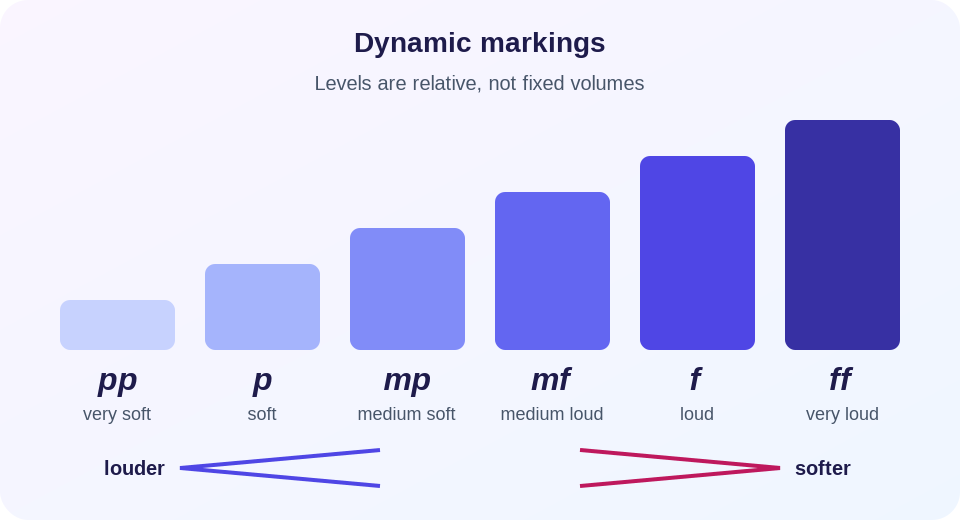
| pp | pianissimo | very soft |
| p | piano | soft |
| mp | mezzo piano | moderately soft |
| mf | mezzo forte | moderately loud |
| f | forte | loud |
| ff | fortissimo | very loud |
These are not fixed volume numbers. They are relative to each other, to the style and to the room. Forte in a gentle lullaby may be softer than forte in a lively march.
A marking usually stays in force until another one appears. A sign such as sf or sfz (sforzando) asks for a sudden strong accent at that place.
Getting louder and softer
Crescendo (cresc.) means gradually louder. Diminuendo (dim.) and decrescendo (decresc.) mean gradually softer. These are often drawn as long wedges, called hairpins. A wedge that opens to the right gets louder. A wedge that closes to the right gets softer.
The key word is gradually. A common mistake is to jump to loud as soon as you see "cresc.". Start a crescendo from a soft enough level that you have room to grow. Plan where the peak is.
How touch makes volume
On an acoustic piano, a key moves a mechanism that throws a hammer at the strings. The faster the key goes down, the faster the hammer moves and the louder the note. After the hammer has struck, you cannot change that note's loudness by pressing the key more.
This leads to practical advice:
- For soft notes, start close to the key and move down gently and steadily. Press far enough that the note sounds.
- For loud notes, let more arm weight arrive with a quicker movement. Keep the wrist free. Do not hit from a stiff hand.
- For even notes, try to give each key a similar speed.
A loud, tense sound can feel harsh. A loud sound from relaxed arm weight often feels fuller, and it is much kinder to your body.
Your instrument
Many digital pianos and some keyboards are touch sensitive (also called velocity sensitive). They respond to how fast you press. Some also let you adjust the touch response. Others always play at the same level whatever you do. On those, you can still shape music with timing and note length, but not with finger dynamics. If you plan to study piano seriously, a touch-sensitive instrument with weighted keys is helpful.
Shaping a phrase
A phrase is a musical thought, a little like a sentence. When you speak a sentence, you do not give each word the same stress. Music is similar.
Try this with C D E F G F E D C:
- Start quietly.
- Grow a little with each note up to G.
- Relax the sound on the way down.
- Let the last C be soft and unhurried.
Now try it the other way: start strong, become softer toward the top and grow on the way down. Both are possible. Which feels more natural to you? When the score has no markings, listen to the line and make a choice.
Often the highest note, a long note or a tense chord is a natural peak, but not always. Follow the written signs first.
Practice the levels
Play one chord at pp, then p, mp, mf, f and ff. Try to make six steps that you can hear. Then play only p, f, p, f to switch quickly. Finally, make one smooth crescendo over eight repeated notes.
Protect your ears and think about your neighbors. Loud practice does not need to be long. With headphones, keep the overall volume moderate and still practice the contrast.
Worked example: planning an eight-measure line
Suppose a piece has two four-measure phrases with similar notes. The score shows only p at the start. You can still make a plan.
- Phrase one: start at p. Grow a little toward its highest or longest note, and relax at the end.
- Phrase two: start at p again. Make the growth slightly larger than before, because the idea has returned.
- Ending: become gently softer over the last two notes.
This creates a question and an answer without adding any loud passage. Pencil your plan on your own copy. If a composer or editor prints a different marking later, follow the printed sign.
Balance between the hands matters too. A p marking applies to the whole sound, but the melody can still be a little stronger than the accompaniment. Think of two levels of soft: a singing soft for the tune and a quieter soft for everything else.
Common mistakes
- Playing soft notes so timidly that some of them make no sound.
- Slowing down when playing softly or speeding up when playing loudly without meaning to.
- Hitting keys from high up with stiff fingers to create forte.
- Reaching the peak of a crescendo too early.
Try it
Draw your own phrase shape by choosing a level for each note. Then play it the same way. The bars give a picture of your plan.
Check your understanding
Quick check · 4 questions
of 4 answered You scored / 4 · perfect!
-
1. Which list goes from soft to loud?
Mezzo piano is softer than mezzo forte. -
2. What does diminuendo mean?
It changes loudness, not speed. -
3. What mainly makes a note louder on an acoustic piano?
The hammer speed depends on how the key goes down. -
4. How should you start a long crescendo?
If you start loud, you have nowhere to go.
Summary
- Dynamics run from pp to ff and are relative levels.
- Crescendo and diminuendo are gradual.
- Key speed shapes loudness; use relaxed arm weight.
- Shape phrases with a planned peak.
Track your progress
Create a free account to tick off lessons and pick up where you left off on any device.