
























Lesson 15 · Composition
Composition: The Frame and the Rule of Thirds
Start composing better photos: choose a clear subject, simplify the frame, place points of interest with the rule of thirds, and know when to break it.
Composition is how you arrange things inside the frame. It decides where a viewer looks first, what feels important and what feels calm or tense.
Good composition does not need expensive gear. It needs attention.
What you will learn
- How to pick and show a clear subject
- How the rule of thirds works
- When centering works better
- How to check the edges of your frame
Start with a subject
Before you shoot, finish this sentence: "This picture is about..."
- "...my sister's concentration while she draws."
- "...the pattern of shadows on the stairs."
- "...how small the boat looks on the lake."
Your answer guides your choices. Anything that helps the sentence stays. Anything that fights it should go, if you can change it.
The frame is a choice
A photo has four edges. What you leave out is as important as what you put in.
Ways to simplify
- Move closer to remove distractions.
- Change your angle to hide clutter behind the subject.
- Zoom in to narrow the view.
- Wait until a distracting person or car leaves.
- Crop later, keeping enough pixels for how you will use the photo.
The rule of thirds
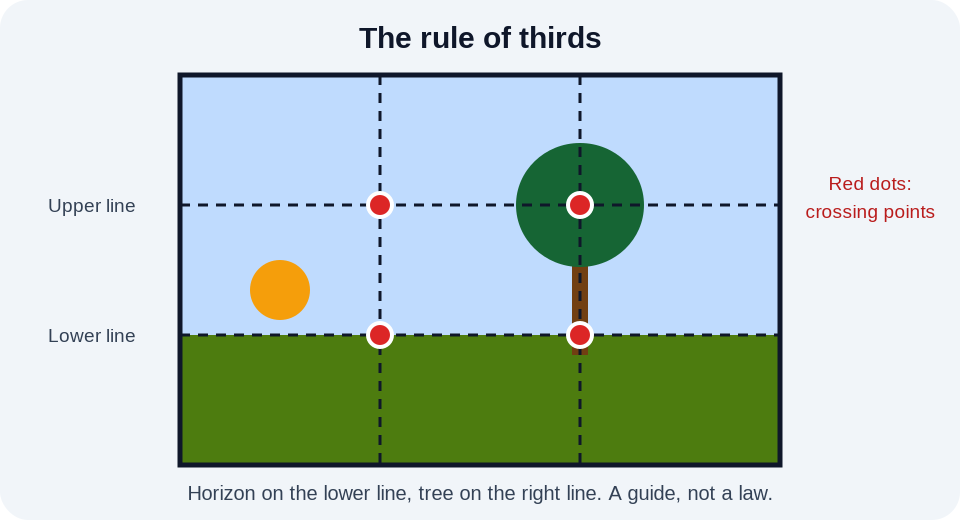
Imagine two lines across and two lines down that split the frame into nine equal parts. The rule of thirds suggests placing important things:
- Along one of these lines, or
- Near one of the four points where they cross
Many cameras and phones can show this grid on screen.
Horizon placement
- Horizon on the lower line: gives space to the sky. Good for dramatic clouds.
- Horizon on the upper line: gives space to the ground or water. Good for interesting foregrounds.
- Horizon in the middle: can be strong for reflections or calm symmetry.
Portraits
Try putting the subject's eyes near the upper third line. If the person looks to one side, many photographers leave more space on that side. This "looking room" often feels comfortable.
It is a guide, not a law
The rule of thirds is a helpful starting point. It does not guarantee a good picture, and many great pictures ignore it.
When centering works
- Symmetry: a doorway, a hallway, a reflection
- A face looking straight at you for a direct, strong feeling
- A single simple subject with a plain background
When extreme placement works
A tiny person near the edge of a huge empty space can show loneliness, freedom or size. The picture's idea decides.
When in doubt, take both: one with the thirds placement and one centered. Compare them later and say which one tells your idea better.
Look at the edges
Before pressing, run your eyes around all four edges.
- Is a hand or foot cut off in an awkward way?
- Is a bright object peeking in from the side?
- Is there half a sign or half a person?
When you crop people, many photographers avoid cutting right at joints such as wrists, elbows, knees or ankles. Cropping between joints usually looks more natural.
Horizontal, vertical or square
- Horizontal can feel wide and calm, and suits groups and landscapes.
- Vertical can stress height and suits many single people.
- Square often suits centered or balanced subjects.
Choose the shape your idea needs. If you plan to publish in a certain shape, leave a little space so you can crop.
Fill the frame
When the subject is the whole story, let it take up most of the frame. A close view of a gardener's hands in soil may say more than a full view of the garden. Check the lens's minimum focus distance when you move in close.
A worked example
You see a cyclist waiting at a red light, next to a bright painted wall.
- Subject: "a quiet moment before the cyclist rides off".
- Frame: you step so that a trash bin leaves the picture.
- Placement: the cyclist goes on the left third, facing into the open space on the right.
- Edges: the front wheel is fully inside the frame.
- Moment: you wait for the cyclist to look up.
Stand on the sidewalk in a safe spot, and be considerate when you photograph people. Rules about publishing pictures of strangers differ by country.
Review your own placements
After a shoot, pick three pictures. For each one, answer these questions in a short sentence.
- Where did my eye go first, and was that my subject?
- What would change if the subject moved to another third?
- Is there anything at the edges that I would remove next time?
You can also crop a copy of one picture two or three ways. Keep the original file. Compare the versions side by side. Cropping is a safe way to test placement, but it cannot change your viewpoint, so try that while you are still at the scene.
Common mistakes
No clear subject. If you cannot say what it is about, the viewer may not know either.
Putting every subject in the center without thinking. Centering works best on purpose.
Treating the rule of thirds as required. Use it as one option.
Ignoring edges. Small distractions at the border pull the eye.
Try it
Click anywhere in the frame to place your subject. The tool tells you how close it is to a thirds crossing point.
Check your understanding
Quick check · 4 questions
of 4 answered You scored / 4 · perfect!
-
1. How many crossing points does the rule of thirds grid have?
Two vertical and two horizontal lines cross at four points. -
2. Which scene often works well centered?
Symmetry is often strongest when centered. -
3. Why leave space in the direction a person is looking?
Looking room is a common, helpful habit, though not a rule. -
4. What should you check at the edges of the frame?
Small things at the border can pull attention away.
Summary
- Name your subject before you shoot.
- Simplify by moving, changing angle, waiting or cropping.
- The rule of thirds places key things on or near grid lines and crossings.
- Centering and edge placement can work on purpose.
- Check all four edges.
Track your progress
Create a free account to tick off lessons and pick up where you left off on any device.