
























Lesson 16 · Recording
Microphones and Polar Patterns
Compare dynamic, condenser and ribbon microphones, read cardioid, omni and figure-8 polar patterns, understand proximity effect and choose a mic for the job.
A microphone turns sound pressure changes into an electrical signal. Different designs do this in different ways, and each one picks up sound from some directions better than others.
There is no single "best" microphone. The right one depends on your source, your room and what you want to hear.
What you will learn
- How dynamic, condenser and ribbon microphones differ
- How to read polar patterns
- What proximity effect is
- How to choose a microphone for a recording job
Microphone types
| Type | How it works | Power needed? | General tendencies |
|---|---|---|---|
| Dynamic (moving coil) | A diaphragm moves a coil near a magnet | No | Often sturdy and handles loud sources well |
| Condenser | A diaphragm and backplate form a capacitor; electronics buffer the signal | Yes, phantom or other power | Often sensitive with detailed high frequencies |
| Ribbon | A very thin metal ribbon moves in a magnetic field | Passive types no; active types yes | Often a smooth tone; many are delicate |
These are tendencies, not rules. Individual models differ a lot.
Sensitivity describes how strong a signal a microphone produces for a given sound pressure. A less sensitive microphone needs more preamp gain. Maximum SPL is the loudest sound level the maker says it can handle within a stated amount of distortion.
Condensers come in large-diaphragm and small-diaphragm designs. Large ones are often used for voices. Small ones are often used for acoustic instruments, cymbals and stereo recording.
USB microphones include a converter and plug straight into a computer. They are simple, but using several at once can be harder than using several microphones on one interface.
Polar patterns
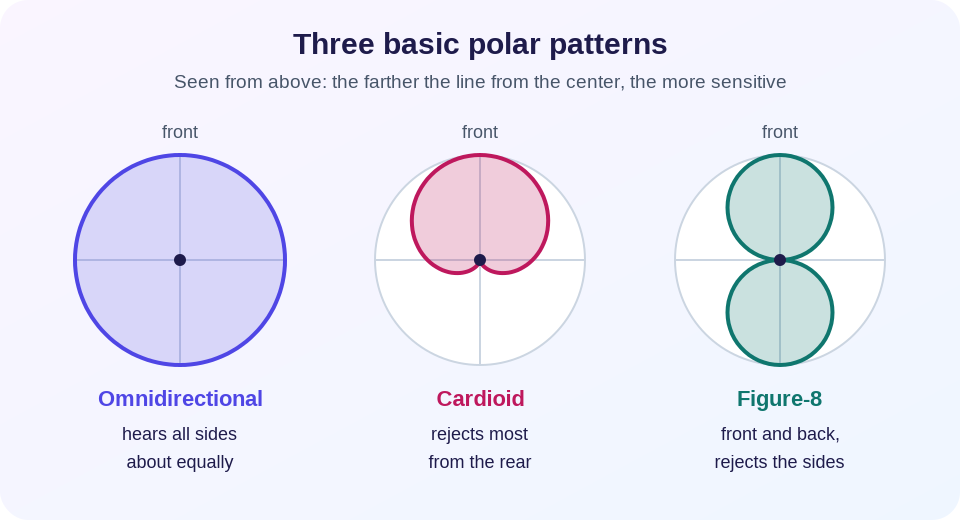
A polar pattern shows how sensitive a microphone is from different directions. Imagine looking down from above. The farther the line is from the center, the more sensitive the microphone is in that direction.
- Omnidirectional: picks up about equally from all directions.
- Cardioid: strongest at the front, with the most rejection at the rear (180°).
- Supercardioid and hypercardioid: narrower at the front than cardioid. They have a small rear lobe and their strongest rejection is at angles toward the back-sides, roughly 125° and 110° from the front in ideal forms.
- Figure-8 (bidirectional): picks up front and back, with strong rejection at the sides (90°).
Real microphones are not ideal. Patterns usually change with frequency. For example, many directional microphones become less directional at low frequencies and narrower at high ones.
Using patterns on purpose
Rejection is your friend. Point the least sensitive side toward what you want less of:
- With a cardioid vocal mic, place a noisy computer behind the microphone.
- With a supercardioid stage mic, do not put a monitor speaker directly behind it; aim speakers toward the rejection angles instead.
- With a figure-8, you can turn its side toward a source you want to reduce. Remember that the back picks up as strongly as the front, so think about what is behind it.
A common phrase is "mind the back": reflections from the wall behind a performer or behind the mic can matter.
Omni microphones have no rejection, but they usually sound natural off-axis and show little proximity effect. In a good room, an omni can sound open. In a noisy or boxy room, it captures a lot of the room.
Proximity effect
Directional microphones (such as cardioid and figure-8) usually boost low frequencies when the source is very close. This is the proximity effect. An ideal omni microphone does not have it.
- It can make a thin voice sound fuller.
- It can also make a voice boomy or muddy.
- If a singer moves closer and farther, the tone changes.
To manage it, set a steady distance, or use the microphone's or DAW's low-cut (high-pass) filter with care.
Pads, filters and accessories
- A pad switch lowers the signal inside the microphone or preamp to help with very loud sources.
- A low-cut switch reduces low rumble.
- A pop filter reduces bursts of air from "p" and "b" sounds, called plosives.
- A foam windscreen helps with light wind and breath. Outdoors, stronger wind protection may be needed.
- A shock mount reduces vibrations passing through the stand.
Choosing for the job
| Situation | A common starting choice | Why |
|---|---|---|
| Voice in an untreated room | A close dynamic or cardioid mic | Close placement reduces the share of room sound |
| Voice in a well-treated room | Condenser (often cardioid) | Captures detail |
| Loud guitar amplifier | Dynamic mic, or another mic rated for high SPL | Handles loud sound |
| Two people facing each other with one mic | Figure-8 | Picks up both sides |
| A group around one mic in a good room | Omni | Picks up all directions |
Test whenever you can. Record the same phrase with different options, level match them and listen.
Handle microphones with care
Do not blow into or tap a microphone to test it, especially a ribbon. Speak or play instead. Follow maker advice on phantom power, storage and cleaning. In shared use, follow basic hygiene.
Common mistakes
- Assuming a more expensive condenser always beats a dynamic in your room.
- Speaking into the wrong side of a side-address microphone. Check which side is the front.
- Pointing a cardioid's back at the singer by mistake.
- Letting a singer drift in and out and then wondering why the bass keeps changing.
Try it
Rotate a sound source around the microphone and compare ideal patterns. Real microphones differ and change with frequency.
Check your understanding
Quick check · 4 questions
of 4 answered You scored / 4 · perfect!
-
1. Where does an ideal cardioid microphone reject sound the most?
An ideal cardioid has its null at 180 degrees. -
2. Which pattern rejects sound from the sides and picks up front and back?
A figure-8 has nulls at 90 and 270 degrees. -
3. What is the proximity effect?
Directional microphones usually gain bass as the source gets very close. -
4. Which statement about condenser microphones is correct?
Condenser designs need power for their electronics or capsule.
Summary
- Dynamic, condenser and ribbon microphones have different strengths.
- Polar patterns show sensitivity by direction and vary with frequency.
- Aim rejection areas toward unwanted sound.
- Directional microphones add bass up close.
- Test options and follow maker instructions.
Track your progress
Create a free account to tick off lessons and pick up where you left off on any device.