
























Lesson 11 · Greetings and Introductions
Saying Hello and Goodbye
Say hello and goodbye in Korean: 안녕하세요, the two polite goodbyes for leaving or staying, casual forms, phone greetings and a short dialogue.
A good greeting is often your first real conversation in Korean. A few short phrases can open many doors.
Korean greetings also teach an important idea: your words change with the person and the situation.
What you will learn
- How to say hello politely and casually
- How to choose between two goodbyes
- Simple follow-up phrases
- How to greet people with respect
Hello
| Korean | Romanization | When to use it |
|---|---|---|
| 안녕하세요 | annyeonghaseyo | polite; useful in most daily situations |
| 안녕하십니까 | annyeonghasimnikka | very formal |
| 안녕 | annyeong | casual; close friends and children |
안녕하십니까 is pronounced [안녕하심니까]. You may hear it in announcements, news programs and formal business settings.
안녕 comes from a word about peace and well-being. In casual speech, friends use it for both "hi" and "bye."
You can say 안녕하세요 in the morning, afternoon or evening. You do not need a different greeting for each time of day.
Goodbye depends on who moves
In the polite style, there are two common goodbyes.
| Korean | Romanization | Say it to |
|---|---|---|
| 안녕히 가세요 | annyeonghi gaseyo | a person who is leaving |
| 안녕히 계세요 | annyeonghi gyeseyo | a person who is staying |
Think of the meanings: "go in peace" and "stay in peace." 가 is connected with going, and 계 with staying.
Three scenes
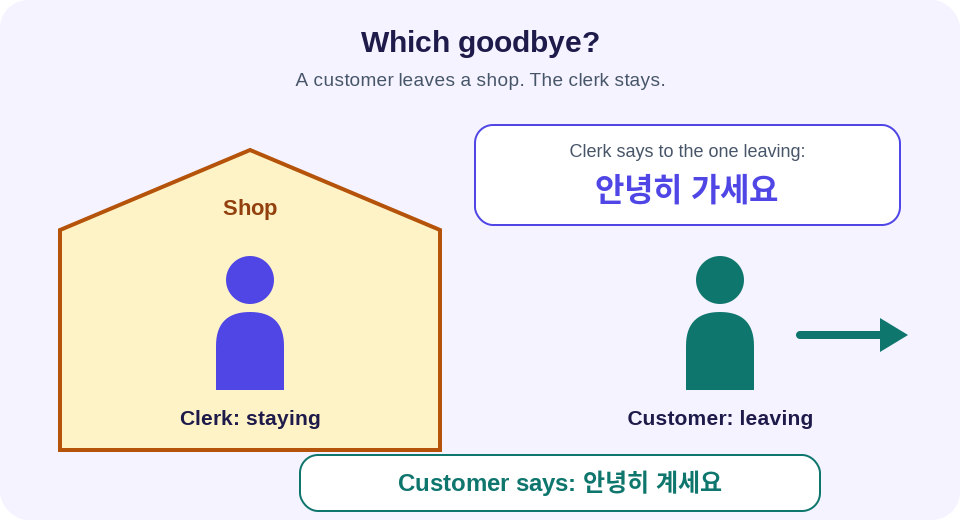
- You leave a shop. The clerk stays. You say 안녕히 계세요. The clerk says 안녕히 가세요.
- A guest leaves your home. You say 안녕히 가세요. The guest says 안녕히 계세요.
- You and a classmate both leave a café and walk different ways. You can both say 안녕히 가세요.
Casual goodbyes
With close friends:
| Korean | Romanization | Meaning |
|---|---|---|
| 잘 가 | jal ga | bye (to someone leaving) |
| 잘 있어 | jal isseo | bye (to someone staying) |
| 안녕 | annyeong | bye |
| 또 봐 | tto bwa | see you again |
Polite versions include 또 봐요 (tto bwayo), "see you again," and 내일 봐요 (naeil bwayo), "see you tomorrow."
After hello
| Korean | Romanization | Meaning |
|---|---|---|
| 오랜만이에요 | oraenmanieyo | it has been a long time |
| 잘 지냈어요? | jal jinaesseoyo | have you been well? |
| 네, 잘 지냈어요 | ne, jal jinaesseoyo | yes, I have been well |
| 반가워요 | bangawoyo | nice to see or meet you |
| 좋은 하루 보내세요 | joeun haru bonaeseyo | have a nice day |
You may also hear 식사하셨어요? or 밥 먹었어요?, "Have you eaten?" People often use these as a friendly way to check on someone. A short answer such as 네, 먹었어요 (yes, I have) works well. It is not always an invitation to a meal.
Answering the phone
When you answer or start a phone call, you can say 여보세요 (yeoboseyo). It is a phone greeting, so do not use it as "hello" when you meet someone face to face.
Body language
A small bow of the head often goes with a polite greeting. A deeper bow shows more formality. Handshakes happen too, for example in business. Habits depend on the people and the setting, so watch what others do and follow gently. Friends may simply wave.
Dialogue
Meeting a neighbor
- 지수: 안녕하세요! 오랜만이에요. (annyeonghaseyo! oraenmanieyo.) Hello! It has been a long time.
- Ana: 안녕하세요! 잘 지냈어요? (annyeonghaseyo! jal jinaesseoyo?) Hello! Have you been well?
- 지수: 네, 잘 지냈어요. (ne, jal jinaesseoyo.) Yes, I have been well.
- Ana: 좋은 하루 보내세요. (joeun haru bonaeseyo.) Have a nice day.
Read both roles aloud. Then replace one phrase and practice again.
Practice in real life
Imagine your own day. Who will you greet? A teacher, a shop clerk, a close friend? Choose a phrase for the hello and one for the goodbye. Say each pair aloud with a small bow where it fits.
Choosing a level of politeness
Ask two questions before you speak: How well do I know this person? What is the setting?
| Situation | Good choice |
|---|---|
| A new classmate who is an adult | 안녕하세요 |
| A shop clerk or a server | 안녕하세요 |
| Your friend's grandmother | 안녕하세요 |
| A close friend your age | 안녕 |
| A formal speech to a large group | 안녕하십니까 |
When you are not sure, choose the polite form. Being a little too polite is usually a smaller problem than being too casual. If someone invites you to speak casually, you can change then.
Why the goodbyes look so similar
The two polite goodbyes share the first part, 안녕히 (peacefully, safely). Only the last part changes. Train yourself to listen for 가 and 계. A simple memory aid: 가 goes with someone who is going. Practice each time you leave a room, even when you are alone: picture who stays and say the matching phrase.
A short role-play
Act out a visit with a partner, or play both parts yourself: say hello, ask 잘 지냈어요?, answer, and finish with the correct goodbyes for the guest and the host.
Common mistakes
Do not swap 가세요 and 계세요. If you leave and tell the person staying 안녕히 가세요, it sounds as if they are the one going. Do not use casual 안녕 with a stranger, a boss or an older person unless casual speech is clearly welcome. And keep 여보세요 for the phone as a greeting.
Try it
Check your understanding
Quick check · 4 questions
of 4 answered You scored / 4 · perfect!
-
1. Which greeting is a good polite choice for most daily situations?
안녕하세요 is polite and widely useful. -
2. You are leaving a friend's parents at their home. What do you say?
They are staying, so use 계세요. -
3. Two people both leave a meeting place. What can each say?
Each person is going, so each can wish the other a good trip. -
4. What does 잘 지냈어요? ask?
It is a common question after a greeting.
Summary
- 안녕하세요 is the everyday polite hello.
- Use 가세요 to someone leaving and 계세요 to someone staying.
- 안녕 is casual. 여보세요 is for phone calls.
- Match your words and gestures to the person and setting.
Track your progress
Create a free account to tick off lessons and pick up where you left off on any device.