
























Lesson 11 · Rhythm and Strumming
Beat and Counting
Understand beat, tempo, bars and note values, count quarter and eighth notes out loud, and practice with a metronome so your guitar playing stays steady.
You can play every chord perfectly and still sound unsure if your timing wobbles. Rhythm is what makes a few chords sound like music. The good news is that rhythm is a skill, and you can train it without any difficult theory.
In this lesson you learn to feel a steady beat, count it out loud, and place strums on it.
What you will learn
- What beat, tempo and bar mean
- How whole, half, quarter and eighth notes relate
- How to count with numbers and "and"
- How to use a metronome calmly
Beat and tempo
The beat is the steady pulse you tap your foot to. It is like regular footsteps. The tempo is how fast the beat goes. It is often measured in BPM, beats per minute. At 60 BPM, there is one beat each second. At 120 BPM, there are two beats each second.
A bar, also called a measure, is a small group of beats. In much popular music, a bar has four beats. You count them 1, 2, 3, 4, then start again at 1. Beat 1 often feels a little stronger.
Note values in 4/4
The time signature 4/4 is very common. For now, think: four beats in each bar, and each beat is a quarter note (called a crotchet in British English).
| Note | Length in 4/4 | Count |
|---|---|---|
| Whole note | 4 beats | 1 - 2 - 3 - 4 |
| Half note | 2 beats | 1 - 2, 3 - 4 |
| Quarter note | 1 beat | 1, 2, 3, 4 |
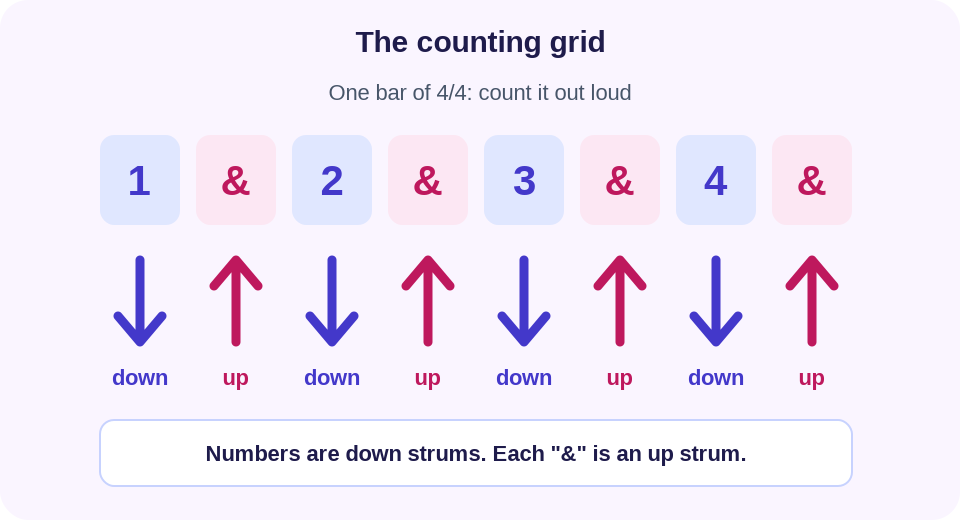
| Eighth note | half a beat | 1 & 2 & 3 & 4 & |
A rest is a silence with a length, just like a note. Silence is part of rhythm. You keep counting during a rest.
Counting out loud
Say the count while you play. It feels strange at first, but it is one of the best habits you can build.
- For quarter notes, say "one, two, three, four".
- For eighth notes, say "one and two and three and four and".
The numbers are the downbeats. The "and" between them is often called the offbeat. Each number and each "and" should take the same amount of time. Do not rush the "and".
Start with your body
Before you pick up the guitar:
- Tap your foot slowly and evenly.
- Count "1, 2, 3, 4" with each tap.
- Clap only on beat 1 for four bars.
- Clap on beats 1 and 3.
- Count "1 & 2 &..." and clap on every number and every "and".
If this feels easy, add the guitar. If it does not, spend more days here. It pays off quickly.
Using a metronome
A metronome gives a steady click. You can use a device or an app. Some metronomes can flash instead of click, which helps if you prefer to watch.
- Start slowly, for example at 60 BPM.
- Listen for a few clicks before you play.
- Count along with the clicks.
- Strum a chord on beat 1 of each bar.
- When that is comfortable, strum every beat.
- Raise the speed by small steps only when you are steady.
If you cannot keep up, lower the tempo. A slow, steady beat teaches more than a fast, uneven one.
A worked example
Take the chord Em. Set 60 BPM and count four beats per bar.
| Bar | Beat 1 | Beat 2 | Beat 3 | Beat 4 |
|---|---|---|---|---|
| 1 | strum | - | - | - |
| 2 | strum | - | strum | - |
| 3 | strum | strum | strum | strum |
In bar 1, one strum rings for four beats. In bar 2, two strums each last two beats. In bar 3, you play four quarter notes. Keep counting through every dash. Next, add Am: play bar 1 on Em, then bar 1 again on Am. The change must happen during beats 2, 3 and 4, while you count.
If you get lost, do not stop the count. Keep saying the numbers, wait for the next beat 1, and join in again. Real players do this too.
Timing and chord changes
A change happens between beats. If you often arrive late, try to start moving earlier, for example on beat 4. In the beginning, it is fine to make the last strum of a bar short or lighter so you have time to move. Later, you will need less time.
Practice ladder
Use this short ladder for one week:
- Day 1 and 2: count and tap without the guitar.
- Day 3 and 4: strum one chord on beat 1 only.
- Day 5 and 6: strum every quarter note on one chord.
- Day 7: switch between two chords every two bars.
Common mistakes
- Speeding up when the part is easy and slowing down when it is hard.
- Stopping the count while you fix your fingers.
- Making the "and" shorter than the number.
- Starting at a fast tempo because slow practice feels boring.
- Counting silently when your timing is not yet steady. Say it out loud.
Try it
Watch the boxes move and say the count with them. The metronome is silent, so tap your foot to feel the pulse.
Check your understanding
Quick check · 4 questions
of 4 answered You scored / 4 · perfect!
-
1. What does BPM mean?
BPM tells you how many beats fit in one minute. -
2. In 4/4, how many beats does a half note last?
A half note is half of the four-beat whole note. -
3. How do you count eighth notes in one 4/4 bar?
Each beat splits into two equal parts, the number and the "and". -
4. You lose your place while playing with a metronome. What is a good response?
Keeping the count going helps you stay in the music.
Summary
- The beat is a steady pulse, and tempo is its speed in BPM.
- A bar in 4/4 has four quarter-note beats.
- Count out loud, using "and" for eighth notes.
- Practice slowly with a metronome and raise speed in small steps.
- Keep counting even when something goes wrong.
Track your progress
Create a free account to tick off lessons and pick up where you left off on any device.