
























Lesson 28 · Academic and Work English
Formal and informal word choice
Choose the right level of English for essays, reports and messages with clear word pairs, rewriting examples and practice that you can check yourself.
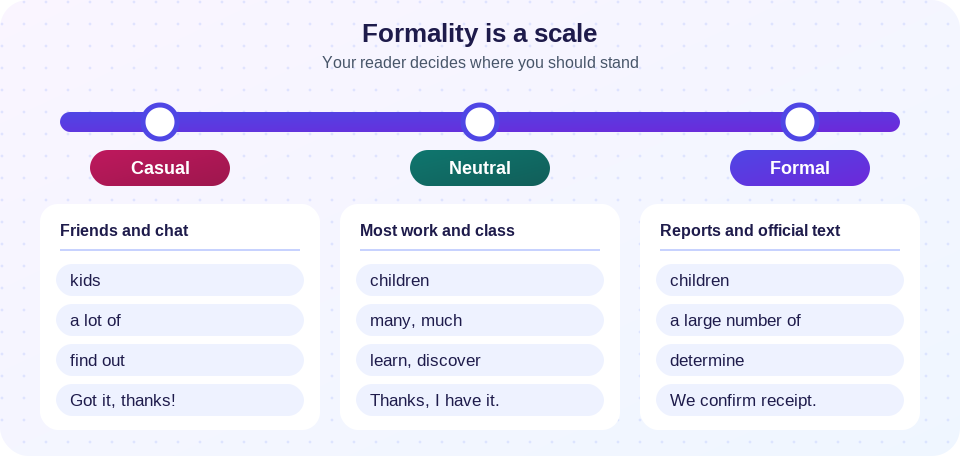
You may know a word and still use it in the wrong place. Kids is fine with friends, but a school report usually says children. In study and work, readers judge your message partly by the level of formality of your words.
This lesson starts chapter 7. You will see how everyday words and academic or professional words differ, and how to move between them without sounding stiff.
What you will learn
- Common casual and formal word pairs.
- Why "formal" does not mean "long and difficult".
- Habits that make writing sound too casual.
- How to rewrite a message for a new reader.
Three questions
Formal writing
Word pairs
| Casual | More formal | Example (formal) |
|---|---|---|
| get | obtain, receive | We obtained the data in May. |
| show | demonstrate | The results demonstrate a clear trend. |
| need | require | The task requires care. |
| help | assist | A tutor can assist you. |
| check | verify, examine | Please verify the dates. |
| big | substantial, significant | There was a substantial rise. |
| a lot of | many, much, a large number of | Many students agreed. |
| kids | children | The survey included children. |
| start | begin, commence | The course begins in June. |
| enough | sufficient | We do not have sufficient time. |
Commence is very formal. In most reports, begin or start is perfectly fine. Choose the level that your reader expects.
Casual habits to avoid in formal writing
- Contractions: write do not instead of don't.
- Slang and chat spelling: avoid gonna, wanna, thx and u.
- Vague words: replace stuff, things and kind of with exact nouns.
- Very strong casual words: awesome and totally are better in chat.
- Direct address: in many essays, writers avoid speaking to you and prefer students or readers. Follow the rules your teacher gives.
Compare: We did loads of stuff, and it was kind of useful. and We completed several tasks, which proved useful.
Precision beats length
Longer words do not automatically make writing better. Utilize usually adds nothing to use. In order to is often just to. At this point in time means now. A clear short word is a good choice in formal writing.
Precision matters more than difficulty. The price went up is vague. The price rose by 5 percent is exact. Learn words that say something specific: increase, decline, remain stable, fluctuate (change up and down).
Connotation: the feeling of a word
A word's connotation is the feeling it carries. These words are close in meaning but not in feeling.
| Neutral | More positive | More negative |
|---|---|---|
| thin | slim | skinny |
| cheap | affordable | low-quality |
| confident | assured | arrogant |
| careful | thorough | fussy |
In a report, neutral words help you sound fair. In an advertisement, writers often choose positive ones.
A rewriting example
Casual: Hey, we got the numbers back and they're way worse than we thought. We gotta fix this ASAP.
Formal: We have received the results, and they are considerably worse than expected. We need to address this issue promptly.
What changed? The greeting disappeared, the contraction became two words, way worse became considerably worse, and gotta and ASAP were replaced. The facts did not change.
Neutral is often safest
Many workplace messages sit between the two extremes. Thanks for your message. I will check the figures and reply tomorrow. This is friendly, polite and clear. When you are unsure, neutral is usually a safe choice. You can learn more about workplace messages in work emails and messages.
Practice routine
When you meet a new word, record its level in your notes: casual, neutral or formal. Then add its closest partner. For a review, cover the formal column and recall it from the casual word, then swap. For more academic words, see the next lesson on academic verbs and linking words.
Phrasal verbs and single verbs
Formality often shows in verb choice. Phrasal verbs are normal and correct, but a single verb may suit a formal document better.
| Everyday | Formal partner | Formal example |
|---|---|---|
| find out | determine | We aim to determine the cause. |
| carry out | conduct | The team conducted two surveys. |
| look into | investigate | The council will investigate the complaint. |
| set up | establish | The school established a reading club. |
Do not remove every phrasal verb. A sentence such as The meeting was put off is acceptable in many workplaces. The goal is a consistent tone. Review the full list in phrasal verbs for work and study.
Check your own writing
Before you send or hand in a text, run this quick check.
- Circle every contraction and decide whether it fits.
- Underline vague words such as stuff, nice and good. Can you be more exact?
- Look for slang, emojis or exclamation marks.
- Read the text aloud. If one word sounds very different in level from the rest, change it.
- Ask: would I be comfortable if the reader showed this to their manager?
Five minutes of checking often improves a text more than adding long words.
Common mistakes
- Choosing the longest word every time. It can make writing heavy and unclear.
- Mixing levels. We shall totally commence sounds odd.
- Replacing a word without checking grammar. Assist someone with a task is a common pattern.
- Ignoring connotation. Skinny and slim do not feel the same.
Try it
Check your understanding
Quick check · 4 questions
of 4 answered You scored / 4 · perfect!
-
1. Which is the more formal partner of need?
Require is the formal partner of need. -
2. Which habit is usually avoided in a formal essay?
Many formal styles use full forms. -
3. What does connotation mean?
Words can be positive, neutral or negative in feeling. -
4. What is usually safest when you are unsure of the level?
Neutral language suits many situations.
Summary
- Match your words to the reader, purpose and format.
- Formal writing is precise and calm; it does not have to be complicated.
- Watch contractions, slang, vague words and connotation.
- Record the level of each new word in your notes.
Track your progress
Create a free account to tick off lessons and pick up where you left off on any device.