
























Lesson 28 · Connected Speech
Linking: how English words join together
Discover how final consonants, matching consonants, vowels and the letter r link words in spoken English, with IPA examples and practice drills.
In writing, spaces separate words. In speech, there are usually no spaces. Words flow into each other, so "turn it off" can sound like one long word. This flow is called connected speech, and its first and most useful part is linking.
Linking helps you speak more smoothly. It also explains why you may know every word on a page and still miss them when someone says them quickly.
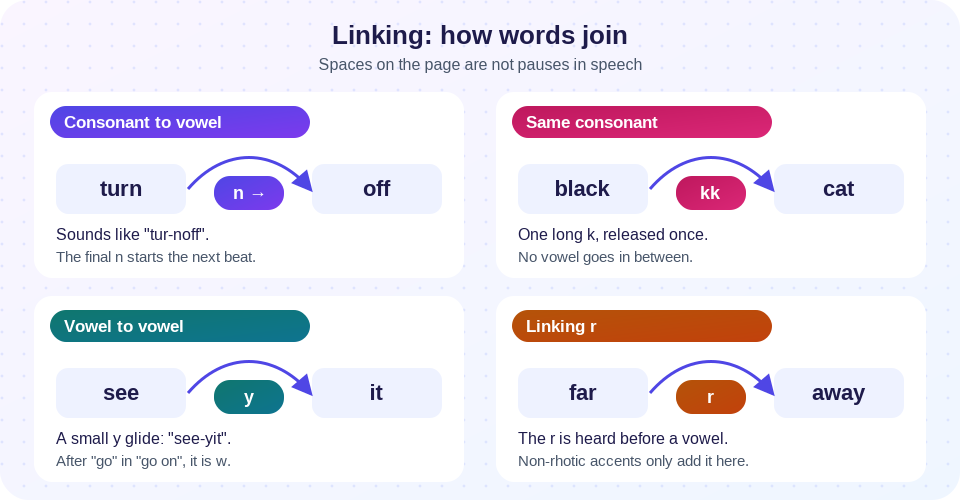
Consonant to vowel
Same consonant
Vowel to vowel
Linking r
Common in non-rhotic accents
What you will learn
- How a final consonant joins a following vowel
- What happens when two matching consonants meet
- How /j/ and /w/ bridge two vowels
- What linking r and intrusive r are
Consonant to vowel
When a word ends in a consonant sound and the next word starts with a vowel sound, the consonant often moves over to start the next syllable.
| Written | Sounds like | IPA |
|---|---|---|
| turn off | "tur-noff" | /ˌtɜːˈnɒf/ |
| an apple | "a-napple" | /ə ˈnæpəl/ |
| not at all | "no-ta-tall" | /ˌnɒt ət ˈɔːl/ |
| keep on | "kee-pon" | /ˌkiːp ˈɒn/ |
| pick it up | "pi-ki-tup" | /ˌpɪk ɪt ˈʌp/ |
Remember to listen to the sound, not the letter. "Make up" ends in the sound /k/, although the spelling ends in "e", so it joins as "may-kup".
In American English, and in many other accents, a /t/ between vowels often becomes a quick tap, similar to a very soft /d/: "get out" may sound like "gedout".
Two matching consonants
When one word ends with the same consonant that starts the next, you usually do not release it twice. Instead, you hold it a little longer and release it once.
- black cat /blæk kæt/: one long /k/
- good day: one longer /d/
- bus stop: one long /s/
- some more: one long /m/
- big girl: one long /ɡ/
Do not insert a vowel between them, as in "black-uh-cat". And do not drop one so completely that "black cat" sounds like "bla cat". Similar sounds, such as /t/ and /d/ in "hot dog", often join in a similar way.
When a stop consonant (/p, t, k, b, d, ɡ/) meets a different consonant, the first is often not released: in "good book", the tongue touches for /d/, but you move straight to the /b/ without a puff of sound.
Vowel to vowel
When two vowels meet at a word edge, speakers often make a small glide to move smoothly between them. This sound is a natural result of the mouth moving, not a new full consonant.
A small /j/ (like the y in "yes") often appears after a vowel that ends high at the front: /iː/, /ɪ/ (as in happy), /eɪ/, /aɪ/, /ɔɪ/.
- see it: /siː‿ʲɪt/, like "see-yit"
- I am: "I-yam"
- they are: "they-yar"
A small /w/ often appears after a vowel that ends with rounded lips: /uː/, /ʊ/, /əʊ/ (American /oʊ/), /aʊ/.
- go on: "go-won"
- do it: "do-wit"
- how are you: "how-war you"
The symbol ‿ shows that two words are linked. Do not exaggerate the glide: "I am" should not sound like it contains a strong "y".
Linking r
In non-rhotic accents, such as most accents of England, Australia and New Zealand, the r at the end of a word is not said before a pause or a consonant. Before a vowel, it returns. This is linking r.
| Phrase | Non-rhotic pronunciation |
|---|---|
| far (alone) | /fɑː/ |
| far away | /ˌfɑːr əˈweɪ/ |
| my car is | /maɪ ˈkɑːr ɪz/ |
| more eggs | /ˌmɔːr ˈeɡz/ |
Speakers of rhotic accents, such as most American, Canadian, Scottish and Irish speakers, say the r in both cases, so for them nothing special happens.
Intrusive r
Some non-rhotic speakers also insert an /r/ where there is no r in the spelling, after vowels such as /ə/, /ɑː/ and /ɔː/. For example, "the idea of it" may sound like "the idea-r-of it", and "law and order" like "law-r-and order". This intrusive r is very common, although some people dislike it. You do not need to use it, but knowing it helps you listen.
When not to link
You can pause between thought groups, so linking happens mainly inside a group. A pause, hesitation or strong emphasis can also separate words. In "I want a RED | APPLE, not a red pear", a speaker might separate the words to make the contrast clear.
How to practice
- Mark the links with
‿: "pick‿it‿up". - Say it slowly, as if it were one word.
- Keep the stress on the right syllables.
- Speed up while keeping each sound.
Linking works together with weak forms: "a cup of tea" is linked and reduced at the same time.
Common mistakes
- Adding a short vowel before a word that starts with a consonant group, or between two joined consonants.
- Releasing two identical consonants separately in a fast phrase.
- Making the small /j/ or /w/ glide so strong that it sounds like a real word.
- Linking across a clear pause between thought groups.
Try it
Check your understanding
Quick check · 4 questions
of 4 answered You scored / 4 · perfect!
-
1. What usually happens to the final consonant in "keep on"?
It becomes the start of the next syllable. -
2. In which accents does linking r appear?
In rhotic accents the r is always said. -
3. What happens with matching consonants as in "bus stop"?
The sound is held and released once. -
4. What is intrusive r?
Some non-rhotic speakers add it between certain vowels.
Summary
- Final consonants join following vowels.
- Matching consonants are usually held and released once.
- Vowels are bridged by small /j/ or /w/ glides.
- Non-rhotic accents often use linking r, and some use intrusive r.
- Link inside thought groups, not across clear pauses.
Track your progress
Create a free account to tick off lessons and pick up where you left off on any device.