
























Bài 42 · Projects and Practice
Chapter 9 overview: projects and practice
Plan the final chapter: three hands-on aerodynamics projects, a practice problem bank, a glossary, a cheat sheet and ideas for further study.
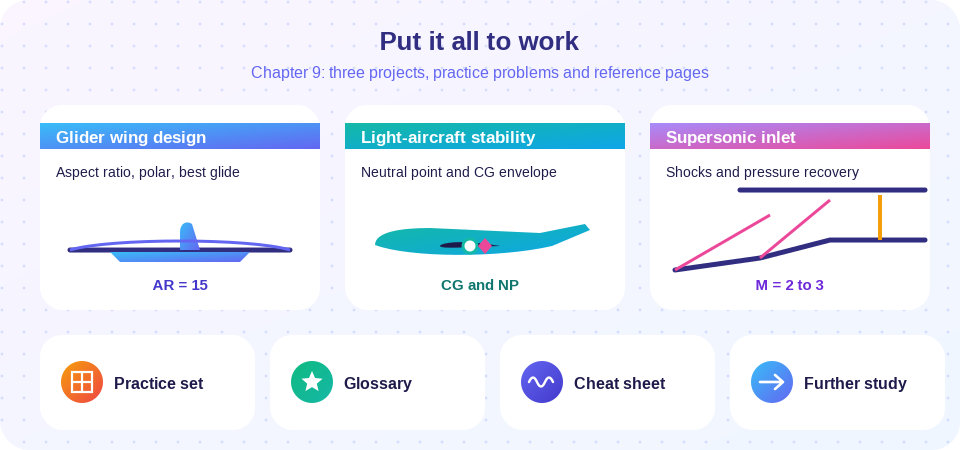
You now have the main tools of aerodynamics: lift and drag, finite wings, compressible flow, stability and control, and numerical methods. Tools only become skills when you use them on a whole problem with competing requirements. This last chapter gives you three complete mini-projects, each ending in a design decision you can defend with numbers, then a problem bank, a glossary, a one-page cheat sheet and a map of where to go next.
What you will learn
- How to turn requirements into a sequence of calculations.
- How the chapters combine: wings, performance, stability and compressible flow in one design.
- How to check your own work with sanity bounds and limiting cases.
The chapter in slides
Project 1: a glider wing
Project 2: stability study
Project 3: supersonic inlet
Then consolidate
What each lesson covers
- Glider wing design: requirements, aspect ratio, the drag polar, best glide, minimum sink and the effect of changing the design.
- Light-aircraft stability study: neutral point, loading and the CG envelope, and the effect of tail size.
- Supersonic inlet and nozzle: oblique-shock inlets, pressure recovery, and a converging-diverging nozzle.
- Practice problems: twelve problems with a checker you can run.
- Glossary, cheat sheet and further study.
How to work a project
A good engineering project follows the same rhythm every time:
- Requirements: write down what the design must do, with numbers.
- Model: choose the simplest model that captures the physics, and say what it ignores.
- Calculate: do the numbers with code, and keep units visible.
- Check: test limits and orders of magnitude. Does a longer wing lower induced drag? Is the answer a sensible size?
- Decide and explain: state the choice, the margin and what would change your mind.
Key terms
Requirement: a measurable thing the design must achieve.
Trade study: varying a design parameter to see how performance changes.
Margin: the cushion between a design value and its limit.
Sanity check: a quick estimate or limit that an answer must satisfy.
Try it
Projects mix units: knots, kilometers per hour, meters per second. A small converter that also reports Mach number saves mistakes. Run it, then adapt it for your project.
Press Run (or Ctrl + Enter) to see the result here.
Program input · what you'd type while the program runs
Type the answers before you press Run, one per line. Each time the program reads a line (with input()), it gets the next line from this box.
Check your understanding
Quick check · 3 questions
of 3 answered You scored / 3 · perfect!
-
1. What is the first step of a design project?
Requirements define success; everything else follows from them. -
2. A sanity check is
For instance, a longer wing must reduce induced drag; if your calculation says otherwise, something is wrong. -
3. What is a trade study?
It exposes sensitivities and helps choose between designs.
Summary
- The three projects combine wings, performance, stability and compressible flow.
- Work in the rhythm requirements, model, calculate, check, decide.
- Use sanity checks and trade studies to build confidence in your numbers.
Next: Glider wing design
Theo dõi tiến độ của bạn
Tạo tài khoản miễn phí để đánh dấu bài đã học và tiếp tục từ chỗ bạn dừng lại trên mọi thiết bị.