
























Bài 26 · Wings and Finite Span Effects
Chapter 5 review: wings and finite span effects
Review finite wings, induced drag, lifting-line theory, sweep and high-lift devices with a one-page summary, a recap table and a ten-question quiz.
You have now moved from the two-dimensional airfoil to the real, three-dimensional wing. This page gathers the chapter's main results in one picture and one table, lets you test them with a small calculator, and ends with a ten-question quiz that mixes all the lessons.
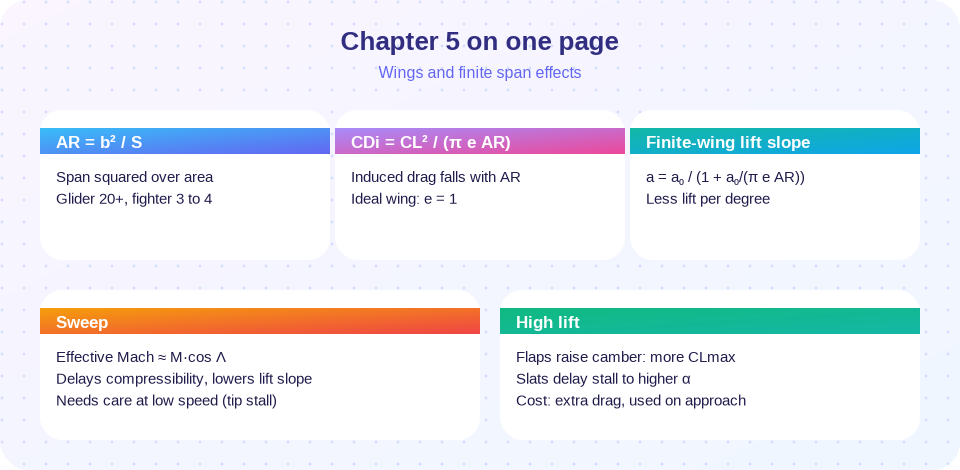
The chapter in a table
| Idea | Key result | Why it matters |
|---|---|---|
| Finite span | Tip vortices cause downwash | Lift tilts back, producing induced drag |
| Aspect ratio | AR = b² / S |
Long wings have less induced drag, higher lift slope |
| Induced drag | CDi = CL² / (π e AR) |
Grows with CL²; large at low speed |
| Lifting line | CL = π AR A₁, e = 1/(1+δ) |
Predicts span loading; elliptical is ideal |
| Sweep | Edge sees V cos Λ |
Delays compressibility; hurts low-speed behavior |
| High lift | Vs = √(2W/(ρ S CLmax)) |
Flaps and slats allow slow, short landings |
Try it
A one-stop calculator for the formulas of the chapter. Change the numbers and check them against your own hand calculations.
Press Run (or Ctrl + Enter) to see the result here.
Program input · what you'd type while the program runs
Type the answers before you press Run, one per line. Each time the program reads a line (with input()), it gets the next line from this box.
Check your understanding
Quick check · 10 questions
of 10 answered You scored / 10 · perfect!
-
1. What is the aspect ratio of a rectangular wing with chord 1.5 m and span 12 m?
For a rectangle AR = b / c = 12 / 1.5 = 8. -
2. What creates downwash at a finite wing?
The two counter-rotating tip vortices induce a downward velocity at the wing. -
3. An elliptically loaded wing has AR = 8 and CL = 0.6. Its induced drag coefficient is closest to
CDi = 0.36 / (π · 8) = 0.0143. -
4. Which loading gives the minimum induced drag for a given span and lift?
The elliptical loading has e = 1. -
5. Induced drag in level flight, as speed increases,
CL falls as speed rises, and CDi goes with CL², so induced drag falls. -
6. To reduce induced drag at constant lift most efficiently, you would
Dᵢ = L² / (π q b² e) depends on span squared. -
7. A wing is swept 30° and flies at M = 0.8. The effective Mach number at the leading edge is
0.8 × cos 30° = 0.693. -
8. Why do back-swept wings often have washout?
Tip stall on a swept wing causes pitch-up and loss of roll control. -
9. The weight of an airplane increases by 21% (factor 1.21) at the same CLmax and density. The stall speed rises by
Vs ∝ √W, and √1.21 = 1.1. -
10. Which pair of devices does an airliner use to raise CLmax for landing?
Flaps add camber and area; slats delay stall to higher angles.
Summary
- The finite wing sheds tip vortices; downwash tilts the lift vector and creates induced drag.
- Aspect ratio and span efficiency set induced drag and lift slope.
- Lifting-line theory predicts span loading; elliptical loading is the ideal.
- Sweep delays compressibility but needs washout; flaps and slats make low-speed flight possible.
Theo dõi tiến độ của bạn
Tạo tài khoản miễn phí để đánh dấu bài đã học và tiếp tục từ chỗ bạn dừng lại trên mọi thiết bị.