
























Bài 15 · Airfoils and Lift
Chapter 3 review: Airfoils and lift
Review airfoil geometry, the pressure coefficient, Kutta-Joukowski, thin-airfoil theory, stall speed and high-lift devices, with a recap table, practice code and a 10-question quiz.
Chapter 3 answered the question "how does a wing lift?" at three levels: qualitatively (three views of lift), geometrically (the airfoil and its NACA code) and mathematically (Cp, circulation, cl = 2π(α − α0), stall). Check yourself with the table, the practice code and the quiz.
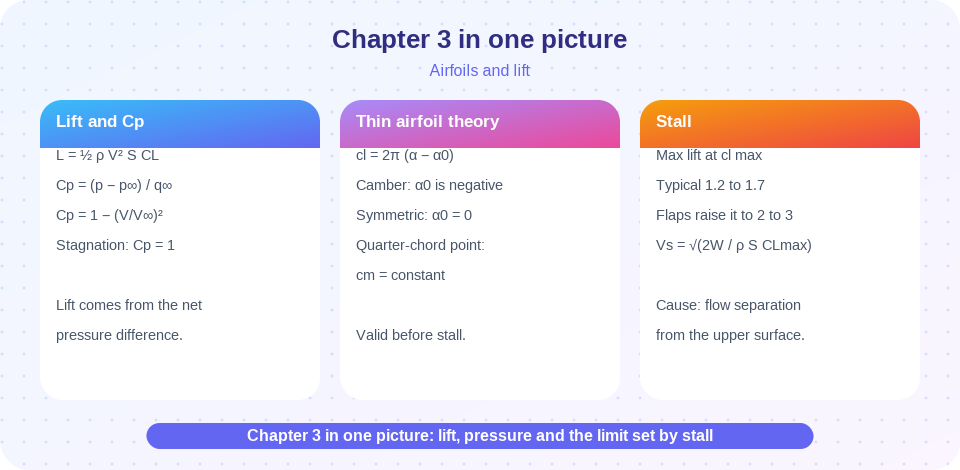
Recap table
| Idea | Key statement | Lesson |
|---|---|---|
| Three views of lift | Pressure difference, downward momentum, circulation | Chapter 3 overview |
| Geometry | Chord, camber, thickness; NACA MPTT | Airfoil geometry |
| Cp | Cp = 1 − (V/V∞)²; stagnation Cp = 1 |
Pressure and lift |
| Kutta–Joukowski | L' = ρ V Γ; Kutta condition fixes Γ |
Pressure and lift |
| Thin airfoil | cl = 2π(α − α0); aerodynamic center at c/4 |
Thin-airfoil theory |
| Stall | Separation at CLmax; Vs = √(2W/(ρ S CLmax)) |
Stall and high-lift devices |
| High lift | Flaps add camber, slats delay stall | Stall and high-lift devices |
Try it
Press Run (or Ctrl + Enter) to see the result here.
Program input · what you'd type while the program runs
Type the answers before you press Run, one per line. Each time the program reads a line (with input()), it gets the next line from this box.
Press Run (or Ctrl + Enter) to see the console output here.
No output.
Check your understanding
Quick check · 10 questions
of 10 answered You scored / 10 · perfect!
-
1. Which of these is NOT one of the three views of lift?
The equal-transit-time argument is a myth. The other three are valid descriptions of the same flow. -
2. A NACA 2412 has:
Digits: maximum camber, its position in tenths of chord, thickness. -
3. What is Cp where the air speed is 1.4 V∞?
Cp = 1 − 1.4² = −0.96. -
4. The Kutta–Joukowski theorem gives lift per unit span as:
L' = ρ V∞ Γ. -
5. What is cl for a symmetric airfoil at 3°?
cl = 2π × 3° × π/180 = 0.329. -
6. Which statement about camber is correct?
Camber produces lift at zero angle of attack, moving the zero-lift angle below zero. -
7. In thin-airfoil theory, the moment about the aerodynamic center changes with α:
The aerodynamic center is defined as the point where the moment is independent of α. -
8. An aircraft stalls at 30 m/s in level flight. In a 60° banked turn its stall speed is about:
n = 2 so Vs rises by √2 = 1.41: 30 × 1.41 = 42 m/s. -
9. Which device extends the usable angle of attack of the wing?
Slats energize the boundary layer at the nose so separation happens at a higher α. -
10. Trailing-edge stall develops mostly on:
On thicker sections separation creeps forward from the trailing edge, giving a gentler stall.
Summary
- Lift can be described by pressure, momentum or circulation; all three agree.
- NACA MPTT decodes camber and thickness; camber moves α0 negative.
Cp = 1 − (V/V∞)², Kutta–JoukowskiL' = ρVΓ, thin airfoilcl = 2π(α − α0).- Stall limits CLmax;
Vs = √(2W/(ρ S CLmax)), scaled by √n in turns; flaps and slats lower it.
Theo dõi tiến độ của bạn
Tạo tài khoản miễn phí để đánh dấu bài đã học và tiếp tục từ chỗ bạn dừng lại trên mọi thiết bị.