
























Bài 9 · The Atmosphere and Flight Basics
Chapter 2 review: The atmosphere and flight basics
Review the standard atmosphere, the ideal gas law, density altitude, dynamic pressure and the four airspeeds, with a recap table, calculators and a 9-question quiz.
Chapter 2 gave you a model of the air and a way to measure how fast you move through it. Those tools appear in every later calculation: lift needs ρ and V, drag needs ρ and V, Mach number needs T and V. Use this page to check you can compute with them.
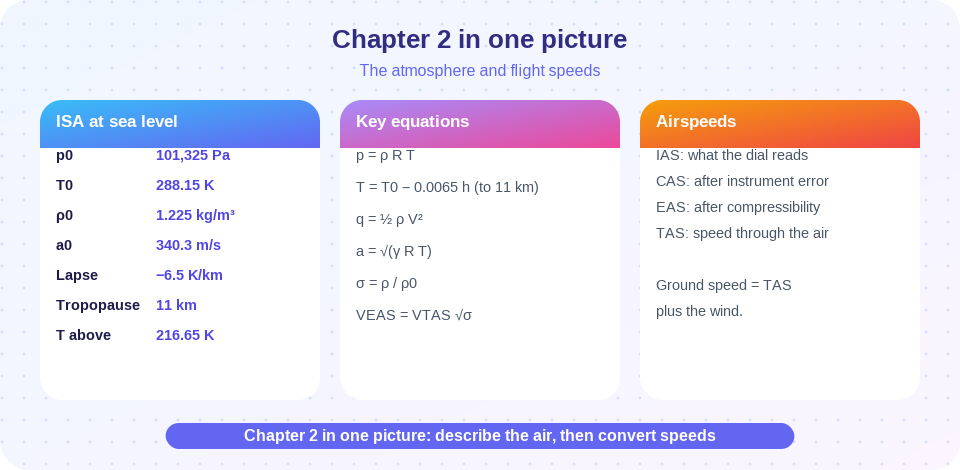
Recap table
| Idea | Key statement | Lesson |
|---|---|---|
| ISA | 288.15 K, 101,325 Pa, 1.225 kg/m³ at sea level; 6.5 K/km to 11 km | The standard atmosphere |
| Pressure | p = p₀ (T/T₀)^5.2559 below 11 km; exponential above |
The standard atmosphere |
| Gas law | p = ρRT, R = 287.053 J/(kg·K) |
Air density and the gas law |
| Density altitude | ISA altitude with the same density | Air density and the gas law |
| Dynamic pressure | q = ½ρV² = pt − p |
Airspeeds and dynamic pressure |
| Airspeeds | EAS = TAS·√σ; M = TAS/a | Airspeeds and dynamic pressure |
Try it
Press Run (or Ctrl + Enter) to see the result here.
Program input · what you'd type while the program runs
Type the answers before you press Run, one per line. Each time the program reads a line (with input()), it gets the next line from this box.
Press Run (or Ctrl + Enter) to see the result here.
Program input · what you'd type while the program runs
Type the answers before you press Run, one per line. Each time the program reads a line (with input()), it gets the next line from this box.
Check your understanding
Quick check · 9 questions
of 9 answered You scored / 9 · perfect!
-
1. What is the ISA temperature at 6 km?
288.15 − 0.0065 × 6000 = 249.15 K. -
2. Which law gives air density from pressure and temperature?
Solving p = ρRT for ρ gives ρ = p/(RT). -
3. On a hot day the density altitude is usually:
Hot air is less dense, which is equivalent to being higher in the standard atmosphere. -
4. What is dynamic pressure at 100 m/s at sea level?
q = 0.5 × 1.225 × 100² = 6,125 Pa. -
5. σ = 0.5 and EAS = 100 m/s. What is TAS?
TAS = EAS/√σ = 100/0.707 = 141 m/s. -
6. Which altitude range is isothermal in ISA?
The layer from 11 to 20 km has constant temperature 216.65 K. -
7. Which instrument reading depends on a blocked static port?
Both the altimeter and the airspeed indicator use static pressure. -
8. A flow has pt = 34,495 Pa and p = 22,632 Pa. The Mach number is about:
pt/p = 1.524, which equals (1 + 0.2M²)^3.5 at M = 0.8. -
9. Which quantity does the airspeed indicator display when set to sea-level density assumptions?
The dial is graduated from q = pt − p assuming ρ0, so it reflects dynamic pressure.
Summary
- The ISA gives reference T, p, ρ and a; real days differ by a temperature offset.
p = ρRTexplains why heat and altitude thin the air; density altitude captures the effect.q = ½ρV²is the pressure scale for forces; EAS preserves q, TAS is the real speed.- You now have every input the lift and drag equations need.
Theo dõi tiến độ của bạn
Tạo tài khoản miễn phí để đánh dấu bài đã học và tiếp tục từ chỗ bạn dừng lại trên mọi thiết bị.