
























Bài 6 · Stress and Strain
Stress and Strain: The Big Picture
See why stress and strain, not force and elongation, let engineers compare any part with any material, and get a map of chapter 2 with its five lessons.
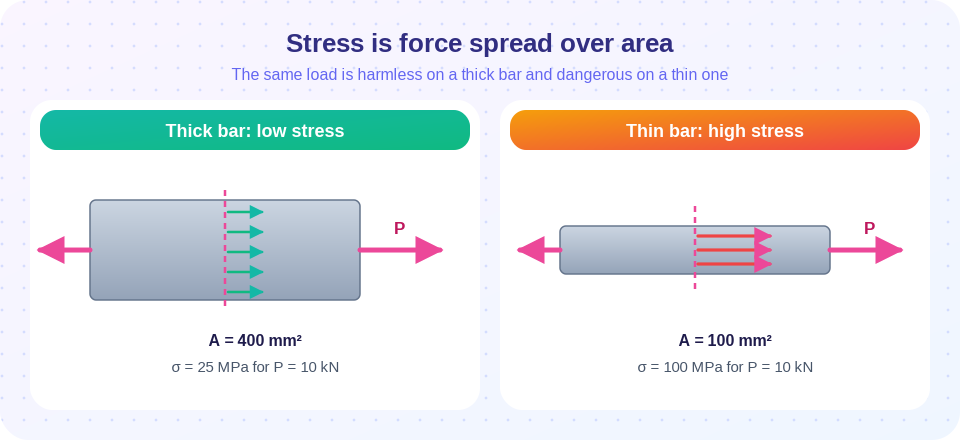
A 10 kN pull on a thick steel bar is harmless. The same 10 kN on a thin wire snaps it. Force alone says nothing about whether a part survives, because what matters is how that force is spread over the material. Dividing force by area gives stress; dividing elongation by length gives strain. These two ideas let a test on a small laboratory specimen predict the behaviour of a bridge cable.
What you will learn
- Why stress and strain are the natural quantities for comparing parts.
- The two basic kinds of stress: normal and shear.
- How the chapter's five lessons fit together.
Key terms
Normal stress σ: force perpendicular to a surface divided by its area.
Shear stress τ: force parallel to a surface divided by its area.
Normal strain ε: change in length divided by original length.
Shear strain γ: change in the angle between two originally perpendicular lines, in radians.
The idea in one sentence
Materials do not feel forces; they feel force per unit area. The thick and thin bars above carry the same 10 kN, but their stresses are 10 000 N / 400 mm² = 25 MPa and 10 000 N / 100 mm² = 100 MPa. If the steel yields at 250 MPa, the first bar is at 10% of its limit and the second at 40%. Stress puts both bars on the same scale as the material's properties.
Strain does the same for deformation. A 2 mm stretch on a 20 mm gauge length is dramatic (10%); the same 2 mm on a 20 m cable is nothing (0.01%). A material's relation between stress and strain, measured once, can be reused for every part made of it.
Two kinds of stress
Normal stress σ
Shear stress τ
Strain
Material law
What each lesson in this chapter covers
- Normal Stress:
σ = P / A, tension and compression, sizing rods and posts, and where the average is not enough. - Shear and Bearing Stress: bolts, pins and rivets in single and double shear, bearing on plates, and punching.
- Strain and the Stress-Strain Curve: what a tensile test shows, yield, ultimate strength, ductile and brittle behaviour.
- Hooke's Law and Material Properties: Young's modulus, Poisson's ratio, shear modulus and how they connect.
- Chapter 2 Review: a summary sheet and a ten-question quiz.
Try it
Press Run (or Ctrl + Enter) to see the result here.
Program input · what you'd type while the program runs
Type the answers before you press Run, one per line. Each time the program reads a line (with input()), it gets the next line from this box.
Common misconceptions
"A bigger force always means a bigger stress." Only if the area is unchanged. Stress is the ratio, so a larger area can carry a larger force at the same stress.
"Strain has units." Strain is a ratio of two lengths. You may write it as a fraction (0.0012), a percent (0.12%) or microstrain (1200 µε), but it is dimensionless.
Check your understanding
Quick check · 4 questions
of 4 answered You scored / 4 · perfect!
-
1. A 10 kN force acts on a 100 mm² area. What is the stress?
σ = 10 000 N / 100 mm² = 100 N/mm² = 100 MPa. -
2. Which stress acts parallel to a surface?
Shear stress is the component parallel to the surface; normal stress is perpendicular to it. -
3. A 2 mm stretch on a 2 m rod gives a strain of…
ε = δ / L = 2 mm / 2000 mm = 0.001, or 1000 microstrain. -
4. Why do engineers use stress instead of force when comparing parts?
A material's yield strength is a stress, so comparing stress with that limit works for any size of part.
Summary
- Stress is force per area, strain is elongation per length; both let you compare different sizes and materials.
- Normal stress acts perpendicular to a surface, shear stress along it.
- The stress-strain curve of a material, measured once, applies to every part made from it.
- This chapter builds from normal stress to shear, strain, and Hooke's law.
Next: Normal Stress
Theo dõi tiến độ của bạn
Tạo tài khoản miễn phí để đánh dấu bài đã học và tiếp tục từ chỗ bạn dừng lại trên mọi thiết bị.