
























Bài 42 · Failure Theories and Design
Chapter 8 review: failure theories and design
Review failure modes, Tresca and von Mises, fatigue, notches and factors of safety with a recap table, a shaft audit tool and a nine-question quiz.
This chapter turned stresses into decisions. A part can fail by yielding, fracture, fatigue, buckling or excessive deflection; each has a rule, and the factor of safety is the smallest margin over all of them. Here it is on one page.
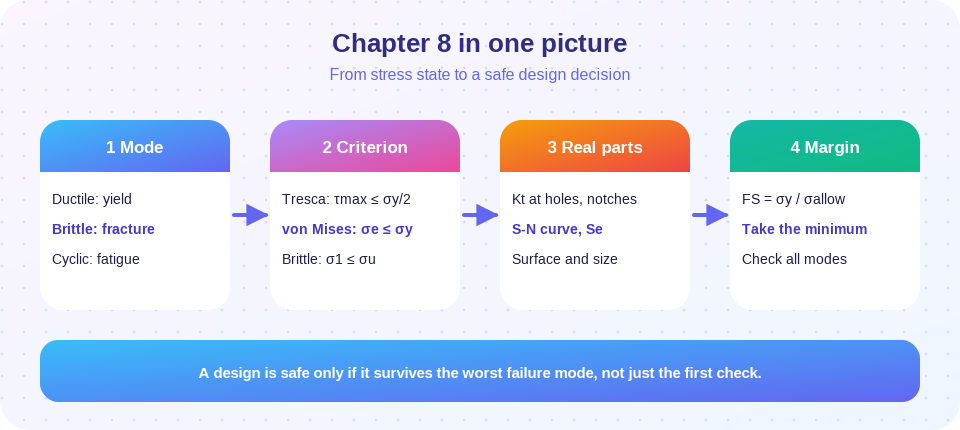
Recap table
| Topic | Rule | Remember |
|---|---|---|
| Ductile yielding | Tresca: σ1 − σ3 ≤ σy |
Include σ3 = 0 in plane stress |
| Ductile yielding | von Mises: σe = √(σ1² − σ1σ2 + σ2²) ≤ σy |
τy = 0.577 σy in pure shear |
| Brittle fracture | σ1 ≤ σut (and Coulomb–Mohr) |
Strong in compression, weak in tension |
| Fatigue cycle | σa = (σmax − σmin)/2, σm = (σmax + σmin)/2 |
Check cycles, not just peaks |
| S-N and endurance | Steel Se' ≈ 0.5 σu in the lab |
Correct for surface, size and loading |
| Notches | Kf = 1 + q(Kt − 1), local stress Kf σa |
Round the corners |
| Goodman | σa/Se + σm/σu = 1/n |
Tensile mean stress hurts |
| Factor of safety | FS = strength / applied, σallow = σy/FS |
Weakest mode governs |
| LRFD | φ Rn ≥ Σ γᵢ Qᵢ |
Larger factors on uncertain loads |
Try it
This audit checks a shaft that carries a fully reversed bending moment and a steady torque against both static yielding and fatigue, then names the governing mode. The fatigue part uses a simple Goodman combination with the equivalent von Mises stresses and illustrative correction factors.
Press Run (or Ctrl + Enter) to see the result here.
Program input · what you'd type while the program runs
Type the answers before you press Run, one per line. Each time the program reads a line (with input()), it gets the next line from this box.
The weakest mode decides the size. This plot shows how both margins grow with the diameter (both scale as d³), and where the 2.0 requirement is met.
Press Run (or Ctrl + Enter) to see the result here.
Program input · what you'd type while the program runs
Type the answers before you press Run, one per line. Each time the program reads a line (with input()), it gets the next line from this box.
Check your understanding
Quick check · 9 questions
of 9 answered You scored / 9 · perfect!
-
1. Plane stress has σ1 = 100 MPa and σ2 = −50 MPa. What is the von Mises equivalent stress?
σe = √(100² − 100 × (−50) + (−50)²) = √(10 000 + 5 000 + 2 500) = √17 500 = 132 MPa. -
2. For the same state, what is the Tresca equivalent (σ1 − σ3 with σ3 = −50 as the smallest)?
The principal stresses are 100, 0 and −50, so the largest difference is 100 − (−50) = 150 MPa. -
3. A notch has Kt = 3 and q = 0.5. What is the fatigue notch factor Kf?
Kf = 1 + 0.5 × (3 − 1) = 2.0. -
4. The Goodman line with σa = 120 MPa, σm = 0 and Se = 240 MPa gives a factor of safety of...
n = 1/(σa/Se) = 240/120 = 2.0. -
5. A part has n = 3.0 against yield and n = 1.4 against buckling. Its factor of safety is...
The weakest failure mode governs. -
6. A steel has σu = 800 MPa. What is the rule-of-thumb laboratory endurance limit?
Se' ≈ 0.5 σu = 400 MPa for steels with σu up to about 1400 MPa, before the correction factors. -
7. Which pure-shear yield stress does von Mises give for σy = 400 MPa?
τy = σy/√3 = 400/1.732 = 231 MPa. -
8. Which criterion is normally used for a brittle material such as cast iron?
Brittle failure starts from the largest tensile normal stress. -
9. A fatigue crack in a shaft most often starts...
Cracks start where the stress is highest, usually at the surface and at stress concentrations.
Summary
- Failure modes: yielding, fracture, fatigue, buckling and deflection. Each needs its own check.
- Ductile metals: Tresca or von Mises with
σy; brittle materials: maximum normal stress withσut. - Fatigue depends on cycles: use
σa,σm, the S-N curve, correctedSe, notch factorKfand the Goodman line. - The factor of safety is the smallest margin of all modes, and codes set the required value.
Theo dõi tiến độ của bạn
Tạo tài khoản miễn phí để đánh dấu bài đã học và tiếp tục từ chỗ bạn dừng lại trên mọi thiết bị.