
























Bài 11 · Stress and Strain
Chapter 2 Review: Stress and Strain
Review normal stress, shear and bearing stress, strain, the stress-strain curve and Hooke's law with a summary sheet, recap table and a ten-question mixed quiz.
Chapter 2 introduced the four quantities that run through the rest of the course: stress, strain, the material law connecting them, and the allowable values that make a design safe. You can now take a force and a cross-section and say how hard the material is working, and take a stress and predict a deformation.
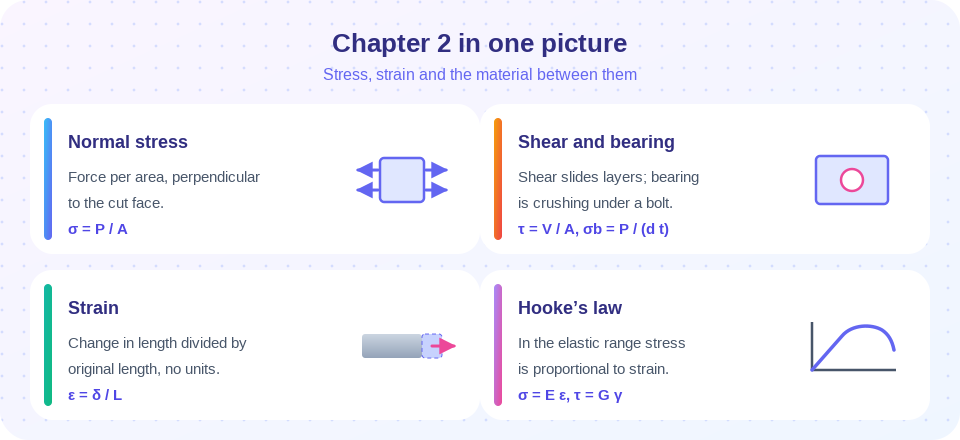
Recap table
| Lesson | Quantity | Formula | Unit |
|---|---|---|---|
| Normal stress | σ | P / A |
MPa |
| Shear and bearing | τ, σ_b | V / A, P / (d t) |
MPa |
| Strain | ε, γ | δ / L, angle |
none, rad |
| Hooke's law | E, G, ν | σ = E ε, τ = G γ, ε_lat = −ν ε |
GPa, none |
A combined worked example
A steel rod (E = 200 GPa, ν = 0.3, yield strength 250 MPa) with a 16 mm diameter and length 2.0 m hangs a load of 40 kN. The rod ends in a clevis with a 14 mm pin in double shear.
- Rod stress:
A = π × 16² / 4 = 201.1 mm²,σ = 40 000 / 201.1 = 198.9 MPa. The factor of safety against yield is250 / 198.9 = 1.26. - Strain and elongation:
ε = 198.9 / 200 000 = 9.94 × 10⁻⁴,δ = 9.94 × 10⁻⁴ × 2000 = 1.99 mm. - Pin shear: two planes, so
τ = 40 000 / (2 × π × 14² / 4) = 40 000 / 307.9 = 130 MPa. - Lateral change:
Δd = −0.3 × 9.94 × 10⁻⁴ × 16 = −0.0048 mm.
The rod is probably good for static use, but a safety factor of 1.26 is thin for most codes. The one calculation touches every idea of the chapter.
Press Run (or Ctrl + Enter) to see the result here.
Program input · what you'd type while the program runs
Type the answers before you press Run, one per line. Each time the program reads a line (with input()), it gets the next line from this box.
Press Run (or Ctrl + Enter) to see the result here.
Program input · what you'd type while the program runs
Type the answers before you press Run, one per line. Each time the program reads a line (with input()), it gets the next line from this box.
Check your understanding: chapter 2
Quick check · 10 questions
of 10 answered You scored / 10 · perfect!
-
1. A 25 kN force acts on a 500 mm² section. The normal stress is…
σ = 25 000 / 500 = 50 N/mm² = 50 MPa. -
2. A bolt in double shear carries 40 kN and has area 154 mm². The shear stress is about…
Two planes share the load: τ = 40 000 / (2 × 154) = 130 MPa. -
3. The bearing area of a 20 mm bolt in a 12 mm plate is…
Projected area = d × t = 20 × 12 = 240 mm². -
4. Strain is measured in…
Strain is a ratio of two lengths. -
5. A 3 m cable stretches 6 mm. The strain is…
6 mm / 3000 mm = 0.002. -
6. The proportional limit marks the end of…
Up to it, stress is proportional to strain. -
7. What is the 0.2% offset yield strength?
It stands in for the yield point of materials that have no yield plateau. -
8. A steel bar has ε = 0.0005 in the axial direction and ν = 0.3. The lateral strain is…
ε_lat = −ν ε_axial = −0.3 × 0.0005 = −0.00015. -
9. Which is true for all steel grades?
E is about 200 GPa for all steels; yield strength differs widely. -
10. For an isotropic material, which relation is correct?
Only two of E, G and ν are independent, linked by G = E / (2(1 + ν)).
Summary
- Normal stress
σ = P / A, shear stressτ = V / A, bearingσ_b = P / (d t). - Normal strain
ε = δ / L; shear strain γ is an angle. - The tensile-test curve shows E, yield, ultimate strength and ductility.
- Hooke's law and Poisson's ratio turn stress into deformation.
Theo dõi tiến độ của bạn
Tạo tài khoản miễn phí để đánh dấu bài đã học và tiếp tục từ chỗ bạn dừng lại trên mọi thiết bị.