
























Bài 37 · Deflection and Buckling
Chapter 7 review: deflection and buckling
Review curvature, integration, standard deflection cases, superposition and Euler buckling, with a recap table, check tools and a nine-question quiz.
This chapter added two checks to the strength check you already knew: stiffness (deflection stays within a limit) and stability (a slender member does not buckle). Here is the chapter on a page, a pair of tools that run all three checks, and a quiz.
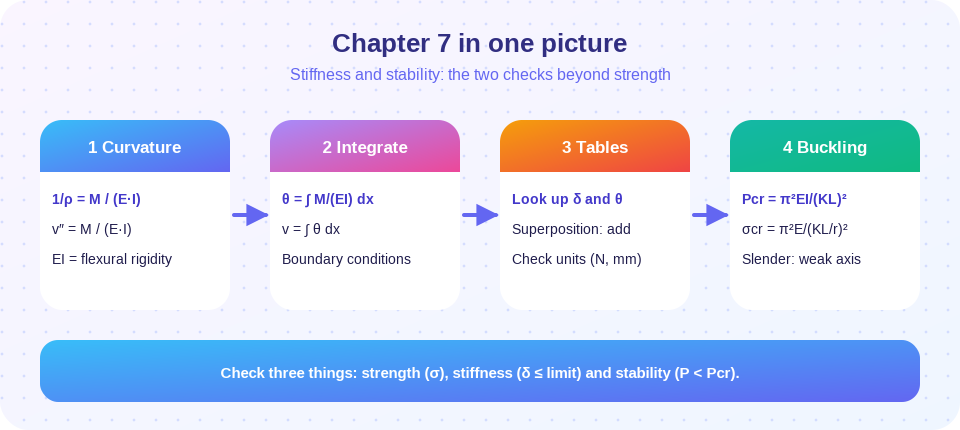
Recap table
| Topic | Result | Remember |
|---|---|---|
| Curvature | 1/ρ ≈ v″ = M/(EI) |
Small slopes only |
| Integration | EI v″ = M, two constants |
Fixed: v = θ = 0; pin: v = 0 |
| Cantilever, end load | δ = PL³/(3EI), θ = PL²/(2EI) |
Very flexible |
| Cantilever, uniform | δ = wL⁴/(8EI) |
L⁴ for distributed loads |
| Simple, center load | δ = PL³/(48EI) |
16 times stiffer than the cantilever |
| Simple, uniform | δ = 5wL⁴/(384EI) |
Max at midspan |
| Superposition | Add separate effects | Linear and small deflections |
| Propped cantilever | R = 3wL/8 |
Compatibility: tip δ = 0 |
| Euler load | Pcr = π²EI/(K·L)² |
Weak axis; K = 1, 2, 0.7, 0.5 |
| Slenderness | σcr = π²E/(KL/r)² |
Valid above about 126 for 250 MPa steel |
Try it
This tool runs the three checks, strength, stiffness and stability, for a simple beam with a center load, so you can see which one governs. Change the section depth and the span.
Press Run (or Ctrl + Enter) to see the result here.
Program input · what you'd type while the program runs
Type the answers before you press Run, one per line. Each time the program reads a line (with input()), it gets the next line from this box.
Second, how the buckling load of a steel column of 40 mm diameter falls with its length for each end condition. Notice the 1/L² collapse.
Press Run (or Ctrl + Enter) to see the result here.
Program input · what you'd type while the program runs
Type the answers before you press Run, one per line. Each time the program reads a line (with input()), it gets the next line from this box.
Check your understanding
Quick check · 9 questions
of 9 answered You scored / 9 · perfect!
-
1. A steel cantilever has EI = 2 × 10¹² N·mm², L = 1.5 m and P = 2 kN at the tip. What is the tip deflection?
δ = PL³/(3EI) = 2000 × 3.375 × 10⁹ / (3 × 2 × 10¹²) = 1.125 mm. -
2. A simply supported beam (EI = 2 × 10¹² N·mm², L = 3 m) carries w = 4 N/mm. Its midspan deflection is closest to...
δ = 5wL⁴/(384EI) = 5 × 4 × 8.1 × 10¹³ / (384 × 2 × 10¹²) = 2.1 mm. -
3. The fixed-pinned column has an effective length factor of about...
K ≈ 0.7 for fixed at one end and pinned at the other. -
4. A pinned-pinned column of E = 200 GPa and I = 100 000 mm⁴ is 2 m long. What is Pcr?
Pcr = π²EI/L² = 9.87 × 200 000 × 100 000 / 2000² = 49.3 kN. -
5. Replacing steel by a high-strength steel with the same E but twice the yield strength changes the Euler load of a slender column by...
Pcr depends on E, I and L only. -
6. Which beam deflection limit gives the largest allowed deflection for a 5 m span?
L/240 is the loosest of the three: 5000/240 = 20.8 mm. -
7. Why does superposition fail for a beam with very large deflections?
Large deflections change the geometry (lever arms), so the response is no longer linear in the loads. -
8. A propped cantilever carries a uniform load w. What happens to the wall moment compared with the unpropped cantilever (wL²/2)?
With R = 3wL/8, the wall moment is wL²/2 − 3wL²/8 = wL²/8. -
9. Doubling both the length of a column and its moment of inertia I (all else equal) changes Pcr by a factor of...
Pcr ∝ I/L², so doubling I doubles it and doubling L quarters it: 2/4 = 1/2.
Summary
- Deflection follows from
EI·v″ = M(x); two integrations and the support conditions give the elastic curve. - Memorize the four standard cases; add their effects by superposition for combined loads and for indeterminate beams (compatibility).
- Euler's column load
Pcr = π²EI/(K·L)²depends on stiffness and length, not strength; always use the weak axis. - Design means passing all three checks: strength, stiffness and stability.
Theo dõi tiến độ của bạn
Tạo tài khoản miễn phí để đánh dấu bài đã học và tiếp tục từ chỗ bạn dừng lại trên mọi thiết bị.