
























Bài 17 · Entropy, Free Energy and Equilibrium
Chapter 3 review: entropy, free energy and equilibrium
Review chapter 3: entropy and the second law, Gibbs free energy, the equilibrium constant, the van 't Hoff equation and Le Chatelier's principle, with a ten-question quiz.
This chapter answered the first two of our four questions: will it happen and how far will it go. Entropy gave a direction to time, the Gibbs energy turned that direction into a criterion for chemists, and the equilibrium constant gave the end point of every reaction in terms of a single tabulated quantity.
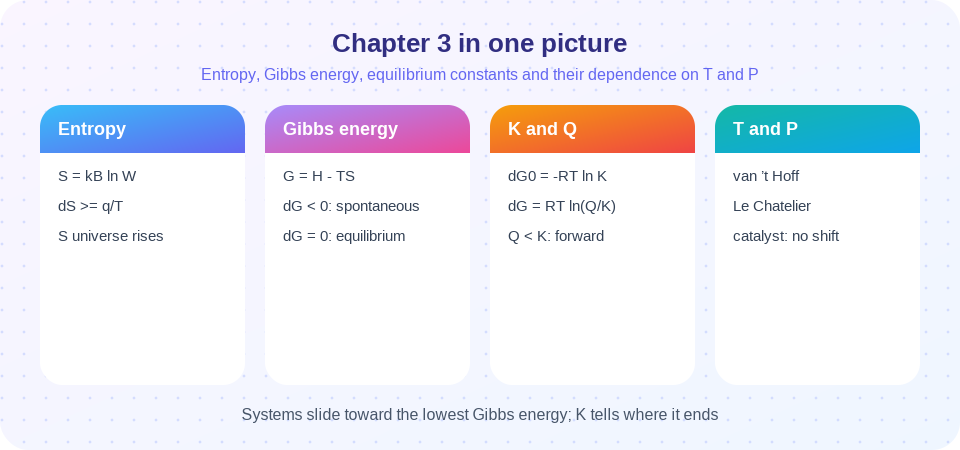
Chapter in a table
| Lesson | Key relations |
|---|---|
| Entropy and the second law | S = kB ln W; dS = δq_rev/T; ΔS_total ≥ 0; ΔS_surr = -ΔH/T |
| Gibbs free energy | ΔG = ΔH - TΔS; crossover T = ΔH/ΔS; w_max = ΔG |
| Equilibrium constant | ΔG = ΔG° + RT ln Q; ΔG° = -RT ln K |
| T and P effects | ln(K₂/K₁) = -(ΔH°/R)(1/T₂ - 1/T₁); Kx = K(P/p°)^(-Δn) |
A worked synthesis
Question: for 2 SO₂(g) + O₂(g) ⇌ 2 SO₃(g), ΔH° = -198 kJ and ΔS° = -188 J/K (approximate values). Is it favorable at 298 K? At which temperature does K = 1? What conditions favor SO₃?
ΔG° (298 K) = -198 + 298 x 0.188 = -142 kJ: strongly favorable,Kenormous.K = 1whereΔG° = 0:T = ΔH/ΔS = 198/0.188 = 1053 K.- Exothermic,
Δn = -1: low temperature and high pressure raise the SO₃ fraction, but the reaction is slow when cold, so sulfuric acid plants use a vanadium catalyst at about 700 to 800 K with several stages and cooling in between.
Common misconceptions
Treating spontaneity, speed and extent as the same thing. ΔG says whether, K says how far, kinetics says how fast. Keep the three questions separate.
Try it
First a drill for typical calculations; predict the answers first.
Press Run (or Ctrl + Enter) to see the result here.
Program input · what you'd type while the program runs
Type the answers before you press Run, one per line. Each time the program reads a line (with input()), it gets the next line from this box.
The second block gathers the whole chapter into one interactive-style plot: for a reaction with chosen ΔH and ΔS, it shows ΔG, K and the equilibrium fraction of product against temperature (for the simple model A ⇌ B).
Press Run (or Ctrl + Enter) to see the result here.
Program input · what you'd type while the program runs
Type the answers before you press Run, one per line. Each time the program reads a line (with input()), it gets the next line from this box.
Check your understanding
Quick check · 9 questions
of 9 answered You scored / 9 · perfect!
-
1. Two moles of ideal gas expand isothermally from 3.0 L to 12.0 L. ΔS is
ΔS = nR ln 4 = 2 x 8.3145 x 1.386 = 23.1 J/K. -
2. For ΔH = +66 kJ and ΔS = +180 J/K, the reaction becomes spontaneous above
T = 66000/180 = 367 K. -
3. ΔG° = -22.5 kJ/mol at 298 K gives K of about
ln K = 22500/(8.3145 x 298.15) = 9.08; K = 8.7 x 10^3. -
4. A reaction has Q = 50 and K = 10. It will
Q > K means too many products; ΔG = RT ln(Q/K) > 0. -
5. An exothermic reaction's K when T rises
Heat acts like a product; adding heat favors reactants, so K decreases. -
6. Which condition shifts N2 + 3 H2 <=> 2 NH3 toward ammonia?
Four moles of gas become two, so compression favors NH3. -
7. For melting, ΔH = +6.0 kJ/mol and ΔS = +22 J/(K mol). At 300 K, ΔG is
ΔG = 6000 - 300 x 22 = -600 J/mol < 0, above the melting temperature 273 K. -
8. The maximum non-expansion work available at constant T and P is
ΔG is the maximum useful non-expansion work. -
9. Which statement about K is correct?
K = exp(-ΔG°/RT) depends only on T.
Summary
- Entropy counts microstates; the total entropy of system plus surroundings never falls.
ΔG = ΔH - TΔSis the constant-T, constant-P criterion; crossoverT = ΔH/ΔS.ΔG° = -RT ln KandΔG = RT ln(Q/K)give direction and extent.- van 't Hoff: slope of
ln Kagainst1/Tis-ΔH°/R; Le Chatelier gives the qualitative shifts. - Catalysts change rate, never K.
Theo dõi tiến độ của bạn
Tạo tài khoản miễn phí để đánh dấu bài đã học và tiếp tục từ chỗ bạn dừng lại trên mọi thiết bị.