
























Bài 28 · Chemical Kinetics
Chapter 5 Review: Chemical Kinetics
Review chemical kinetics in one page: rate laws, integrated laws, half-lives, the Arrhenius equation, mechanisms and catalysis, plus a ten-question mixed quiz.
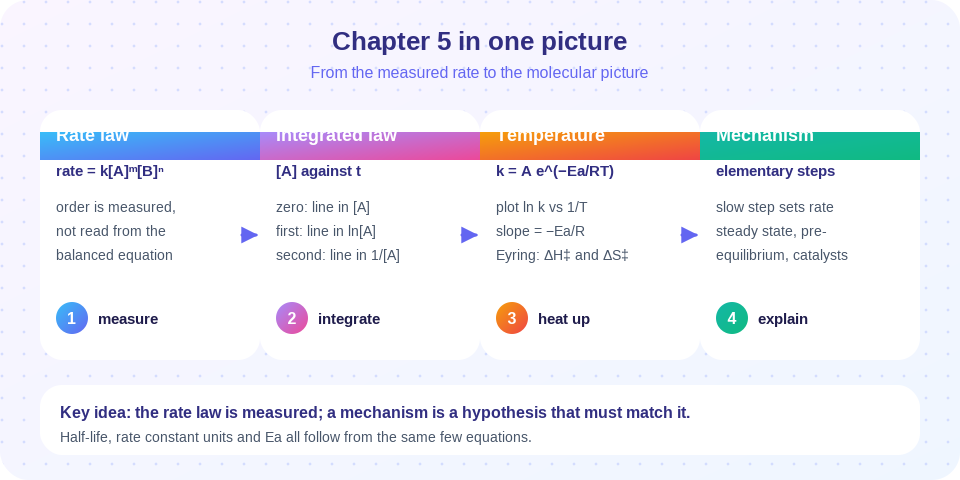
You have now covered the main toolkit of kinetics. This review ties the four lessons into one picture and gives you a mixed quiz that resembles an exam.
Recap table
| Topic | Key equations | Remember |
|---|---|---|
| Rate law | rate = k[A]ᵐ[B]ⁿ |
orders come from experiment |
| Zero order | [A] = [A]₀ − kt; t½ = [A]₀/2k |
straight line in [A] |
| First order | ln[A] = ln[A]₀ − kt; t½ = ln 2/k |
constant half-life |
| Second order | 1/[A] = 1/[A]₀ + kt; t½ = 1/k[A]₀ |
half-life grows |
| Arrhenius | ln k = ln A − Ea/RT |
slope of ln k vs 1/T is −Ea/R |
| Eyring | k = (kBT/h) e^(ΔS‡/R) e^(−ΔH‡/RT) |
ΔG‡ of 5.7 kJ/mol is a factor of 10 |
| Steady state | d[I]/dt = 0 |
gives the rate law with no slow step |
| Michaelis-Menten | v = V_max[S]/(K_M + [S]) |
v = V_max/2 at [S] = K_M |
How experts reason
When confronted with new kinetic data, a physical chemist asks three questions in order. First, what is the order in each reactant? Initial rates or linear plots answer this. Second, how does k vary with temperature? That gives Ea, A or ΔH‡ and ΔS‡. Third, what mechanism reproduces both? A tiny or negative A hints at an ordered transition state. A negative Ea hints at a pre-equilibrium step. A fractional order hints at a chain or radical mechanism.
Try it
Use the calculator below to check half-life and fraction-remaining answers while you work through the quiz. It is a calculator that applies the first-order equations, nothing more.
Press Run (or Ctrl + Enter) to see the result here.
Program input · what you'd type while the program runs
Type the answers before you press Run, one per line. Each time the program reads a line (with input()), it gets the next line from this box.
Check your understanding
Quick check · 10 questions
of 10 answered You scored / 10 · perfect!
-
1. For a reaction with rate = k[A][B]², what are the units of k?
Third order overall: k = (M s⁻¹)/M³ = M⁻² s⁻¹. -
2. A first-order reaction is 75 % complete after 40 min. What is its half-life?
75 % complete leaves 25 % = (1/2)², two half-lives in 40 min, so 20 min. -
3. Successive half-lives of a reaction are 10 s, 20 s, 40 s. The order is
Doubling half-lives is the signature of second order. -
4. Which plot is linear for a first-order reaction?
ln[A] = ln[A]₀ − kt. -
5. An Arrhenius plot has a slope of −6000 K. What is Ea?
Ea = −slope × R = 6000 × 8.314 = 49,900 J/mol. -
6. Which statement about a catalyst is correct?
Equal speed-up of both directions leaves K unchanged. -
7. A mechanism has a fast equilibrium step followed by a slow step. Which approximation gives the rate law?
The intermediate's concentration is fixed by the equilibrium constant of the fast step. -
8. Doubling the absolute temperature (300 K to 600 K) doubles the rate constant:
The factor is exp[(Ea/R)(1/T₁ − 1/T₂)], which depends on Ea. -
9. In Michaelis-Menten kinetics, a very large [S] gives
The enzyme is saturated, so the rate levels off at V_max. -
10. Which is an intermediate in the mechanism NO₂ + F₂ → NO₂F + F; NO₂ + F → NO₂F?
F atoms are formed in step 1 and consumed in step 2, and are absent from the overall equation.
Summary
- Rate laws are measured; integrated laws and half-lives reveal the order.
ln kagainst1/Tgives Ea; Eyring links rates to ΔH‡ and ΔS‡.- Mechanisms are tested by the rate laws they predict; catalysts change the route, not the equilibrium.
Theo dõi tiến độ của bạn
Tạo tài khoản miễn phí để đánh dấu bài đã học và tiếp tục từ chỗ bạn dừng lại trên mọi thiết bị.