
























Bài 33 · Quantum Chemistry
Molecular Orbitals and Chemical Bonding
Build molecular orbitals from atomic orbitals with LCAO, work out bond order and magnetism for diatomic molecules, and see why O2 is paramagnetic and N2 is so strong.
How do two atoms hold together? Valence bond theory pictures a shared electron pair. Molecular orbital (MO) theory, the subject of this lesson, spreads each electron over the entire molecule in orbitals that belong to all the nuclei at once. It explains things that the simple pair picture cannot: why oxygen is attracted to a magnet, why the ions N₂⁺ and O₂⁺ have the bond lengths they have, and why molecules absorb light.
The central idea is the linear combination of atomic orbitals (LCAO): add and subtract atomic wavefunctions to make molecular ones.
What you will learn
- Build bonding and antibonding MOs from two atomic orbitals
- Define and compute bond order
- Fill MO diagrams for second-period homonuclear diatomics and predict magnetism
- Describe how unequal atoms (heteronuclear) change the picture
Key terms
LCAO: ψ_MO = c_A φ_A ± c_B φ_B: a molecular orbital written as a combination of atomic orbitals.
Bonding orbital: lower in energy than the atomic orbitals; electrons build up between the nuclei.
*Antibonding orbital (marked ): higher in energy, with a node between the nuclei.
Bond order: (bonding electrons − antibonding electrons) / 2.
σ and π: σ orbitals are symmetric around the bond axis; π orbitals have a nodal plane containing it.
Two atomic orbitals, two molecular orbitals
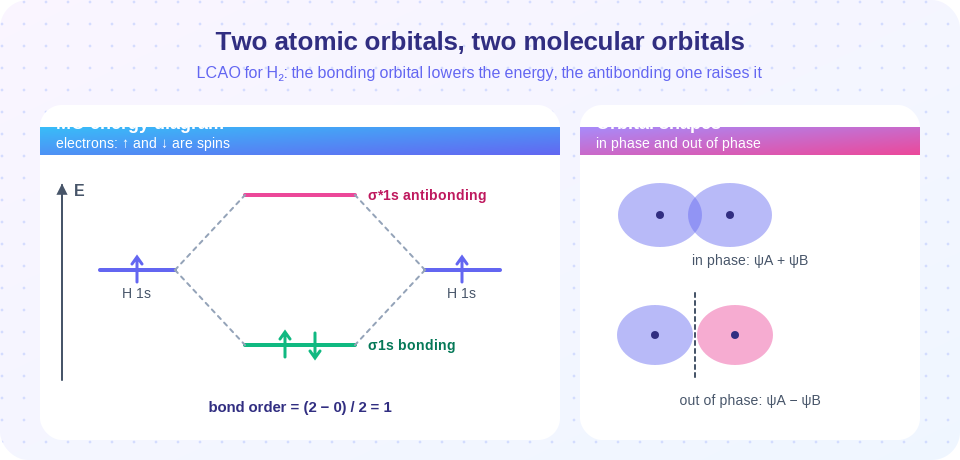
Combine two 1s orbitals φ_A and φ_B. Two results emerge:
ψ₊ = N₊ (φ_A + φ_B): the in-phase combination. The waves add between the nuclei, electron density piles up there, and the energy falls below that of the separate atoms.ψ₋ = N₋ (φ_A − φ_B): the out-of-phase combination. The waves cancel between the nuclei, creating a node. The energy rises, and by slightly more than the bonding orbital falls, because of overlap.
The number of MOs equals the number of AOs you started with. The size of the splitting depends on the overlap S between φ_A and φ_B, which depends on the internuclear distance R: no overlap, no bonding.
H₂, He₂ and bond order
H₂ has two electrons, both in σ₁ₛ with opposite spins: bond order (2 − 0)/2 = 1, a single bond (436 kJ mol⁻¹, 74 pm). Helium would need four electrons, two in σ₁ₛ and two in σ*₁ₛ: bond order (2 − 2)/2 = 0. He₂ does not form a chemical bond, which MO theory predicts without any extra rule. H₂⁺ (one electron in σ₁ₛ) has bond order ½ and does exist as an ion.
Higher bond order means shorter and stronger bonds: for the species of one family, O₂⁺ (2.5) > O₂ (2) > O₂⁻ (1.5) in strength.
Second-period diatomics
For atoms Li through Ne the valence orbitals are 2s and 2p. Combining them gives σ₂ₛ, σ₂ₛ, σ₂ₚ, two degenerate π₂ₚ, two degenerate π₂ₚ and σ*₂ₚ. The energy order depends on 2s–2p mixing:
- Li₂ to N₂:
σ₂ₛ < σ*₂ₛ < π₂ₚ < σ₂ₚ < π*₂ₚ < σ*₂ₚ - O₂ and F₂:
σ₂ₛ < σ*₂ₛ < σ₂ₚ < π₂ₚ < π*₂ₚ < σ*₂ₚ
Fill with valence electrons from the bottom, two per orbital, following Hund's rule in degenerate sets:
| Molecule | Valence e⁻ | Bond order | Unpaired e⁻ | Magnetism |
|---|---|---|---|---|
| B₂ | 6 | 1 | 2 | paramagnetic |
| C₂ | 8 | 2 | 0 | diamagnetic |
| N₂ | 10 | 3 | 0 | diamagnetic |
| O₂ | 12 | 2 | 2 | paramagnetic |
| F₂ | 14 | 1 | 0 | diamagnetic |
| Ne₂ | 16 | 0 | 0 | does not exist |
Oxygen is the celebrated success. The Lewis structure O=O has all electrons paired, but liquid oxygen is visibly attracted to a magnet. MO theory puts the last two electrons into the two degenerate π*₂ₚ orbitals, one in each with parallel spins: two unpaired electrons, bond order 2. Nitrogen has eight bonding and two antibonding valence electrons, so a bond order of 3 and one of the strongest bonds known (945 kJ mol⁻¹), which is why N₂ is so inert.
Heteronuclear molecules
When atoms differ, as in HF or CO, the more electronegative atom's orbitals lie lower in energy. The bonding MO is then mostly like the lower AO (the electrons spend more time near fluorine), and the antibonding MO resembles the higher AO. Unequal sharing explains bond polarity and dipole moments. Orbitals whose energies differ by a large amount hardly mix at all, which is why chemistry is dominated by the valence orbitals.
The variational principle
Where do the coefficients c_A and c_B come from? The variational principle states that any trial wavefunction gives an energy at or above the true ground-state energy. So you adjust the coefficients to minimize the energy: the result is a set of equations whose solutions are the MOs and their energies. Computational chemistry packages do precisely this, with hundreds of basis functions instead of two.
Common misconceptions
"Antibonding orbitals are empty because they are unstable." They are perfectly good orbitals. Electrons put into them cancel bonding; they are filled in O₂ and F₂.
"MOs are real objects." They are mathematical solutions of an approximate model; observable quantities such as the electron density are real.
"Bond order is always an integer." Half-integers occur, as in H₂⁺ (½) and O₂⁻ (1.5).
Try it
First, a real calculation. The LCAO energy of H₂⁺ as a function of internuclear distance R (in atomic units, bohr), using exact one-electron integrals for two 1s orbitals. Bonding has a minimum, antibonding does not. This is the approximate LCAO model, not an exact result.
Press Run (or Ctrl + Enter) to see the result here.
Program input · what you'd type while the program runs
Type the answers before you press Run, one per line. Each time the program reads a line (with input()), it gets the next line from this box.
Second, an MO filler for homonuclear diatomics. It uses the orbital order from the lesson and Hund's rule to output bond order and magnetism for any valence-electron count.
Press Run (or Ctrl + Enter) to see the result here.
Program input · what you'd type while the program runs
Type the answers before you press Run, one per line. Each time the program reads a line (with input()), it gets the next line from this box.
Check your understanding
Quick check · 5 questions
of 5 answered You scored / 5 · perfect!
-
1. What is the bond order of He₂⁺ (three valence electrons)?
Two electrons in σ₁ₛ and one in σ*₁ₛ gives (2 − 1)/2 = ½. -
2. Which description fits the antibonding orbital σ*₁ₛ?
Out-of-phase combination: destructive interference between nuclei. -
3. Why is O₂ paramagnetic?
Hund's rule puts one electron in each π*₂ₚ orbital. -
4. What is the bond order of N₂?
Eight bonding and two antibonding valence electrons: (8 − 2)/2 = 3. -
5. The number of molecular orbitals formed equals
n atomic orbitals combine into n molecular orbitals.
Summary
- LCAO combines atomic orbitals: in-phase gives bonding, out-of-phase gives antibonding.
- Bond order
(bonding − antibonding)/2predicts bond strength and length. - MO theory explains O₂ paramagnetism and the strength of N₂.
- Unequal atoms give polar MOs weighted toward the more electronegative atom; the variational principle fixes the coefficients.
Next: Chapter review
Theo dõi tiến độ của bạn
Tạo tài khoản miễn phí để đánh dấu bài đã học và tiếp tục từ chỗ bạn dừng lại trên mọi thiết bị.