
























Bài 23 · Phase Equilibria and Solutions
Chapter 4 review: phase equilibria and solutions
Review chapter 4: phase diagrams, the Clapeyron equation, Raoult's law, colligative properties, activity and Henry's law, with a recap table and a ten-question quiz.
Chapter 4 extended the idea of equilibrium from reactions to phases and mixtures. One principle, that a component has the same chemical potential in every phase present, produced phase diagrams, vapor-pressure curves, freezing and boiling shifts, osmosis and the laws that govern dissolved gases.
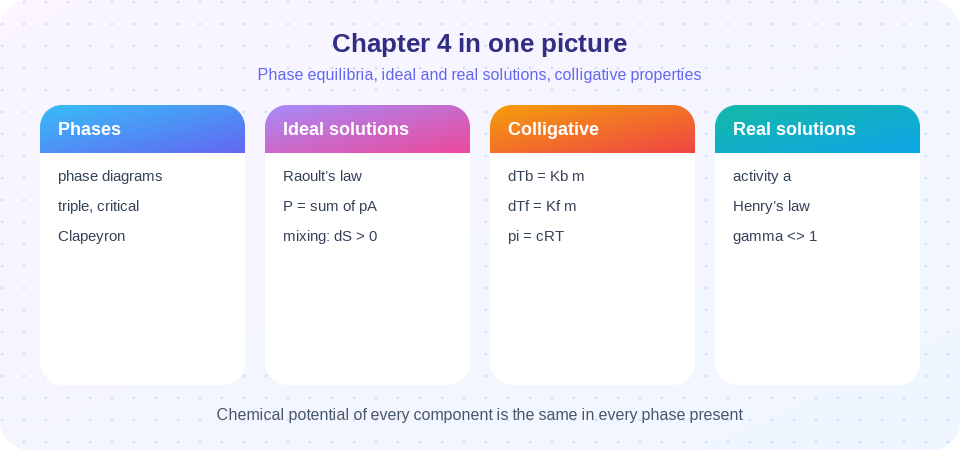
Chapter in a table
| Lesson | Key relations |
|---|---|
| Phase diagrams | F = C - P + 2; dP/dT = ΔH/(TΔV); ln(P₂/P₁) = -(ΔH_vap/R)(1/T₂ - 1/T₁) |
| Ideal solutions | p_A = x_A P*_A; μ_A = μ*_A + RT ln x_A; Δ_mix S = -nRΣ x ln x |
| Colligative properties | ΔT_b = K_b m; ΔT_f = K_f m; π = cRT; factor i |
| Real solutions | a = γ x; p_B = k_H x_B; log γ± = -0.509|z₊z₋|√I |
Chapter in one idea
Every equation in the chapter is a consequence of μ(α) = μ(β). When you meet a new problem, ask: which phases are in equilibrium, and what is the chemical potential of the component I care about in each?
Common misconceptions
Mixing up K and the colligative constants, or molality and molarity. Use molality (mol per kg of solvent) in ΔT_f and ΔT_b, molarity in π = cRT, and mole fractions in Raoult's law.
Try it
A drill with the chapter's main formulas. Predict each result first.
Press Run (or Ctrl + Enter) to see the result here.
Program input · what you'd type while the program runs
Type the answers before you press Run, one per line. Each time the program reads a line (with input()), it gets the next line from this box.
The second block shows a freezing-point depression picture: the solid-liquid and liquid-gas lines of a solvent shift when a solute is added, giving the "boiling up, freezing down" pattern in one chart. The curves are schematic, built from the Clausius-Clapeyron form with an assumed solute effect.
Press Run (or Ctrl + Enter) to see the result here.
Program input · what you'd type while the program runs
Type the answers before you press Run, one per line. Each time the program reads a line (with input()), it gets the next line from this box.
Check your understanding
Quick check · 10 questions
of 10 answered You scored / 10 · perfect!
-
1. The phase rule for pure water with liquid and vapor coexisting gives F =
F = C - P + 2 = 1 - 2 + 2 = 1: only T or P can be chosen freely. -
2. Water boils at lower temperature at altitude because
Boiling occurs when vapor pressure equals external pressure. -
3. A liquid mixture has x_B = 0.30, P*_A = 60 kPa, P*_B = 20 kPa (ideal). What is y_B?
p_B = 6, p_A = 42, P = 48, y_B = 6/48 = 0.125. -
4. Which has the greater freezing point depression at 0.5 m in water?
NaCl gives about two particles per formula unit; the others one. -
5. The osmotic pressure of 0.200 mol/L at 310 K is about
π = 200 x 8.3145 x 310 = 5.2 x 10^5 Pa = 5.1 atm. -
6. Positive deviation from Raoult's law means
Weaker mixed attractions let molecules escape more easily. -
7. A smaller Henry's constant kH means the gas is
x = p/kH is larger when kH is smaller. -
8. In the Clapeyron equation for ice melting, dP/dT is negative because
Liquid water is denser than ice, so ΔV < 0 on melting. -
9. The ideal Δ_mix H is
Ideal mixing releases no heat; entropy drives it. -
10. Debye-Hückel's limiting law gives γ± < 1 because
The ionic atmosphere lowers the ion's chemical potential, hence its activity.
Summary
- Equal chemical potential in all phases is the basis of the chapter.
- Phase diagrams, the phase rule and Clapeyron/Clausius-Clapeyron describe the boundaries.
- Raoult's law and
Δ_mix Sdefine the ideal solution; vapor is enriched in the volatile component. - Colligative properties count particles; osmosis gives
π = cRT. - Activity
a = γxand Henry's law repair the equations for real solutions.
Next: continue with chapter 5 on the course page
Theo dõi tiến độ của bạn
Tạo tài khoản miễn phí để đánh dấu bài đã học và tiếp tục từ chỗ bạn dừng lại trên mọi thiết bị.