
























Bài 15 · Amplitude and Angle Modulation
Chapter 3 review: Amplitude and angle modulation
Compare AM, DSB-SC, SSB and FM on bandwidth, power efficiency, detection and uses, then test yourself with a ten-question mixed quiz.
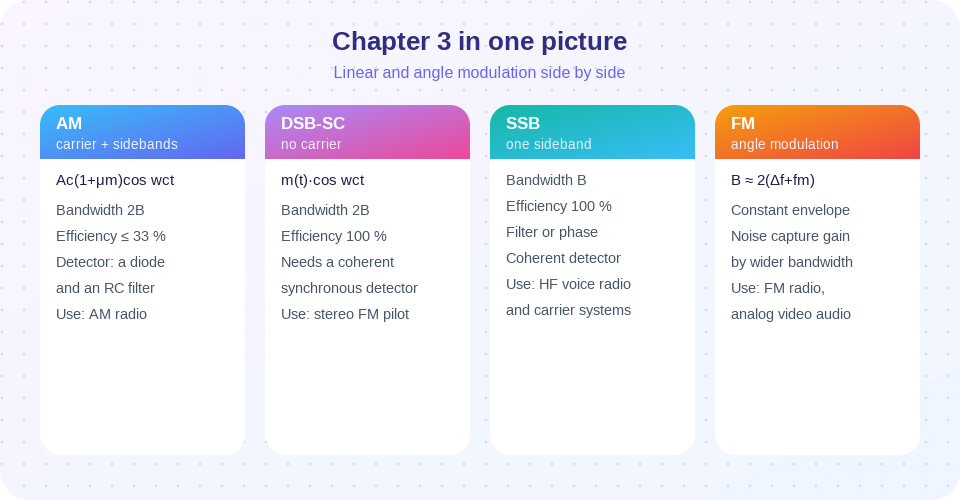
Chapter 3 introduced four ways of putting an analog message on a carrier. Each is a different answer to the same question: how much bandwidth, power and receiver complexity are you willing to pay for a given quality? This review puts the four side by side and tests whether you can pick the right tool and do the numbers.
What you will learn
- The key formulas of each scheme at a glance.
- How to choose a scheme from requirements.
- Whether you can apply them in a mixed set of questions.
Comparison table
| Scheme | Bandwidth | Power efficiency | Receiver | Typical use |
|---|---|---|---|---|
| AM | 2B |
μ²/(2+μ²), at most 1/3 for tone |
Envelope detector (very cheap) | Broadcast on LW/MW/SW |
| DSB-SC | 2B |
100 % | Coherent, needs carrier recovery | Subcarriers, stereo difference signal |
| SSB | B |
100 % | Coherent, accurate oscillator | HF voice, trunk telephony |
| FM | 2(Δf + fm) |
Constant envelope, efficient amplifiers | Discriminator or PLL, with limiter | VHF broadcast, two-way radio |
Rule of thumb. Cheap receivers and many listeners: AM. Narrow spectrum and long range: SSB. Quality in noise and plenty of spectrum: FM. Each rule reappears in digital form in chapter 5.
Try it
The first example is a calculator that gives bandwidth and efficiency for a message of bandwidth B through all four schemes. Change the numbers to see how the choice of deviation drives FM bandwidth.
Press Run (or Ctrl + Enter) to see the result here.
Program input · what you'd type while the program runs
Type the answers before you press Run, one per line. Each time the program reads a line (with input()), it gets the next line from this box.
The second example sketches how the four spectra look for a 2 kHz message tone; the sketch is a diagram, not a measurement.
Press Run (or Ctrl + Enter) to see the result here.
Program input · what you'd type while the program runs
Type the answers before you press Run, one per line. Each time the program reads a line (with input()), it gets the next line from this box.
Check your understanding
Quick check · 9 questions
of 9 answered You scored / 9 · perfect!
-
1. Which scheme needs the narrowest bandwidth for a message of bandwidth B?
SSB uses B; AM and DSB-SC need 2B; wideband FM needs much more. -
2. AM with μ = 0.6 has an efficiency of about
η = μ² / (2 + μ²) = 0.36 / 2.36 ≈ 0.153, about 15 %. -
3. Which receiver is used for conventional AM broadcast?
Because the envelope follows the message when μ ≤ 1, a diode and an RC network are enough. -
4. FM with Δf = 50 kHz and fm = 10 kHz has a Carson bandwidth of
B = 2(Δf + fm) = 2(50 + 10) = 120 kHz. -
5. The modulation index of that FM signal is
β = Δf / fm = 50/10 = 5. -
6. What does a phase error θ do to a coherent DSB-SC detector's output?
The output is (Ac/2) m(t) cos θ. -
7. Which scheme keeps a constant envelope?
FM's amplitude is Ac at all times, so nonlinear amplifiers can be used. -
8. An AM signal's carrier amplitude is 8 V and the envelope minimum is 2 V. The modulation index is
Amax = 8 + μ·8, Amin = 8 − μ·8 = 2 gives μ = 0.75. -
9. Which pair describes SSB correctly?
SSB sends one sideband, with no carrier.
Summary
- AM: simple receiver,
2B, efficiency at most 1/3. DSB-SC:2B, 100 % efficient, coherent. - SSB:
B, 100 % efficient, best for narrow spectrum. - FM:
2(Δf + fm), constant envelope, trades bandwidth for noise performance. - Chapter 4 turns analog messages into bits.
Theo dõi tiến độ của bạn
Tạo tài khoản miễn phí để đánh dấu bài đã học và tiếp tục từ chỗ bạn dừng lại trên mọi thiết bị.