
























Bài 20 · Sampling and Digital Transmission
Chapter 4 review: Sampling and digital transmission
Review the sampling theorem, aliasing, quantization noise, PCM bit rates, line codes and Nyquist pulses with a recap table and a ten-question quiz.
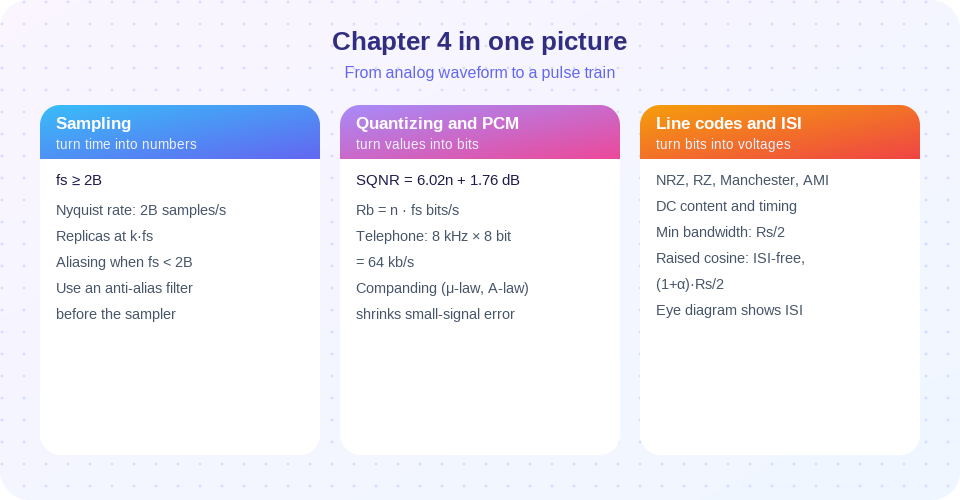
Chapter 4 closed the loop from an analog waveform to a train of voltage pulses ready for a carrier. Three numbers from this chapter come back constantly: the sampling rate (at least 2B), the number of bits (6 dB per bit) and the symbol rate with its bandwidth ((1 + α) Rs / 2). This page gathers them, then checks that you can use them.
What you will learn
- How the chapter's results chain together in one bit-rate and bandwidth calculation.
- Which rules of thumb to know by heart.
- Whether you can apply them to mixed problems.
Recap table
| Step | Rule | Lesson |
|---|---|---|
| Sampling | fs > 2B; alias at distance to nearest multiple of fs |
Sampling theorem |
| Quantization | Δ = 2Vmax/2ⁿ, noise Δ²/12 |
Quantization and PCM |
| SQNR | 6.02 n + 1.76 dB (full-scale sine) |
Quantization and PCM |
| Bit rate | Rb = n · fs |
Quantization and PCM |
| Companding | μ-law (255) and A-law (87.6) | Quantization and PCM |
| Line codes | NRZ, RZ, Manchester, AMI | Line codes |
| Pulse shaping | B = (1 + α) Rs / 2 |
Line codes |
Worked chain. Music of bandwidth 20 kHz: fs = 44.1 kHz; 16 bits, 2 channels gives Rb = 44.1 × 16 × 2 = 1.4112 Mb/s; with binary polar signaling and α = 0.25, B = 1.25 × 1.4112 / 2 ≈ 0.88 MHz.
Try it
The first example runs the chain above for any inputs: sampling rate, bits, channels, levels per symbol and roll-off. Change them to see how each choice moves the bandwidth.
Press Run (or Ctrl + Enter) to see the result here.
Program input · what you'd type while the program runs
Type the answers before you press Run, one per line. Each time the program reads a line (with input()), it gets the next line from this box.
The second example is a mixed drill with answers computed by code, so you can check your hand calculations.
Press Run (or Ctrl + Enter) to see the console output here.
No output.
Check your understanding
Quick check · 10 questions
of 10 answered You scored / 10 · perfect!
-
1. A signal limited to 6 kHz is to be sampled. A valid sampling rate is
fs must be greater than 2B = 12 kHz; 14 kHz qualifies, 12 kHz exactly is the boundary and is not safe. -
2. A 15 kHz tone is sampled at 20 kHz. It appears at
|15 − 20| = 5 kHz. -
3. A 6-bit quantizer and a 7-bit quantizer differ in SQNR by about
Each added bit gives 6.02 dB. -
4. A 16-bit quantizer has Vmax = 1 V. The step size is about
Δ = 2 / 65,536 ≈ 30.5 µV. -
5. Which is true of Manchester coding relative to polar NRZ?
The mid-bit transition doubles the spectral width and gives timing information. -
6. A raised-cosine pulse with α = 0.5 at 2 Msym/s needs
B = (1 + 0.5) × 2 / 2 = 1.5 MHz. -
7. A voice signal is 64 kb/s PCM. Using 4-level signaling the symbol rate is
Four levels carry 2 bits per symbol: 64 / 2 = 32 ksym/s. -
8. Why does μ-law companding help speech?
The compressor stretches small amplitudes so that the uniform quantizer resolves them better. -
9. What does the eye diagram's opening show?
A wide open eye means a decision at the sampling instant is safe. -
10. Which block of the chain loses information irreversibly?
Quantization rounds values; an adequate sampler and a line encoder are reversible.
Summary
- Sample above
2Bafter an anti-aliasing filter; aliases cannot be removed later. - Quantization adds
Δ²/12noise; SQNR improves 6.02 dB per bit. - PCM bit rate
Rb = n fs; line codes and pulse shape set the bandwidth(1 + α) Rs/2. - The remaining chapters of the course (digital modulation, noise and error performance, coding, wireless and optical systems, projects) continue from the course page.
Theo dõi tiến độ của bạn
Tạo tài khoản miễn phí để đánh dấu bài đã học và tiếp tục từ chỗ bạn dừng lại trên mọi thiết bị.