
























Bài 16 · Sampling and Digital Transmission
Chapter 4 overview: Sampling and digital transmission
Preview chapter 4: sampling, quantization, pulse code modulation and line codes, the steps that turn a voice or sensor signal into a stream of bits.
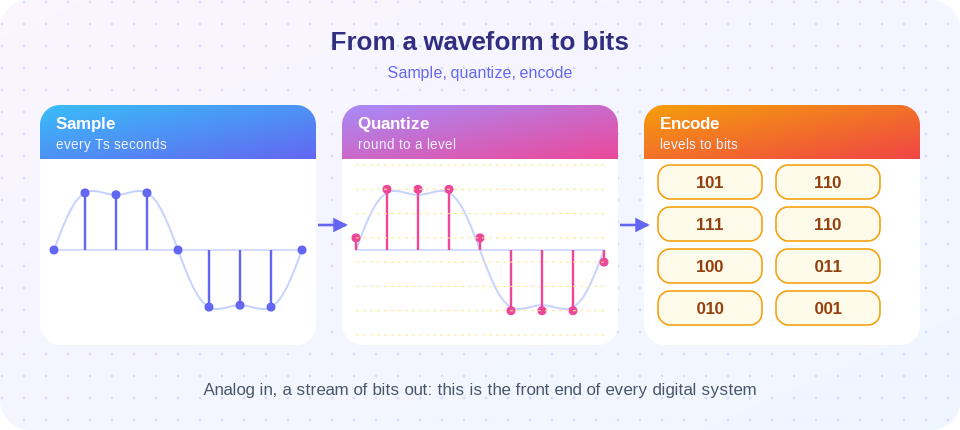
Chapter 3 sent analog messages on carriers. Chapter 4 changes the message itself: it turns a continuous waveform into numbers, and the numbers into bits. This conversion is the reason a phone call can be carried over the same network as a web page, and the reason music can be copied a million times without degradation. Three steps do the job: sampling in time, quantization in amplitude and encoding into bits. A fourth step, the line code, decides which voltages carry the bits on the wire.
What you will learn
- The three steps of analog-to-digital conversion and what each loses or keeps.
- How the lessons of the chapter fit together.
- The bit-rate arithmetic of real systems.
Key terms
- Sampling: measuring the signal at regular instants
Ts = 1/fs. - Quantization: rounding each sample to one of a finite set of levels.
- PCM (pulse code modulation): sampling, quantization and binary coding together.
- Bit rate
Rb: bits transmitted per second. - Line code: the rule that maps bits to voltage pulses.
The chapter in slides
Analog to digital in three steps
Sampling theorem
Quantization
Onto the wire
The lessons in this chapter
- Sampling theorem: how fast to sample, and aliasing.
- Quantization and PCM: levels, quantization noise, SQNR, bit rates.
- Line codes and pulse shaping: NRZ, RZ, Manchester, AMI, Nyquist pulses and ISI.
- Chapter 4 review.
Why bother with digital?
Three reasons, each of which returns in the rest of the course. Regeneration: a repeater decides which bit was sent and transmits a clean copy, so noise does not accumulate. Processing: once a signal is numbers, you can compress, encrypt, multiplex and error-correct it. Universality: voice, video and data are all just bits, so one network carries everything.
The costs are bandwidth (a digitized voice needs about 64 kb/s, which needs more spectrum than the analog 4 kHz) and an irreversible quantization error. The rest of the chapter measures both costs.
Common misconceptions
"Digitizing loses nothing." Sampling at a sufficient rate loses nothing in theory, but quantization always discards a little. You choose how much by choosing the number of bits.
"More samples than necessary make quality worse." Oversampling costs bit rate or memory, but it never harms quality; it often helps by relaxing the anti-aliasing filter.
Try it
The first example performs the full chain on a short waveform: sample, quantize to 3 bits, write out codewords and reconstruct. You can change bits and watch the error shrink.
Press Run (or Ctrl + Enter) to see the result here.
Program input · what you'd type while the program runs
Type the answers before you press Run, one per line. Each time the program reads a line (with input()), it gets the next line from this box.
The second example computes bit rates for four real systems. The arithmetic is the same each time: samples per second times bits per sample times channels.
Press Run (or Ctrl + Enter) to see the console output here.
No output.
Check your understanding
Quick check · 4 questions
of 4 answered You scored / 4 · perfect!
-
1. In which order does analog-to-digital conversion proceed?
The signal is first measured at discrete times, then each value is rounded to a level, then the level is written as bits. -
2. Which step of PCM always loses a little information?
Rounding to a finite number of levels discards the exact value. -
3. A telephone call samples at 8 kHz with 8 bits. The bit rate is
8000 × 8 = 64,000 b/s. -
4. Why can a digital repeater avoid accumulating noise?
As long as the decision is correct, the noise is discarded rather than carried on.
Summary
- ADC = sample, quantize, encode; PCM does all three.
- Sampling is lossless if
fs ≥ 2B; quantization always loses a little. - Bit rate = samples/s × bits/sample × channels.
- Line codes then turn bits into voltages for transmission.
Next: Sampling theorem
Theo dõi tiến độ của bạn
Tạo tài khoản miễn phí để đánh dấu bài đã học và tiếp tục từ chỗ bạn dừng lại trên mọi thiết bị.