
























Bài 45 · Projects and Practice
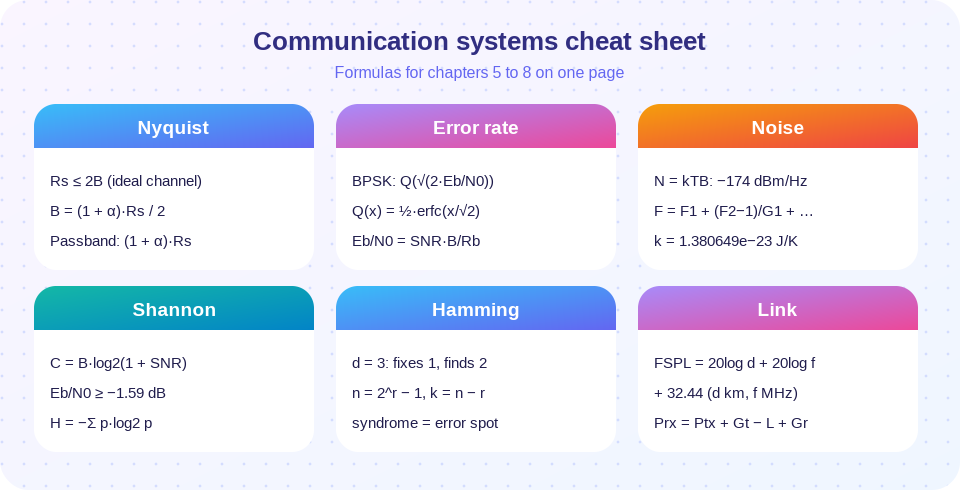
Cheat Sheet: Communication Systems Formulas
A one-page recap of the key formulas for modulation, noise, error rates, coding, link budgets, fading and fiber, with a worked end-to-end design and a modulation chooser.
Keep this page open while you solve problems. It lists the formulas of chapters 5 to 8 with their units and the rules of thumb that make quick estimates possible, plus a few facts from the earlier chapters of the course. Below the tables you will find an end-to-end worked design and a small tool for choosing a modulation.
What you will learn
- Find any key formula quickly, with its units.
- Run a complete design from bit rate to transmit power.
- Choose a modulation from an
Eb/N0target.
Key terms
- Rb, Rs: bit rate and symbol rate.
- γ = Eb/N0: energy per bit over noise density, linear.
- η: spectral efficiency in bit/s/Hz.
- Q(x): Gaussian tail,
½·erfc(x/√2).
Modulation and pulses
| Item | Formula |
|---|---|
| Bit rate | Rb = Rs · log2(M) |
| Raised-cosine bandwidth | B = (1 + α) · Rs (passband); Rs/2·(1 + α) baseband |
| Nyquist limit | Rs ≤ 2B for ISI-free baseband signaling |
| BPSK / QPSK signal | s(t) = I·cos(ωt) − Q·sin(ωt), I, Q = ±√Eb |
| Square QAM energy | Es = 2(M − 1)/3 for levels ±1, ±3, … |
| Phase error | amplitude falls by cos φ |
Noise and error rates
| Item | Formula |
|---|---|
| Thermal noise | N = kTB; −174 dBm/Hz + 10·log10(B) at 290 K |
| Noise figure | NF = 10·log10(F), Te = T0·(F − 1) |
| Cascade | F = F1 + (F2 − 1)/G1 + (F3 − 1)/(G1·G2) |
| Ratios | Eb/N0 = SNR · B/Rb; Es/N0 = k · Eb/N0 |
| Matched filter | peak SNR 2E/N0 |
| BPSK, QPSK | Pb = Q(√(2γ)); 6.8 dB for 10⁻³, 9.6 dB for 10⁻⁵ |
| 16-QAM | Pb ≈ 0.75 · Q(√(0.8γ)) |
| DPSK, noncoherent FSK | ½e^(−γ), ½e^(−γ/2) |
| Rayleigh BPSK | ½(1 − √(γ/(1 + γ))) ≈ 1/(4γ) |
Information and coding
| Item | Formula |
|---|---|
| Entropy | H = −Σ p·log2 p |
| BSC capacity | C = 1 − H(p) |
| AWGN capacity | C = B·log2(1 + SNR) |
| Shannon limit | Eb/N0 ≥ (2^η − 1)/η → −1.59 dB |
| Block code | rate k/n; detects dmin − 1; corrects ⌊(dmin − 1)/2⌋ |
| Hamming | n = 2^r − 1, k = n − r, dmin = 3; syndrome = column of H |
| Convolutional | states 2^(K−1); Viterbi keeps one survivor per state; soft decisions gain about 2 dB |
Wireless and optical
| Item | Formula |
|---|---|
| Friis | Pr = Pt·Gt·Gr·(λ/4πd)² |
| Free-space loss | 20·log10(d_km) + 20·log10(f_MHz) + 32.44 dB |
| Log-distance | PL = PL0 + 10·n·log10(d/d0) |
| Link budget | Pr = Ptx + Gtx − L + Grx (dBm); margin = SNR − required |
| Fade margin | shadowing 2.33σ for 99 %; Rayleigh 20 dB for 99 % |
| Doppler, coherence | fd = v·f/c; Tc ≈ 0.423/fd; Bc ≈ 1/(5·τrms) |
| OFDM | Δf = 1/Tu; cyclic prefix longer than the delay spread |
| Fiber | NA = √(n1² − n2²); 0.2 dB/km at 1550 nm; Δτ = D·L·Δλ, D = 17 ps/(nm·km) |
A few facts from earlier chapters
| Item | Fact |
|---|---|
| AM bandwidth | 2·fm |
| FM bandwidth (Carson) | B ≈ 2(Δf + fm) |
| Sampling | fs ≥ 2·fmax |
| PCM | bit rate fs·n; SQNR about 6.02·n + 1.76 dB for a full-scale sine |
Common misconceptions
- "One formula fits all BER curves." Each scheme has its own; always check coherent versus noncoherent.
- "The cheat sheet replaces understanding." It saves lookup time but cannot tell you which ratio (SNR,
Es/N0,Eb/N0) to use. - "dB values add for power sums." Only gains and losses add; powers must be converted to linear first.
Try it
First, a complete design. Given a data rate, choose a modulation and bandwidth, find the required Eb/N0 for BER 10⁻⁵, convert to SNR, compute the noise floor and finally the transmit power needed for a 2.4 GHz, 500 m link with a 10 dB fade margin.
Press Run (or Ctrl + Enter) to see the result here.
Program input · what you'd type while the program runs
Type the answers before you press Run, one per line. Each time the program reads a line (with input()), it gets the next line from this box.
Second, a modulation chooser. Slide the available Eb/N0 and see which modulations reach a BER of 10⁻⁵. Denser ones need more energy per bit, but you saw they use less bandwidth.
Check your understanding
Quick check · 5 questions
of 5 answered You scored / 5 · perfect!
-
1. A link needs Eb/N0 = 10 dB. Its bit rate is 2 Mbit/s and its bandwidth is 1 MHz. What SNR does it need?
SNR = Eb/N0 · Rb/B = 10 dB + 10·log10(2) = 13 dB. -
2. Which formula gives the available thermal noise power?
N = kTB; 4kTRB is the mean-square open-circuit voltage. -
3. What is the Carson bandwidth of an FM signal with peak deviation 75 kHz and a 15 kHz message?
B ≈ 2(75 + 15) = 180 kHz. -
4. How many bits does an 8-bit PCM system send per second at 8,000 samples/s?
8,000 × 8 = 64,000 bit/s. -
5. Which statement about Hamming (7,4) is correct?
k/n = 4/7 and t = ⌊(3 − 1)/2⌋ = 1.
Summary
- Keep the ratio chain straight: SNR,
Es/N0,Eb/N0, BER. - Free-space loss needs km and MHz; thermal noise needs dBm/Hz plus
10·log10(B). - The Shannon limit is
−1.59 dB; real schemes need several dB more, and coding closes the gap. - Denser modulation saves bandwidth at the cost of energy per bit.
Next: Further study
Theo dõi tiến độ của bạn
Tạo tài khoản miễn phí để đánh dấu bài đã học và tiếp tục từ chỗ bạn dừng lại trên mọi thiết bị.