
























Bài 5 · Getting Started
Chapter 1 review: Getting started
Review the communication chain, decibels, bandwidth, noise and Shannon capacity with a one-page summary, a recap table and a ten-question quiz.
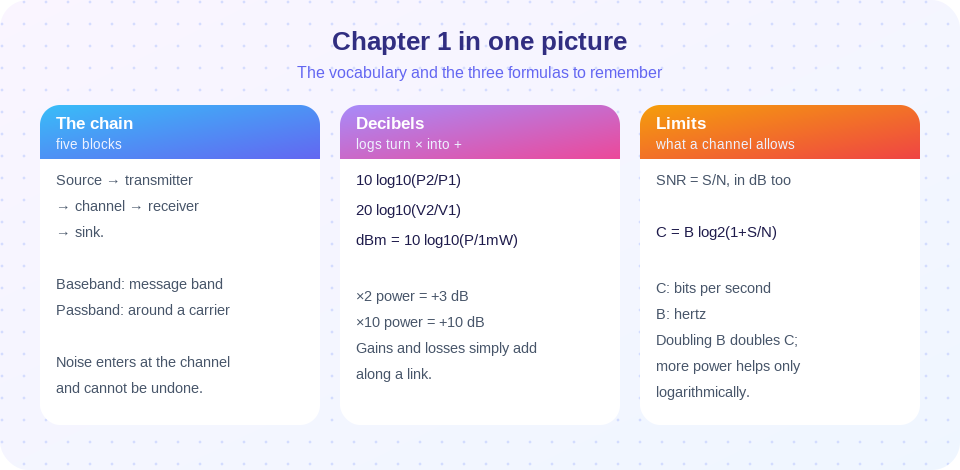
Chapter 1 gave you three tools that you will use in every later chapter: the five-block chain, the decibel, and the pair of bandwidth and signal-to-noise ratio. Before moving on to spectra, make sure the vocabulary is automatic. This lesson collects the key ideas on one page, gives a recap table and finishes with a longer quiz.
What you will learn
- How the chapter's lessons fit together.
- Which formulas to know without looking.
- Where you are still shaky, through a ten-question check.
Recap table
| Idea | Formula or statement | Lesson |
|---|---|---|
| Chain | source → transmitter → channel → receiver → sink | The communication model |
| Wavelength | λ = c / f, c ≈ 3 × 10⁸ m/s |
The communication model |
| Power ratio | dB = 10 log10(P2/P1) |
Decibels and power |
| Voltage ratio | dB = 20 log10(V2/V1) |
Decibels and power |
| Absolute level | dBm = 10 log10(P / 1 mW) |
Decibels and power |
| Thermal noise | N = k T B, −174 dBm/Hz at 290 K |
Bandwidth and channels |
| Nyquist | C = 2 B log2(M) |
Bandwidth and channels |
| Shannon | C = B log2(1 + SNR) |
Bandwidth and channels |
Study tip. Cover the middle column and try to recall each formula from its name. Then do it the other way round: cover the name and say what the formula is for.
Try it
Here is a stretch example that combines everything in chapter 1. The free-space path loss between two isotropic antennas is FSPL = 20 log10(4π d f / c). Combine it with a transmit level and noise floor to predict the SNR of a Wi-Fi link at several distances.
Press Run (or Ctrl + Enter) to see the result here.
Program input · what you'd type while the program runs
Type the answers before you press Run, one per line. Each time the program reads a line (with input()), it gets the next line from this box.
The second example is a two-way converter for quick checks in your own work.
Press Run (or Ctrl + Enter) to see the console output here.
No output.
Check your understanding
Quick check · 9 questions
of 9 answered You scored / 9 · perfect!
-
1. Which block is the only one that adds the random disturbance we call noise?
Noise enters in the channel and in the receiver's first stages. -
2. Why is a 3 kHz audio signal rarely sent directly as radio?
λ = c/f = 100 km, so a quarter-wave antenna is 25 km. Modulating onto a high carrier shrinks the antenna. -
3. A power ratio of 0.1 is
10 log10(0.1) = −10 dB. -
4. Doubling the voltage across a fixed resistor changes the level by
Voltage ratio 2 → 20 log10(2) ≈ 6.02 dB. -
5. A transmitter of 100 mW is how many dBm?
10 log10(100 mW / 1 mW) = 20 dBm. -
6. Which is the noise power in 1 MHz at 290 K, approximately?
−174 dBm/Hz + 10 log10(10⁶) = −174 + 60 = −114 dBm. -
7. The Shannon capacity of a 10 kHz channel at an SNR of 7 (ratio) is
C = 10,000 · log2(1 + 7) = 10,000 · 3 = 30,000 b/s. -
8. At high SNR, what does doubling the signal power (+3 dB) buy you?
At high SNR, log2(1 + SNR) is about log2(SNR), so doubling SNR adds log2(2) = 1 bit/s/Hz. -
9. Which pair is a definition of bandwidth (not a measure of bit rate)?
Bandwidth is a width in hertz.
Summary
- The chain has five blocks; the receiver outputs an estimate.
- Decibels turn multiplication into addition; use 10 for power and 20 for voltage.
- Noise
N = k T Band SNR set the channel capacity together with B. - Next stop: the mathematical tools for looking at signals in frequency.
Theo dõi tiến độ của bạn
Tạo tài khoản miễn phí để đánh dấu bài đã học và tiếp tục từ chỗ bạn dừng lại trên mọi thiết bị.