
























Bài 21 · Construction Materials
Chapter 4 Review: Construction Materials
Review construction materials: properties, concrete mix and strength, steel behavior, timber, masonry, asphalt, and stress, strain and testing, with a ten-question quiz.
You can now describe the main construction materials in the language engineers use: properties, numbers and tests. This review pulls the chapter into one picture, gives you a recap table with the key formulas, and ends with a longer quiz that mixes all five lessons.
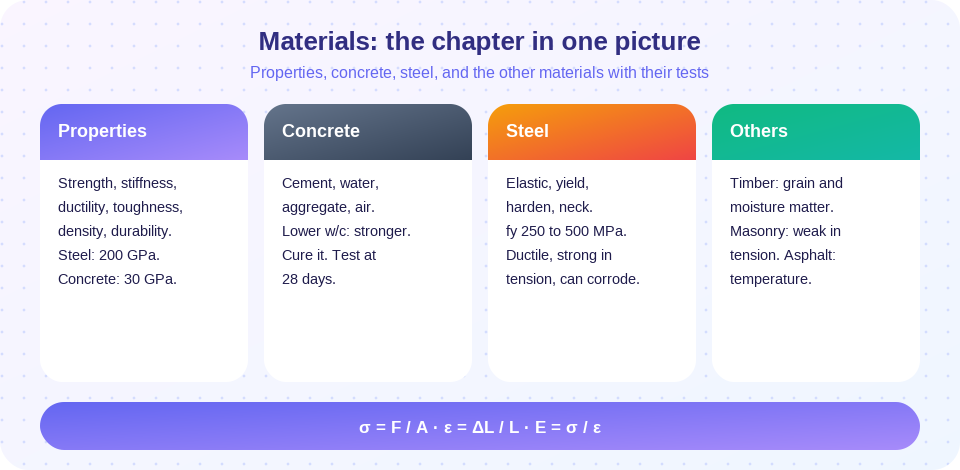
Recap table
| Lesson | Big idea | Remember |
|---|---|---|
| Chapter 4 Overview | Compare materials by strength, stiffness, ductility, density, durability | Steel 200 GPa, concrete about 30 GPa, timber about 11 GPa |
| Concrete Basics | Lower w/c gives higher strength; cure it | f(t) = f28 × t / (4 + 0.85 t); fc = F / A |
| Steel and Metals | Elastic, yield, harden, neck | Py = fy × A; εy = fy / E |
| Timber, Masonry and Asphalt | Grain and moisture; compression-only masonry; temperature-sensitive asphalt | MC = (wet − dry) / dry |
| Stress, Strain and Material Testing | Size-free measures and how tests give them | σ = F/A, ε = ΔL/L, E = σ/ε, δ = FL/(AE) |
Try it
Press Run (or Ctrl + Enter) to see the result here.
Program input · what you'd type while the program runs
Type the answers before you press Run, one per line. Each time the program reads a line (with input()), it gets the next line from this box.
Press Run (or Ctrl + Enter) to see the console output here.
No output.
Check your understanding
Quick check · 10 questions
of 10 answered You scored / 10 · perfect!
-
1. Which property does Young's modulus measure?
E relates stress to strain in the elastic range; it is a measure of stiffness. -
2. A concrete mix has 150 kg of water and 300 kg of cement. What is w/c?
150 ÷ 300 = 0.50. -
3. Which is the correct reason to cure concrete?
Hydration needs water; early drying stops strength gain. -
4. A 12 mm bar (A = 113 mm²) has fy = 500 MPa. Its yield load is about:
500 × 113 = 56,500 N ≈ 56.5 kN. -
5. Timber is weakest in:
Across the grain the fibers are crushed sideways, so strength is much lower. -
6. Masonry walls tend to crack under sideways loading because masonry is:
Bending causes tension on one face, and masonry resists tension poorly. -
7. A 4 m steel bar (E = 200 GPa) carries 100 MPa. How much does it stretch?
ε = 100 ÷ 200,000 = 0.0005; δ = 0.0005 × 4,000 mm = 2 mm. -
8. What do you get by dividing force by area?
σ = F / A. -
9. Why do steel and concrete work well together in reinforced concrete?
They expand by similar amounts and complement each other: concrete takes compression, steel takes tension. -
10. Which statement about asphalt is true?
Asphalt is mostly aggregate with about 5 % bitumen, and it softens when hot and stiffens when cold.
Summary
- Materials are compared by strength, stiffness, ductility, density and durability; strength and stiffness are different.
- Concrete strength falls as w/c rises and grows with age and curing; steel behaves elastically, yields, hardens and necks.
- Timber depends on grain and moisture, masonry on compression and bond, asphalt on temperature.
- Stress, strain and Young's modulus link tests to design numbers.
- Chapters 5 to 9 apply these tools to water, transportation, soil, sustainability and projects.
Theo dõi tiến độ của bạn
Tạo tài khoản miễn phí để đánh dấu bài đã học và tiếp tục từ chỗ bạn dừng lại trên mọi thiết bị.