
























Bài 42 · Environmental and Sustainable Design
Chapter review: Environmental and sustainable design
Review water treatment, BOD, settling, stormwater detention and embodied carbon on one page, then test yourself with a ten-question mixed quiz.
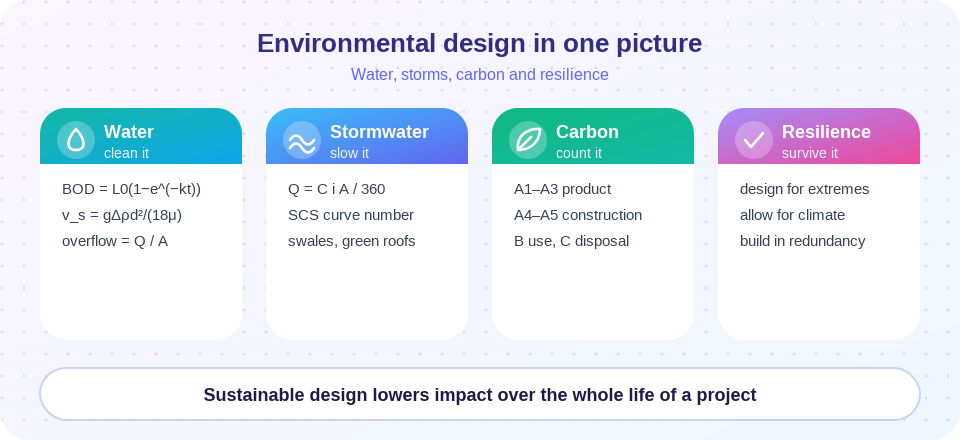
This chapter widened the engineer's question from "will it stand up?" to "what will it do to the world?" Here are the main tools side by side, a worked example that touches three of them, and a ten-question quiz.
What you will learn
- Which equation or idea answers each environmental question.
- How the lessons combine in one site design.
- How to spot weak claims about "green" design.
Key terms
BOD: oxygen demand of pollution in water, BOD_t = L₀ (1 − e^(−kt)).
Overflow rate: Q / A, which decides which particles settle.
Detention: temporary storage that flattens the peak flow leaving a site.
Embodied carbon: product-stage and construction emissions, mass × factor.
Whole-life carbon: embodied plus operational emissions over the lifetime.
Recap table
| Question | Tool | Key relation |
|---|---|---|
| How polluting is the water? | BOD | BOD_t = L₀ (1 − e^(−kt)) |
| Will a particle settle? | Stokes and overflow rate | v_s = gΔρd²/(18μ) ≥ Q/A |
| How big is the flood peak? | Rational method | Q = C i A / 360 |
| How much to store? | Detention | V = ½ T_b (Q_p − Q_o)² / Q_p |
| How much carbon in the build? | LCA modules A1 to A3 | Σ mass × factor |
| Which option is greener? | Whole-life comparison | upfront + yearly × years |
A site design in four steps
A developer plans to pave a 12 ha meadow site next to a small stream.
- Hydrology: the paved site raises the 10-year peak from 0.80 to 2.13 m³/s.
- Stormwater: a detention pond of about 1500 m³ and a swale line hold the peak to the old value, and permeable paving in the car parks reduces the volume.
- Water quality: the pond and the swales settle sediment, and the overflow rate gives the size of particle caught.
- Carbon: the car parks and pond lining use concrete and steel, so the team compares options by embodied carbon and picks a slag-blend concrete and reuses excavated soil on site.
Each step used a different tool, and each decision affected the next one.
Common misconceptions
"Treatment plants create energy for free." Biogas can supply a large share of a plant's energy, but the plant remains a net energy user in most cases.
"A green label guarantees low impact." Check the data. An EPD or a transparent calculation is evidence; an adjective is not.
"Detention solves water quality." Detention helps with flood peaks. Quality needs settling, filtering and plants, and often source control.
Try it
A mini planner chains the stormwater and carbon calculations, then a demonstration checker flags weak "green" claims.
Press Run (or Ctrl + Enter) to see the result here.
Program input · what you'd type while the program runs
Type the answers before you press Run, one per line. Each time the program reads a line (with input()), it gets the next line from this box.
Press Run (or Ctrl + Enter) to see the console output here.
No output.
Check your understanding
Quick check · 10 questions
of 10 answered You scored / 10 · perfect!
-
1. A sample has BOD₅ = 150 mg/L and k = 0.23 d⁻¹. 1 − e^(−1.15) ≈ 0.683. The ultimate BOD is about
L₀ = 150 / 0.683 ≈ 220 mg/L. -
2. Doubling the surface area of an ideal settling tank at the same flow
Overflow rate is Q / A, so doubling A halves it and more particles settle. -
3. Which particle settles fastest? (same material)
Stokes settling velocity grows with d². -
4. A 5 ha site with C = 0.7 and i = 72 mm/h has a peak of
Q = 0.7 × 72 × 5 / 360 = 0.7 m³/s. -
5. Which feature mainly stores water under a surface and lets it soak in?
Permeable paving has a stone reservoir below it. -
6. Which module covers demolition and waste processing?
C modules cover end of life. -
7. 2000 kg of rebar at 1.4 kg CO₂e per kg contributes
2000 × 1.4 = 2800 kg CO₂e. -
8. Why does embodied carbon often dominate for bridges and walls?
Operational energy is small, so the material emissions are most of the total. -
9. A detention pond mainly reduces
It stores water and releases it slowly. -
10. First priority in carbon reduction is to
Avoiding new construction removes the emissions at the source.
Summary
- Water quality uses BOD and settling; flood control uses runoff and detention; carbon uses mass × factor.
- Green infrastructure complements pipes; it does not replace them in extreme storms.
- Compare options over the whole life, with transparent numbers.
- Avoid and reduce first; offset last.
Theo dõi tiến độ của bạn
Tạo tài khoản miễn phí để đánh dấu bài đã học và tiếp tục từ chỗ bạn dừng lại trên mọi thiết bị.