
























Bài 21 · Bernoulli and Energy
Chapter 4 Review: Bernoulli and Energy
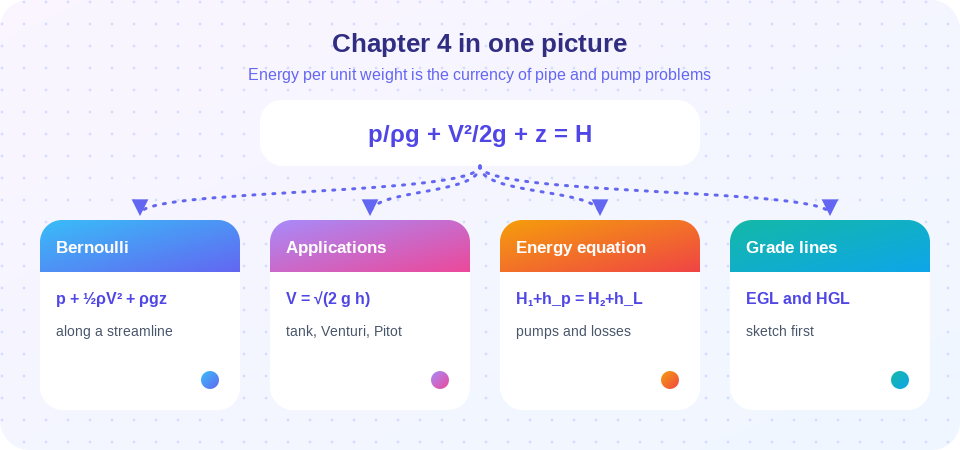
Review Bernoulli's equation, Pitot tubes, Venturi meters, the energy equation with pumps and losses, and grade lines with a recap table and a 10-question quiz.
You now have the three conservation tools for ideal and simple real flows: continuity (mass), the momentum equation (forces) and the energy equation (heads). This review pulls chapter 4 together and gives you a mixed quiz. After this, chapter 5 introduces dimensional analysis, the method that tells you how to scale experiments and how to organise results when no equation is available.
What you will learn
- How the four lessons of chapter 4 connect.
- A checklist for choosing between Bernoulli and the energy equation.
- The formulas and sign conventions to memorize.
Recap table
| Lesson | Key equation | Remember |
|---|---|---|
| Overview | p/ρg + V²/2g + z = H |
Heads are energy per unit weight |
| Bernoulli equation | p + ½ρV² + ρgz = constant |
Steady, frictionless, incompressible, along a streamline |
| Applications | V = √(2gh), V = √(2Δp/ρ), Venturi Q |
Use C_d for real devices |
| Energy equation | … + h_p = … + h_T + h_L |
P = ρ g Q h_p/η; EGL only falls |
Choosing the right tool
- Is there friction, a pump or a turbine between the points? Use the energy equation.
- Short, smooth, no machines? Bernoulli is accurate.
- Need a force? Use the momentum equation.
- Unknown velocity? Add continuity.
- Gas near Mach 0.3 or faster? Chapter 8 (compressible flow).
A combined problem
Water flows at 0.05 m³/s through a horizontal Venturi (inlet 150 mm, throat 75 mm) and then through a nozzle into the air.
V₁ = 0.05/(π 0.075²) = 2.83 m/s;V₂ = 4 V₁ = 11.3 m/s.- Pressure drop (Bernoulli):
Δp = ½ρ(V₂² − V₁²) = 0.5 × 998 × (128.2 − 8.0) = 60 kPa. - Jet momentum force if it hits a flat plate with a 50 mm nozzle:
V = 0.05/(π 0.025²) = 25.5 m/s,F = ρ Q V = 998 × 0.05 × 25.5 ≈ 1270 N.
Press Run (or Ctrl + Enter) to see the result here.
Program input · what you'd type while the program runs
Type the answers before you press Run, one per line. Each time the program reads a line (with input()), it gets the next line from this box.
Check your understanding
Quick check · 10 questions
of 10 answered You scored / 10 · perfect!
-
1. Which of these is NOT an assumption of Bernoulli's equation?
Velocity changes along the streamline (that is the whole point); the other three are required. -
2. Water flows in a horizontal pipe at 1 m/s and 150 kPa gauge, then at 4 m/s. The new gauge pressure is about
p₂ = 150 000 + 0.5 × 998 × (1 − 16) = 142.5 kPa. -
3. The jet speed from a hole 8 m below the surface of a large open tank is about
√(2 × 9.81 × 8) = 12.5 m/s. -
4. A Pitot-static tube in water (998 kg/m³) reads Δp = 5 kPa. The speed is
V = √(2 × 5000/998) = 3.17 m/s. -
5. A pump supplies 25 m of head at 0.03 m³/s of water (η = 0.8). Shaft power is about
ρ g Q h_p/η = 998 × 9.81 × 0.03 × 25 / 0.8 ≈ 9.18 kW. -
6. The HGL lies below the EGL by
EGL − HGL = V²/2g. -
7. In a passive pipe (no pump), the EGL
Friction continuously converts mechanical energy to heat. -
8. The kinetic energy correction factor α for laminar pipe flow is
The parabolic laminar profile has α = 2. -
9. At a stagnation point
The stagnation pressure is static plus dynamic pressure of the oncoming flow. -
10. Which is the main limit on how high a water siphon can lift?
The crest pressure cannot fall below the vapor pressure, which limits the lift to roughly 10 m.
Summary
- Bernoulli = energy conservation along a streamline in ideal flow.
- Add
h_p,h_Tandh_Lfor the energy equation of real systems. - The EGL tracks total head and only falls except at pumps; HGL = EGL − V²/2g.
- Applications: Torricelli, Pitot, Venturi, siphon.
Next: Chapter 5 overview: Dimensional analysis and similarity
Theo dõi tiến độ của bạn
Tạo tài khoản miễn phí để đánh dấu bài đã học và tiếp tục từ chỗ bạn dừng lại trên mọi thiết bị.