
























Bài 3 · Getting Started
Units and Dimensions
Master SI units, dimensions (M, L, T) and dimensional homogeneity for fluid mechanics, with unit conversions and a runnable dimension checker.
In 1999 NASA lost its Mars Climate Orbiter because one team used pound-force seconds and another used newton seconds. A spacecraft worth hundreds of millions of dollars burned up for a unit error. Fluid mechanics mixes many quantities (pressure, viscosity, flow rate, power), so a clean habit with units is the cheapest way to avoid mistakes. This lesson sets up the SI system, the idea of dimensions, and a test called dimensional homogeneity that checks an equation before you ever use it.
What you will learn
- The SI base units and the common derived units in fluid mechanics.
- How to write the dimensions of a quantity in terms of M, L and T.
- How to test an equation using dimensional homogeneity.
- How to convert between SI, bar, atm, psi and other pressure units.
Key terms
Dimension: the kind of quantity, such as length (L) or mass (M), independent of the unit you measure it in.
Unit: a specific standard for measuring a dimension, such as meter or foot.
Dimensional homogeneity: every term in a valid physical equation has the same dimensions.
Dimensionless quantity: a ratio with no dimensions, such as a Reynolds number or a drag coefficient.
Dimensions and units
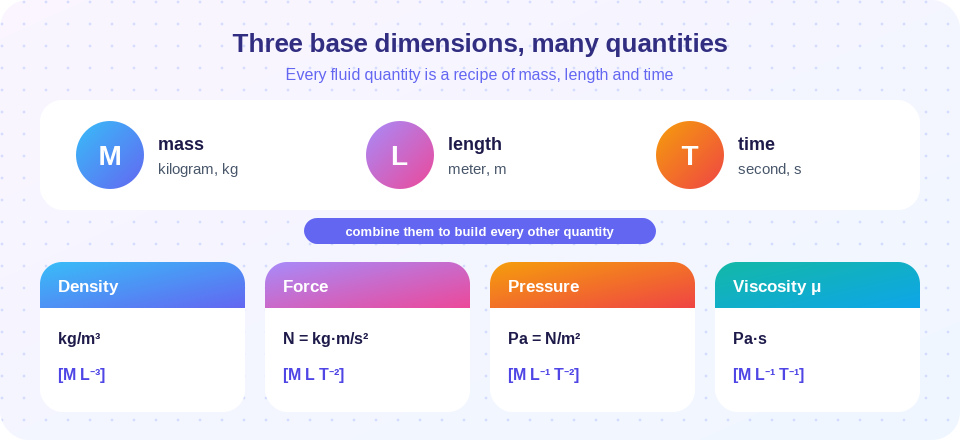
A dimension says what kind of thing you measure; a unit says how you measure it. Length is a dimension; meters, feet and miles are units of it. In mechanics, three base dimensions are enough:
| Dimension | Symbol | SI base unit |
|---|---|---|
| Mass | M | kilogram (kg) |
| Length | L | meter (m) |
| Time | T | second (s) |
(Temperature, Θ, joins them when heat flow or gas properties matter.) Everything else is a combination. Square brackets mean "dimensions of":
| Quantity | Symbol | Dimensions | SI unit |
|---|---|---|---|
| Velocity | V | [L T⁻¹] |
m/s |
| Acceleration | a, g | [L T⁻²] |
m/s² |
| Force | F | [M L T⁻²] |
newton, N = kg·m/s² |
| Pressure, stress | p, τ | [M L⁻¹ T⁻²] |
pascal, Pa = N/m² |
| Density | ρ | [M L⁻³] |
kg/m³ |
| Dynamic viscosity | μ | [M L⁻¹ T⁻¹] |
Pa·s |
| Kinematic viscosity | ν = μ/ρ | [L² T⁻¹] |
m²/s |
| Volume flow rate | Q | [L³ T⁻¹] |
m³/s |
| Mass flow rate | ṁ | [M T⁻¹] |
kg/s |
| Power | P | [M L² T⁻³] |
watt, W |
| Surface tension | σ | [M T⁻²] |
N/m |
You can derive any entry from a defining equation. Force is mass times acceleration, so [F] = M · L T⁻² = M L T⁻². Pressure is force per area, so [p] = M L T⁻² / L² = M L⁻¹ T⁻². Viscosity comes from τ = μ du/dy: [μ] = [τ] / [du/dy] = M L⁻¹ T⁻² / T⁻¹ = M L⁻¹ T⁻¹.
Dimensional homogeneity
A physical equation must make sense whatever units you pick, so it can only add or equate quantities with the same dimensions. You cannot add a length to a time. That principle gives a powerful check.
Test the hydrostatic equation p = ρ g h:
- Left side:
[p] = M L⁻¹ T⁻². - Right side:
[ρ][g][h] = (M L⁻³)(L T⁻²)(L) = M L⁻¹ T⁻². ✓
Now test the Bernoulli equation p + ½ρV² + ρ g z = constant. Each term must have the dimensions of pressure:
[½ρV²] = (M L⁻³)(L² T⁻²) = M L⁻¹ T⁻²✓[ρ g z] = (M L⁻³)(L T⁻²)(L) = M L⁻¹ T⁻²✓
Dimensional homogeneity does not prove an equation is correct (a wrong factor of 2 passes the test), but it catches a large share of algebra slips. It is also the basis of dimensional analysis in chapter 5.
Unit conversions
Always convert to SI before substituting. Some useful values:
| Quantity | Conversion |
|---|---|
| Standard atmosphere | 1 atm = 101 325 Pa |
| Bar | 1 bar = 100 000 Pa = 100 kPa |
| Pound per square inch | 1 psi = 6894.76 Pa |
| mm of mercury | 1 mmHg = 133.322 Pa |
| Standard gravity | g = 9.80665 m/s² |
| Liter | 1 L = 0.001 m³ |
| US gallon | 1 gal = 3.785 × 10⁻³ m³ |
| Horsepower (mechanical) | 1 hp = 745.7 W |
Worked example. A tire gauge reads 32 psi. In pascals: 32 × 6894.76 ≈ 220 600 Pa = 2.21 bar (gauge). A pump delivers 120 L/min: 120 × 0.001 / 60 = 0.0020 m³/s.
Press Run (or Ctrl + Enter) to see the result here.
Program input · what you'd type while the program runs
Type the answers before you press Run, one per line. Each time the program reads a line (with input()), it gets the next line from this box.
Try adding your own quantity, such as surface tension (1, 0, -2), and build the Weber number ρ V² D / σ to confirm it is dimensionless.
Press Run (or Ctrl + Enter) to see the result here.
Program input · what you'd type while the program runs
Type the answers before you press Run, one per line. Each time the program reads a line (with input()), it gets the next line from this box.
Notice that 1 atm is about 10.3 to 10.4 meters of water, the height of a water column that the atmosphere can support (Hydrostatic Pressure explains why).
Common misconceptions
"If the units balance, the equation is right." Homogeneity is necessary, not sufficient. p = 2ρgh passes the test but is wrong.
"kg and N are the same on Earth." A kilogram measures mass; a newton measures force. A 1 kg object weighs 1 × 9.81 = 9.81 N.
"Pounds are always mass." In US customary units, lb (pound-mass) and lbf (pound-force) differ. SI avoids the confusion, so this course uses SI throughout.
Check your understanding
Quick check · 5 questions
of 5 answered You scored / 5 · perfect!
-
1. What are the dimensions of dynamic viscosity μ?
From τ = μ du/dy: [μ] = [M L⁻¹ T⁻²] / [T⁻¹] = M L⁻¹ T⁻¹, with SI unit Pa·s. -
2. Which expression has the dimensions of pressure?
ρV² = (M L⁻³)(L² T⁻²) = M L⁻¹ T⁻², the dimensions of pressure. -
3. A pump delivers 90 L/min. What is the flow rate in m³/s?
90 L/min = 90 × 0.001 m³ / 60 s = 0.0015 m³/s. -
4. Which pressure is the largest?
1 atm = 101.325 kPa, 1 bar = 100 kPa, 14 psi ≈ 96.5 kPa, 700 mmHg ≈ 93.3 kPa. -
5. Dimensional homogeneity can prove that an equation is
If the terms do not share dimensions the equation must be wrong. Passing the test only means it might be right.
Summary
- Dimensions (M, L, T) say what a quantity is; units say how it is measured.
- Pressure is
[M L⁻¹ T⁻²], viscosity[M L⁻¹ T⁻¹], density[M L⁻³]. - Every term in a valid equation has the same dimensions (homogeneity).
- Convert everything to SI first: 1 atm = 101 325 Pa, 1 psi ≈ 6895 Pa, 1 L = 10⁻³ m³.
- Dimensionless groups such as
ρVD/μhave all exponents equal to zero.
Next: Describing Flow
Theo dõi tiến độ của bạn
Tạo tài khoản miễn phí để đánh dấu bài đã học và tiếp tục từ chỗ bạn dừng lại trên mọi thiết bị.