
























Bài 12 · Control Volumes and Conservation
Control Volumes: Chapter Overview
See how the control volume turns fluid flow into bookkeeping: system versus control volume, the Reynolds transport theorem, and the plan for mass and momentum.
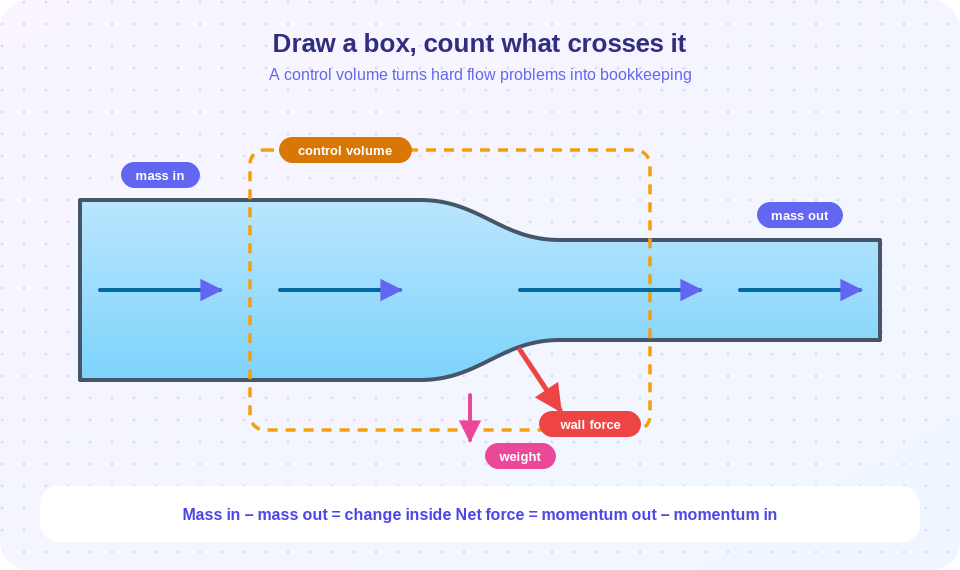
The laws of physics are written for a fixed amount of matter: a system. Newton's second law talks about "a body of mass m". But a river, a jet engine or a garden hose has no fixed body; fluid keeps flowing through. The trick that makes fluid mechanics practical is to switch from following a lump of fluid to watching a fixed region of space and counting what crosses its boundary. This region is called a control volume, and this chapter shows how to use it for mass and momentum.
What you will learn
- The difference between a system and a control volume.
- Why a transport theorem is needed to convert system laws to control-volume laws.
- How the chapter's lessons use the idea for mass and momentum.
- How to choose and draw a good control volume.
Key terms
System: a fixed collection of fluid particles that always contains the same mass.
Control volume (CV): a fixed (or moving) region in space chosen for analysis; fluid can cross its control surface (CS).
Flux: the amount of a quantity (mass, momentum, energy) crossing a surface per unit time.
Reynolds transport theorem (RTT): the rule that converts a system's rate of change into control-volume terms.
System versus control volume
A system follows the same matter forever. A control volume stays put in space and matter flows through it. Think of a bathtub. The system view tracks the particular liters of water that are now in the tub. The control-volume view says: draw a box around the tub; the water level changes at a rate equal to the inflow from the tap minus the outflow through the drain.
For solids you always use systems (a ball, a car). For fluids you almost always use control volumes, because the fluid's boundary is hard to follow and the boundaries you care about (a pipe inlet and outlet, a wing, a nozzle) are fixed.
The Reynolds transport theorem
Let B be any extensive property of a system (mass, momentum, energy) and b = B/m its value per unit mass. Reynolds showed that for a control volume
dB_sys/dt = d/dt ∫_CV ρ b dV + ∮_CS ρ b (V · n) dA
In words: the rate of change of B for the matter currently inside the CV equals the rate at which B accumulates inside the CV, plus the net rate at which B flows out through the control surface. V · n is the velocity component normal to the surface, positive for outflow and negative for inflow.
Plug in B = m, b = 1 and you get conservation of mass. Plug in B = momentum, b = V and you get Newton's second law for flows. The same theorem will later give the energy equation.
Choosing a control volume
Then apply the laws
The lessons in this chapter
| Lesson | What you will do |
|---|---|
| Conservation of Mass | Use ρ A V flows, continuity and draining-tank problems. |
| The Momentum Equation | Find forces on nozzles and bends from momentum flux. |
| Jets, Plates and Vanes | Compute jet forces on fixed and moving surfaces. |
| Chapter 3 Review | Consolidate with a recap and a mixed quiz. |
A first example: bathtub bookkeeping
A tub has a surface area of 0.9 m². Water enters at 0.20 L/s and leaves through the drain at 0.15 L/s. How fast does the level rise? The control volume is the tub. Mass in minus mass out equals storage: ρ (Q_in − Q_out) = ρ A dh/dt, so dh/dt = (Q_in − Q_out) / A.
Press Run (or Ctrl + Enter) to see the result here.
Program input · what you'd type while the program runs
Type the answers before you press Run, one per line. Each time the program reads a line (with input()), it gets the next line from this box.
Press Run (or Ctrl + Enter) to see the result here.
Program input · what you'd type while the program runs
Type the answers before you press Run, one per line. Each time the program reads a line (with input()), it gets the next line from this box.
Common misconceptions
"The control volume must be the whole device." Choose it for convenience. Often the best box is a small piece around one inlet or one bend.
"Mass flowing out equals mass flowing in always." Only in steady flow. When the level in a tank changes, the mass inside is changing.
Check your understanding
Quick check · 4 questions
of 4 answered You scored / 4 · perfect!
-
1. A control volume differs from a system because
A control volume is a chosen region; the matter inside changes as fluid crosses its boundary. -
2. In the Reynolds transport theorem, the surface term describes
∮ρ b (V·n) dA is the net outflow of the property b. -
3. A tub of area 1.2 m² receives 0.3 L/s and drains 0.1 L/s. How fast does the level rise?
dh/dt = (0.3 − 0.1)×10⁻³ / 1.2 = 1.67 × 10⁻⁴ m/s ≈ 0.17 mm/s. -
4. When choosing a control volume, where is it best to cut through the flow?
Cutting where the velocity and pressure are known leaves fewer unknowns.
Summary
- Fluid analysis uses a control volume: a region fixed in space that matter flows through.
- The Reynolds transport theorem turns system laws into: accumulation inside plus net flux out.
- Mass and momentum come next; energy follows in chapter 4.
- Choose the CV boundary where velocity and pressure are known.
Next: Conservation of Mass
Theo dõi tiến độ của bạn
Tạo tài khoản miễn phí để đánh dấu bài đã học và tiếp tục từ chỗ bạn dừng lại trên mọi thiết bị.