
























Bài 38 · Radiation and Antennas
Chapter review: radiation and antennas
Recap retarded potentials, dipole radiation, Larmor's formula and antennas with a one-page picture, formula table and a ten-question quiz.
Chapter 7 followed the life of a radio wave from its birth at an accelerating charge to its capture by a receiving antenna. This page gathers the pieces and checks that they fit.
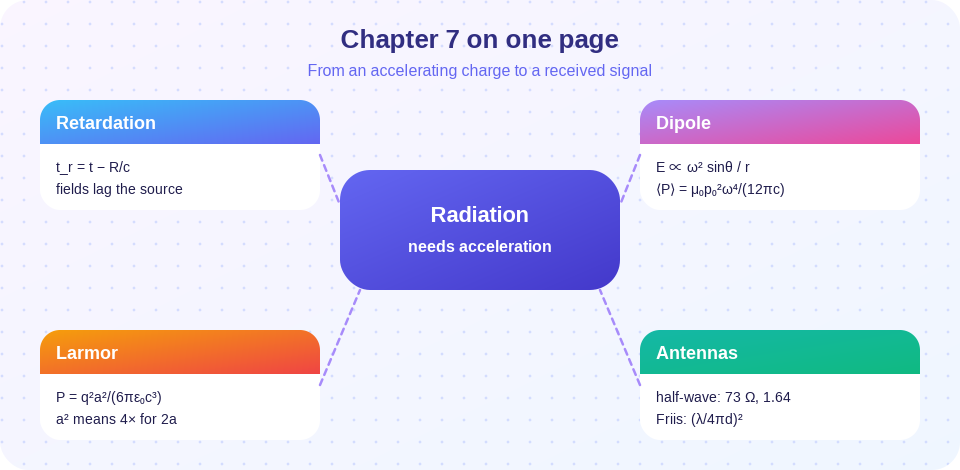
Recap table
| Topic | Result | Remember |
|---|---|---|
| Retardation | t_r = t − R/c (R = distance) |
Sun: 499 s away |
| Dipole fields | E ∝ ω² p₀ sinθ / r |
Power ∝ ω⁴ |
| Dipole power | ⟨P⟩ = μ₀p₀²ω⁴/(12πc) |
Pattern sin²θ |
| Larmor | P = q²a²/(6πε₀c³) |
Doubling a gives 4× |
| Half-wave dipole | R_rad ≈ 73 Ω, D = 1.64 |
Length ≈ 0.47 λ |
| Friis | P_r/P_t = G_tG_r(λ/4πd)² |
2.4 GHz, 10 m: −56 dB |
The chain of reasoning
Experts do not memorize these formulas as a list. They remember one story and rebuild the formulas from it:
- Acceleration bends field lines into a kink that runs outward at
c(overview). Therefore radiation needs acceleration and falls as1/r. - Retardation (retarded potentials) puts that story into equations: the potentials at
(r, t)come from sources att − R/c. Differentiating a retarded quantity brings in the source's time derivatives, so fields containp̈, not justp. - A small source is a dipole (dipole and Larmor):
E ∝ ω² p₀ sinθ/r, so power∝ ω⁴ sin²θ. A single charge gives Larmor'sP ∝ q²a². - A real antenna is a dipole with structure (antennas): add elements with their phases for the pattern, integrate for the power, and use
A_e = Gλ²/4πfor the link.
When you meet a new radiation problem, ask in order: what is accelerating, how fast does the source oscillate compared with c/size, in which direction do I want the power, and how far away is the receiver?
Worked review problems
Problem 1. A dipole with p₀ = 2 × 10⁻⁷ C·m oscillates at 3 MHz. Find the average power.
ω = 2π × 3 × 10⁶ = 1.885 × 10⁷ rad/s, ω⁴ = 1.263 × 10²⁹, so ⟨P⟩ = μ₀p₀²ω⁴/(12πc) = (1.257×10⁻⁶ × 4×10⁻¹⁴ × 1.263×10²⁹)/(12π × 2.998×10⁸) ≈ 0.56 W. (The TryIt below checks it.)
Problem 2. A proton and an electron get the same acceleration. Compare Larmor powers. The power depends on q²a², and both charges have magnitude e, so the powers are equal. The same force gives the electron an acceleration 1836 times larger, and its power 1836² ≈ 3.4 million times larger. That is why light particles radiate so much more in accelerators.
Problem 3. You triple the distance to a transmitter. By how many dB does the received power fall? Power ∝ 1/d², a factor of 9: 10 log₁₀ 9 = 9.5 dB.
Common mistakes to avoid
"Radiation and a static field are two names for the same thing." The 1/r² static field belongs to the charge; the 1/r radiation field belongs to its acceleration.
"Gain measures how much power an antenna makes." Gain is the redistribution of a fixed power: more in one direction means less in others, and G = ηD includes the efficiency η.
"Larmor's formula works at any speed." It is the non-relativistic limit (v ≪ c). Near c the relativistic form (Liénard) has extra factors of γ.
Orders of magnitude to carry with you
| Quantity | Value |
|---|---|
| Light-travel time, Earth to Moon | 1.28 s |
| Light-travel time, Earth to Sun | 499 s |
Free-space impedance Z₀ |
376.7 Ω |
Half-wave dipole R_rad, D |
73 Ω, 1.64 (2.15 dBi) |
| Near/far crossover | r ≈ λ/2π |
| Blue-to-red scattering ratio | about 6 |
Try it
Press Run (or Ctrl + Enter) to see the result here.
Program input · what you'd type while the program runs
Type the answers before you press Run, one per line. Each time the program reads a line (with input()), it gets the next line from this box.
Press Run (or Ctrl + Enter) to see the result here.
Program input · what you'd type while the program runs
Type the answers before you press Run, one per line. Each time the program reads a line (with input()), it gets the next line from this box.
Press Run (or Ctrl + Enter) to see the result here.
Program input · what you'd type while the program runs
Type the answers before you press Run, one per line. Each time the program reads a line (with input()), it gets the next line from this box.
Check your understanding
Quick check · 10 questions
of 10 answered You scored / 10 · perfect!
-
1. A charge moves at constant velocity. Does it radiate?
Larmor's formula gives zero power for a = 0. -
2. The radiation field of a source decreases with distance as
Only a 1/r field keeps the flux through a sphere constant. -
3. A transmitter on Mars (closest 5.5 × 10¹⁰ m) sends a pulse. About when does Earth receive it?
t = 5.5 × 10¹⁰ / 3 × 10⁸ ≈ 183 s ≈ 3 min. -
4. Doubling the dipole frequency (same p₀) changes the radiated power by a factor
P ∝ ω⁴. -
5. Where does a vertical dipole radiate the most?
sin²θ peaks at θ = 90°. -
6. The directivity of an ideal isotropic radiator is
By definition, the isotropic radiator is the reference: D = 1 (0 dBi). -
7. Larmor power for a given charge scales with acceleration as
P = q²a²/(6πε₀c³). -
8. At 100 MHz, a half-wave dipole is roughly
λ = 3 m, so λ/2 = 1.5 m. -
9. In the Friis equation, doubling the distance changes received power by
Power falls as 1/d², so ×1/4 = −6 dB. -
10. Why is the sky blue (qualitatively)?
Driven molecular dipoles radiate ∝ ω⁴, so blue is scattered about six times more than red.
Summary
- Retardation, acceleration and dipole structure make radiation.
- Larmor's formula and the dipole pattern give power and direction.
- Antennas turn those ideas into gain, resistance and link budgets.
- Next: how electromagnetism and special relativity fit together.
Theo dõi tiến độ của bạn
Tạo tài khoản miễn phí để đánh dấu bài đã học và tiếp tục từ chỗ bạn dừng lại trên mọi thiết bị.