
























Bài 9 · Vector Calculus and Electrostatics
Electric potential
Learn why electrostatic fields have a potential, how to compute V for points, rings and spheres, how E follows from V, and how Laplace's equation shapes fields.
Vectors are hard to add. A scalar is easy. The electric potential V turns the problem of adding three components of E from many sources into the much simpler problem of adding numbers. It is also what a voltmeter reads. This lesson shows why the potential exists (because the field has no curl), how to calculate it, how to get E back from it, and how it connects to energy.
What you will learn
- Why
∇×E = 0implies that a potential exists and that work depends only on the endpoints. - How to compute V for point charges, rings and spheres, and how to superpose potentials.
- How to find E from V with
E = −∇V, and why equipotentials are perpendicular to field lines. - The meaning of the volt and the electron-volt, and a first look at Laplace's equation.
Key terms
- Potential V: potential energy per unit charge; units of volts (1 V = 1 J/C).
- Potential difference:
V(b) − V(a) = −∫ₐᵇ E · dl, the quantity that matters physically. - Equipotential: a surface on which V is constant.
- Electron-volt (eV): the energy gained by an electron crossing 1 V;
1 eV = 1.602 × 10⁻¹⁹ J. - Laplace's equation:
∇²V = 0in a region with no charge.
Why a potential exists
Because ∇×E = 0, Stokes' theorem gives ∮ E · dl = 0 around every closed loop. So the line integral of E between two points does not depend on the path. Pick a reference point (usually infinity or ground) and define
V(r) = −∫ from ref to r of E · dl
Then the work done by the field on a charge q moving from a to b is W = q [V(a) − V(b)], and the potential energy is U = qV. The minus sign is chosen so that positive charges move from high V to low V, like a ball rolling downhill.
Only differences of V are physically meaningful: adding a constant to V changes nothing. A bird sitting on a high-voltage wire is at a high potential but feels no field across its body.
From V to E, and back
The fundamental theorem for gradients gives the inverse relation:
E = −∇V
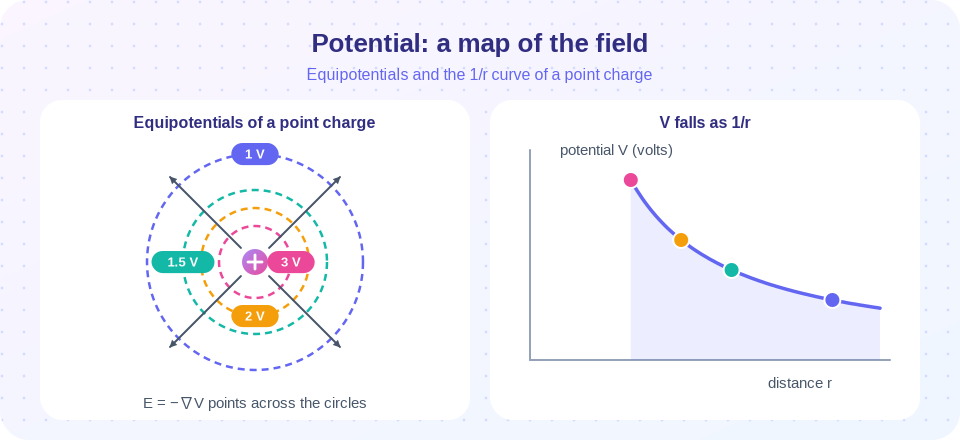
The field points downhill: in the direction in which V decreases fastest, and its magnitude is the steepness. Hence field lines cross equipotentials at right angles, and the equipotentials are closely spaced where the field is strong.
Point charge. V = kq / r (zero at infinity). Check: −dV/dr = kq/r² ✓.
Superposition. For many charges, V = Σ kqᵢ / rᵢ. For continuous charge, V = k ∫ dq / r. This is a scalar sum, no components to track.
Worked example: a ring
For a ring of radius R and charge Q, every element is the same distance √(z² + R²) from the point on the axis, so
V(z) = kQ / √(z² + R²)
and E_z = −dV/dz = kQ z / (z² + R²)^{3/2}, which matches the result found by adding vectors earlier. The potential method did in one line what the vector integral did in several.
Worked example: sphere and shell
A thin shell of radius R and charge Q has V = kQ/r outside and constant V = kQ/R inside (since E = 0 inside). A uniformly charged solid sphere has V = kQ/r outside and V = (kQ / 2R) (3 − r²/R²) inside, with the maximum value 3kQ/2R at the center.
The dipole
For charges +q at distance r₊ and −q at r₋, V = kq (1/r₊ − 1/r₋). Far away, with dipole moment p = qd, this becomes
V = k p cosθ / r²
where θ is measured from p. It falls off as 1/r² (one power faster than a point charge).
Energy and the electron-volt
Moving a charge q through a potential difference ΔV changes its energy by qΔV. An electron accelerated through 1000 V gains 1000 eV = 1.6 × 10⁻¹⁶ J, giving a speed of about 1.9 × 10⁷ m/s (non-relativistic estimate: v = √(2eΔV/m)). The hydrogen atom's potential at the Bohr radius is k e / a₀ ≈ 27.2 V, so the electron's potential energy there is −27.2 eV (twice the 13.6 eV binding energy, as the virial theorem predicts).
Poisson's and Laplace's equations
Combine E = −∇V with ∇·E = ρ/ε₀:
∇²V = −ρ / ε₀ (Poisson's equation)
In charge-free regions, ∇²V = 0 (Laplace's equation). Solutions of Laplace's equation have a remarkable property: the value at any point is the average of the values on a sphere around it. So V has no local maximum or minimum in empty space, and you cannot trap a charge in stable equilibrium using electrostatic forces alone (Earnshaw's theorem). The uniqueness theorem adds that once V is specified on the boundaries of a region, the solution inside is unique. This is the basis for computer solvers and for the method of images.
Common misconceptions
- "Zero potential means zero field." V = 0 can occur where E is large (the midpoint of a dipole has V = 0 but E ≠ 0).
- "Zero field means zero potential." Inside a charged shell, E = 0 but V is a nonzero constant.
- "Potential is a property of one charge." It is a property of the system: potential energy per unit test charge.
- "Voltage flows through a circuit." Charge flows; voltage is a difference between two points.
Try it
The first example draws equipotentials and field lines of a dipole from numerically computed V. The second checks E = −dV/dz for a ring. The third solves Laplace's equation on a grid by repeated averaging.
Press Run (or Ctrl + Enter) to see the result here.
Program input · what you'd type while the program runs
Type the answers before you press Run, one per line. Each time the program reads a line (with input()), it gets the next line from this box.
Press Run (or Ctrl + Enter) to see the result here.
Program input · what you'd type while the program runs
Type the answers before you press Run, one per line. Each time the program reads a line (with input()), it gets the next line from this box.
Press Run (or Ctrl + Enter) to see the result here.
Program input · what you'd type while the program runs
Type the answers before you press Run, one per line. Each time the program reads a line (with input()), it gets the next line from this box.
Check your understanding
Quick check · 5 questions
of 5 answered You scored / 5 · perfect!
-
1. A proton moves through a potential difference of 500 V. Its kinetic energy gain is
Energy gained equals qΔV = e × 500 V = 500 eV. -
2. The potential of a point charge Q at distance r (zero at infinity) is
V = kQ/r. Its negative gradient gives the field kQ/r². -
3. Which statement is correct?
E = −∇V: the field points downhill in potential. -
4. Inside a thin charged spherical shell, the potential is
E = 0 inside, so V does not change and equals its value at the surface, kQ/R. -
5. Why does ∇×E = 0 guarantee that V exists?
By Stokes' theorem the circulation is zero, so the integral depends only on the endpoints.
Summary
∇×E = 0means the work done by the field depends only on endpoints, so a potential V exists withE = −∇V.- Point charge:
V = kq/r; potentials of several charges simply add as numbers. - Equipotentials are perpendicular to field lines; the field is strongest where they bunch together.
U = qV, 1 eV = 1.602 × 10⁻¹⁹ J; V obeys Poisson's equation∇²V = −ρ/ε₀.- In empty space V has no maxima or minima; the boundary values fix the solution.
Next: Conductors and energy
Theo dõi tiến độ của bạn
Tạo tài khoản miễn phí để đánh dấu bài đã học và tiếp tục từ chỗ bạn dừng lại trên mọi thiết bị.