
























Bài 11 · Vector Calculus and Electrostatics
Chapter 2 review: vector calculus and electrostatics
Review gradient, divergence, curl, Gauss's law, potential, conductors and field energy with a one-page poster, a recap table, a potential plot and a 9-question quiz.
Chapter 2 gave electrostatics its mathematical language. Two local equations, ∇·E = ρ/ε₀ and ∇×E = 0, capture everything; Gauss's law and the potential are their global forms. This review gathers the formulas, compares potentials of three standard sources, and checks your understanding with a longer quiz.
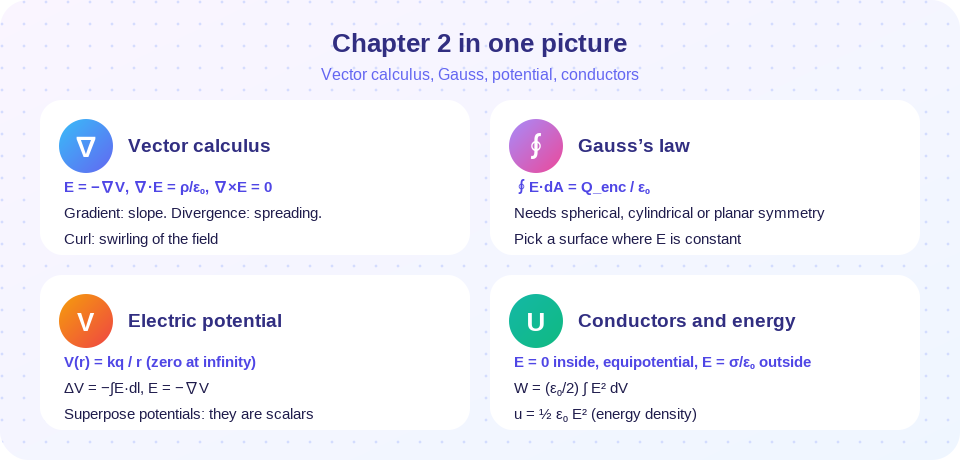
The chapter in a table
| Topic | Key result |
|---|---|
| Gradient | ∇f points uphill; ∇×(∇f) = 0 |
| Divergence theorem | ∮F·dA = ∫∇·F dV |
| Stokes' theorem | ∮F·dl = ∫(∇×F)·dA |
| Gauss's law | ∮E·dA = Q_enc/ε₀, ∇·E = ρ/ε₀ |
| Symmetric fields | sphere kQ/r², line 2kλ/s, plane σ/2ε₀ |
| Potential | E = −∇V, V = kq/r, ∇²V = −ρ/ε₀ |
| Conductors | E = 0 inside, equipotential, E = σ/ε₀ outside |
| Energy | W = (ε₀/2)∫E² dV, u = ½ε₀E² |
A short problem-solving guide
- Sources and symmetry first. Is the problem spherical, cylindrical or planar? Use Gauss. Otherwise, use the potential (scalar sum) and take a gradient.
- Conductor? Replace the conductor by its boundary conditions: constant V on it,
E = σ/ε₀just outside. - Energy? Use
½ Σ q Vfor point charges or(ε₀/2)∫E²dVfor distributed fields. Do not add the energies of two sources and forget the cross term. - Always check units and limits (far away you should recover a point charge).
Common misconceptions
- "If I know E at a point I know V at the point." V needs a reference; only differences are physical.
- "Gauss's law is for symmetric problems only." It always holds; it only gives E from symmetry.
Try it
Press Run (or Ctrl + Enter) to see the result here.
Program input · what you'd type while the program runs
Type the answers before you press Run, one per line. Each time the program reads a line (with input()), it gets the next line from this box.
Press Run (or Ctrl + Enter) to see the result here.
Program input · what you'd type while the program runs
Type the answers before you press Run, one per line. Each time the program reads a line (with input()), it gets the next line from this box.
Check your understanding
Quick check · 9 questions
of 9 answered You scored / 9 · perfect!
-
1. The divergence theorem converts
∮F·dA = ∫∇·F dV relates the total outflow to the sources inside. -
2. A uniform sphere carries Q. The field at half the radius, relative to the field at the surface, is
Inside, E ∝ r, so at r = R/2 it is half the surface value. -
3. The curl of an electrostatic field is
∇×E = 0 in electrostatics, so E derives from a potential. -
4. What is the SI unit of electric flux?
Flux is E times area: (N/C)·m² = N·m²/C, equivalently V·m. -
5. Two points have potentials 120 V and 20 V. A charge of 5 μC is moved from the first to the second. How much work does the field do?
W = q(V_a − V_b) = 5e-6 × 100 V = 5e-4 J. -
6. A positive charge is placed inside a cavity of a conductor. The cavity wall acquires
Gauss's law for a surface in the metal needs −q on the wall. -
7. The electric field just outside the surface of a conductor is
Any parallel component would move the surface charges. -
8. Laplace's equation ∇²V = 0 implies that V has
V at a point equals the average of the surrounding values, so it cannot be an extremum. -
9. The energy density of an electric field E is
u = ½ ε₀ E², with the total energy found by integrating over space.
Summary
- Gradient, divergence and curl measure slope, outflow and circulation; two theorems connect local and global forms.
- Gauss's law and zero curl are the two equations of electrostatics; symmetry makes Gauss's law a tool.
- The potential V packs the field into a scalar, with
E = −∇V; conductors are equipotentials withE = σ/ε₀outside. - Field energy:
u = ½ ε₀ E².
Theo dõi tiến độ của bạn
Tạo tài khoản miễn phí để đánh dấu bài đã học và tiếp tục từ chỗ bạn dừng lại trên mọi thiết bị.