
























Bài 33 · Quantum Simulations
Chapter overview: quantum simulations
A map of numerical quantum mechanics: solving the Schrödinger equation on a grid, evolving wave packets, and using the variational principle, in natural units.
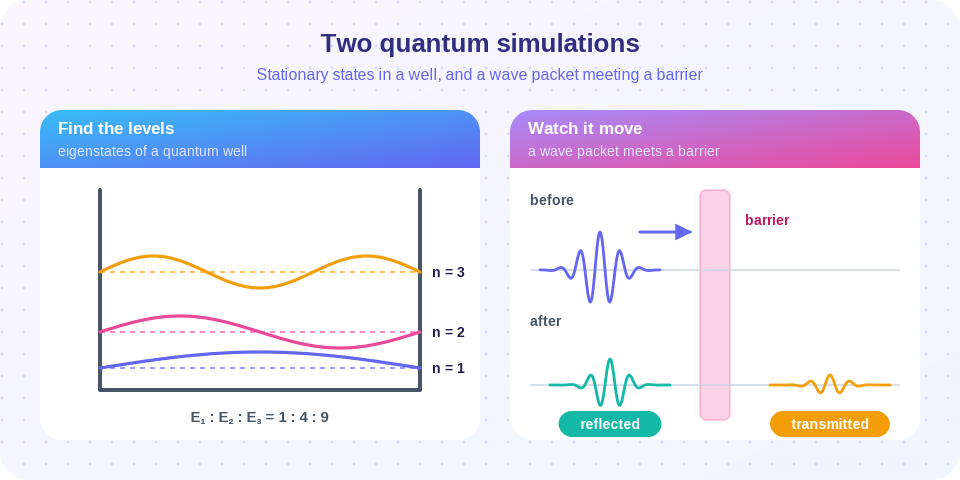
Quantum mechanics replaces trajectories by a wave function ψ(x, t). Its square, |ψ|², is the probability density for finding a particle near x. The equation that governs ψ is the Schrödinger equation, and for a handful of textbook cases it can be solved with pencil and paper. For everything else (a particle in an odd-shaped potential, a collision with a barrier, a molecule) we calculate. This chapter shows three reliable ways to do it, all in one dimension, all in a few lines of NumPy.
What you will learn
- The two forms of the Schrödinger equation and which one to use when.
- Why we work in natural units with
ħ = m = 1. - The three methods of this chapter: matrix diagonalization, split-step propagation and the variational principle.
- What each lesson covers.
Key terms
Wave function ψ: a complex-valued function whose squared magnitude is a probability density.
Hamiltonian H: the energy operator, kinetic plus potential: H = −(ħ²/2m) d²/dx² + V(x).
Eigenstate: a state with a definite energy: Hψ = Eψ.
Wave packet: a localized superposition of many momenta, the quantum picture of a moving particle.
Unitary evolution: time evolution that preserves the total probability, ∫|ψ|² dx = 1.
Two equations, two jobs
The time-independent Schrödinger equation Hψ = Eψ asks: which states have a sharp energy, and what are those energies? On a grid, it becomes a matrix eigenvalue problem and the computer returns the energy levels and shapes directly. This answers "what is the spectrum of this well?".
The time-dependent equation iħ ∂ψ/∂t = Hψ asks: how does a given starting state evolve? We solve it by stepping forward in time. This answers "what happens when the packet reaches the barrier?".
Natural units
Writing ħ, m and the particle charge in every formula is tiresome and error-prone. In natural units we set ħ = m = 1. Then the Hamiltonian is simply H = −½ d²/dx² + V(x), and all quantities are plain numbers. To return to real units at the end, you only need two scales: a length ℓ and an energy ε related by ε = ħ²/(m ℓ²). For an electron and ℓ = 1 Å = 1e-10 m that energy unit is about 7.62 eV.
Method 1: levels
Method 2: motion
Method 3: bounds
Sanity checks
What each lesson covers
- Energy levels from matrices: finite differences, the box, the oscillator and a finite well, with convergence tests.
- Wave packets and tunneling: the split-step Fourier method and a barrier experiment checked against an exact formula.
- The variational method: trial wave functions for an anharmonic oscillator and for hydrogen.
- Chapter 7 review: a one-page picture and ten questions.
Try it
Convert natural units to electron-volts and picometers for an electron. This calculator applies the definitions above.
Press Run (or Ctrl + Enter) to see the result here.
Program input · what you'd type while the program runs
Type the answers before you press Run, one per line. Each time the program reads a line (with input()), it gets the next line from this box.
A first look at a wave function: a Gaussian wave packet is a bump multiplied by a plane wave. We plot its real part and its probability density and check that the density is normalized.
Press Run (or Ctrl + Enter) to see the result here.
Program input · what you'd type while the program runs
Type the answers before you press Run, one per line. Each time the program reads a line (with input()), it gets the next line from this box.
Check your understanding
Quick check · 4 questions
of 4 answered You scored / 4 · perfect!
-
1. What does |ψ(x)|² represent?
The squared magnitude of the wave function is a probability density. -
2. Which equation do you solve to find the energy levels of a well?
Energy eigenstates satisfy Hψ = Eψ. -
3. In natural units with ħ = m = 1, the Hamiltonian is...
The kinetic term −ħ²/(2m) d²/dx² becomes −½ d²/dx². -
4. Unitary time evolution guarantees that...
A unitary operator preserves the norm of ψ.
Summary
- ψ is a complex wave function;
|ψ|²is a probability density and must integrate to 1. - Levels: diagonalize the Hamiltonian matrix. Motion: step
ψin time. Bounds: the variational principle. - Natural units (
ħ = m = 1) turnHinto−½ d²/dx² + V; convert back at the end with a length and an energy scale. - Always test against a case with a known answer.
Theo dõi tiến độ của bạn
Tạo tài khoản miễn phí để đánh dấu bài đã học và tiếp tục từ chỗ bạn dừng lại trên mọi thiết bị.