
























Bài 47 · Projects and Practice
Where to go next
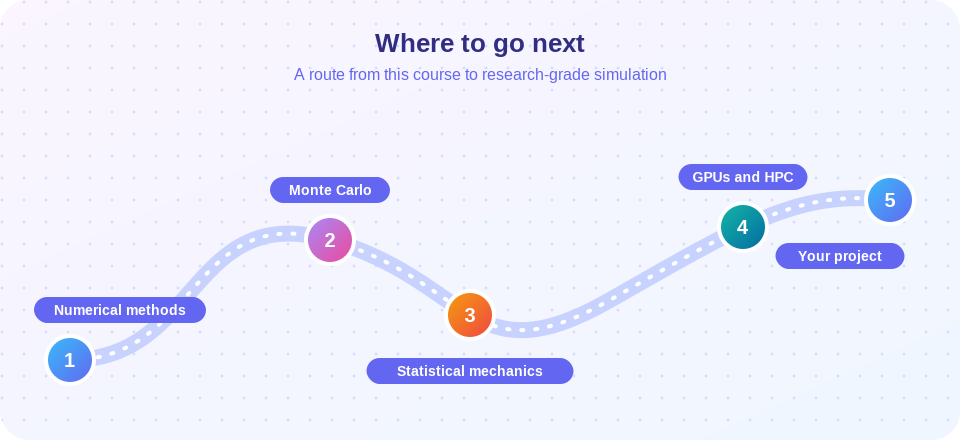
A roadmap from this course to research-grade simulation: numerical methods, Monte Carlo, statistical mechanics, GPUs and your own project, with a scaling calculator.
You can now solve the classic partial differential equations on a grid, run a molecular dynamics simulation, compute quantum energy levels and tunneling, and analyze the output with fits and spectra. That is a real toolkit. This final lesson shows how to deepen it: which topics to study next, how the tracks on this site connect, and how to think about scaling a simulation from a toy to something that tackles research-sized problems.
What you will learn
- Where each topic of this course leads.
- Which tracks on this site continue the story.
- How the cost of a simulation grows with its size.
- How to choose and scope a first project of your own.
Key terms
Scaling: how run time or memory grows with problem size N.
Vectorization: expressing loops as whole-array operations so optimized libraries do the work.
Sparse matrix: a matrix stored by its few non-zero entries, which makes big PDE problems feasible.
Parallelism: splitting work across cores, machines or GPU threads.
Reproducibility: someone else can rerun your code and get your numbers.
Where each topic leads
- Differential equations and numerical methods. Adaptive step sizes, stiff problems, implicit and multi-step integrators, finite elements and spectral methods. See Numerical Methods and Differential Equations, and for the linear algebra behind every solver, Linear Algebra.
- Monte Carlo and statistics. Sampling, importance sampling, the Metropolis algorithm for equilibrium systems and error analysis of correlated data. See Monte Carlo Simulation and Statistics and Probability.
- Statistical mechanics. The theory that tells you what molecular dynamics and Monte Carlo are sampling: ensembles, free energy, phase transitions. See Statistical Mechanics.
- Quantum mechanics. More particles, more dimensions, density functional theory and quantum Monte Carlo. See Quantum Mechanics and Advanced Quantum Mechanics.
- Classical dynamics. Lagrangian and Hamiltonian methods lead to better integrators. See Classical Mechanics: Lagrangian and, for continuum flows, Fluid Dynamics.
- Solids and materials. Molecular dynamics and quantum simulation meet in Condensed Matter Physics.
- Tools. Faster arrays and plots with NumPy, SciPy and Matplotlib; compiled speed with Julia or Fortran; GPUs with CUDA.
How cost grows
Almost every method in this course has a characteristic cost in the number of unknowns N:
- Explicit grid updates (heat, wave):
Nper step, but the stability limit makes the number of steps grow when you refine the grid. - Pair forces without tricks:
N²per step; with cell lists or neighbor lists: aboutN. - FFT:
N log N. - Dense matrix diagonalization:
N³; tridiagonal: aboutNfor a few eigenvalues; sparse iterative methods: in between. - Relaxation for the Laplace equation: Jacobi needs about
N²sweeps (for anN × Ngrid); optimal SOR needs aboutN.
Knowing these scalings tells you in advance whether doubling the system is feasible, and where optimizing pays off.
Choosing a first project
A good first project has three properties: a question you are curious about, a known limit to test against, and a scope you can finish in a month. Some examples that reuse this course: how does the transmission through a double barrier depend on the spacing (resonant tunneling); how does the diffusion constant of a Lennard-Jones liquid change with temperature (from the mean squared displacement); how does a plucked string with a stiff term sound (wave equation plus a fourth-derivative term, analyzed with the FFT).
Common misconceptions
- "I need a supercomputer to do real work." Most published methods papers start with a laptop-sized prototype.
- "Optimize first." Get a correct, tested, slow program first; measure; then optimize the part that matters.
- "A simulation is a replacement for theory." It answers specific questions; theory and simulation test each other.
- "Results do not need to be reproducible if the plot is pretty." Keep your code, random seeds, parameters and versions.
Try it
A scaling calculator: it compares operation counts for several methods as N grows and converts them to rough run times at one billion simple operations per second. It is a model of cost, not a benchmark.
Press Run (or Ctrl + Enter) to see the result here.
Program input · what you'd type while the program runs
Type the answers before you press Run, one per line. Each time the program reads a line (with input()), it gets the next line from this box.
Vectorization is the first speed-up you will use in practice. The same sum is computed with a Python loop and with a single NumPy call. The program measures both and prints their ratio.
Press Run (or Ctrl + Enter) to see the result here.
Program input · what you'd type while the program runs
Type the answers before you press Run, one per line. Each time the program reads a line (with input()), it gets the next line from this box.
Check your understanding
Quick check · 4 questions
of 4 answered You scored / 4 · perfect!
-
1. A pair-force calculation without neighbor lists scales like...
There are N(N−1)/2 pairs. -
2. Which topic explains what molecular dynamics and Monte Carlo are sampling?
Ensembles, partition functions and free energy come from statistical mechanics. -
3. What is a good first project?
A test against a known limit and a finite scope are the best protection against both bugs and burnout. -
4. Why vectorize code?
NumPy executes the loop in C, avoiding Python's per-item overhead.
Summary
- This course leads to numerical methods, Monte Carlo, statistical mechanics, quantum many-body methods and high-performance computing.
- Know the scaling of each method to predict what is feasible.
- Build a correct, tested prototype first; optimize what you measure to be slow.
- Choose a first project with a known test case and a one-month scope, and keep it reproducible.
Back to the course: Computational Physics
Theo dõi tiến độ của bạn
Tạo tài khoản miễn phí để đánh dấu bài đã học và tiếp tục từ chỗ bạn dừng lại trên mọi thiết bị.