
























Bài 37 · Quantum Simulations
Chapter 7 review: quantum simulations
One-picture recap of grid eigenvalue solvers, split-step wave packet evolution and the variational principle, with a recap table and a ten-question quiz.
This chapter gave you three complementary tools for one-dimensional quantum problems. One finds the stationary levels, one follows a wave packet in time, and one gives a guaranteed upper bound on the ground-state energy. Together with natural units they cover a surprising share of what you will meet in quantum simulation.
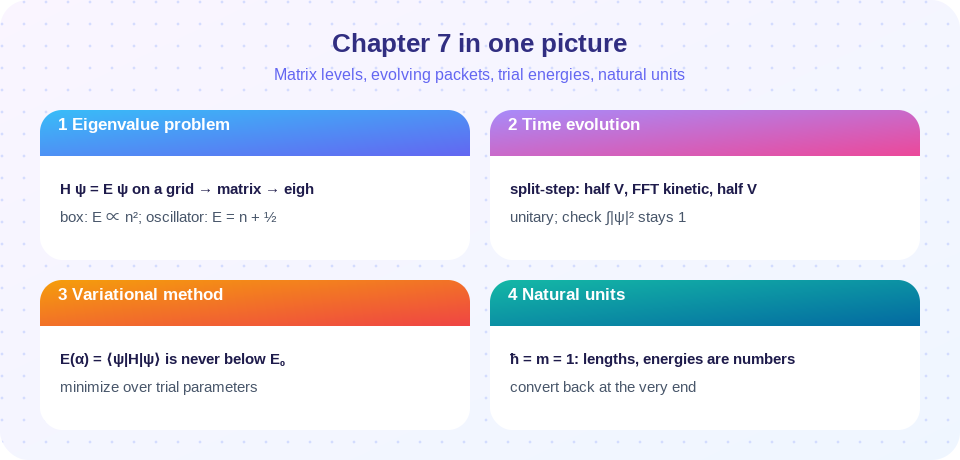
Recap table
| Tool | Equation | Key facts and checks |
|---|---|---|
| Grid eigenvalues | Hψ = Eψ, tridiagonal H |
box E = n²π²/2; oscillator E = n + ½; error ∝ Δx² |
| Split-step Fourier | ψ ← e^{−iVΔt/2} · FFT⁻¹ e^{−ik²Δt/2} FFT · e^{−iVΔt/2} ψ |
unitary; keep the box large; second order in Δt |
| Barrier tunneling | T = 1/(1 + V₀² sinh²(κa)/(4E(V₀ − E))) |
falls exponentially with a; packet needs momentum average |
| Variational | E(α) = ⟨H⟩ ≥ E₀ |
quartic: 0.681 vs 0.668; hydrogen Gaussian: −0.424 vs −0.5 |
| Natural units | ħ = m = 1 |
H = −½ d²/dx² + V; convert at the end |
Choosing the right tool
- "What are the levels?" Build the matrix and call
eigh_tridiagonal. - "What happens over time?" Split-step Fourier.
- "I cannot solve it and just need a good energy." Variational, then compare with a matrix result if the problem is one-dimensional.
- "Is my code right?" Test against box, oscillator, free-packet spreading and the exact barrier formula.
Check your understanding
Quick check · 10 questions
of 10 answered You scored / 10 · perfect!
-
1. The ground-state energy of a particle in a box of length 1 (ħ = m = 1) is...
E₁ = π²/2 ≈ 4.9348. -
2. When Δx is halved, the error of the matrix method falls by about
The scheme is second order: error ∝ Δx². -
3. In the split-step method, the potential factor is applied for...
The symmetric arrangement V/2, T, V/2 gives second-order accuracy. -
4. What does a wave-function norm that drifts away from 1 during a split-step run indicate?
All factors are phases; the norm should stay at 1 to machine precision. -
5. A trial energy is below the exact ground-state energy. Then...
The variational principle forbids ⟨H⟩ < E₀ for a legitimate trial state. -
6. Which change makes tunneling much less likely?
T falls roughly exponentially with barrier width. -
7. A packet of width σ has momentum spread...
For a Gaussian packet, σ_x σ_k = 1/2. -
8. Why divide eigenvectors by √Δx?
eigh returns vectors with unit sum of squares; dividing by √Δx gives the normalized wave function. -
9. At α = 1/2 in the harmonic oscillator VMC example, the local energy...
The trial function is the exact ground state, so E_L = E₀ everywhere. -
10. The mean energy of a packet with k₀ = 3 in natural units is about...
E ≈ k₀²/2 = 4.5 (plus a small contribution from the packet's finite width).
Summary
- Matrix diagonalization finds levels; split-step evolves packets; the variational principle bounds the ground state.
- Use natural units and test every code on known cases.
- Tunneling probability falls roughly exponentially with barrier width and rises with energy.
- A well-chosen grid (the barrier must be an exact number of cells) matters as much as the algorithm.
Theo dõi tiến độ của bạn
Tạo tài khoản miễn phí để đánh dấu bài đã học và tiếp tục từ chỗ bạn dừng lại trên mọi thiết bị.