
























Bài 18 · Monte Carlo Methods
Random Numbers and Sampling
Learn how pseudo-random generators work, why seeds matter, and how to sample exponential, Gaussian and direction distributions by inverse transform, Box-Muller and rejection.
Every Monte Carlo program starts with a stream of random numbers, and almost every physics problem needs them shaped into a specific distribution: exponential lifetimes for radioactive decay, Gaussian velocities for a gas, uniform directions for a scattered neutron. This lesson shows where the numbers come from and the three standard recipes for turning uniform numbers into anything else.
What you will learn
- How a pseudo-random generator works and why seeds make runs repeatable.
- The inverse-transform method, with exponential lifetimes as an example.
- The Box-Muller transform for Gaussian numbers.
- Rejection sampling when the inverse is not available.
- How to pick random directions uniformly on a sphere.
Key terms
PRNG: a pseudo-random number generator, a deterministic algorithm with an internal state.
Seed: the initial state; the same seed gives the same stream.
CDF F(x): the probability that the variable is at most x.
PDF f(x): the probability density, f = dF/dx.
Uniform deviate u: a random number uniformly distributed in [0, 1).
Pseudo-random generators
A computer cannot toss a coin; it computes numbers that pass statistical tests of randomness. The classic example is the linear congruential generator (LCG):
x_{n+1} = (a x_n + c) mod m, u_n = x_n / m
With well chosen a, c, m the sequence looks random but repeats after at most m numbers (the period). Poor parameters give short periods and visible patterns; the infamous RANDU generator from the 1960s put triples of numbers on a small number of planes. NumPy's default generator, np.random.default_rng(), uses the PCG64 algorithm: a huge period (2¹²⁸) and excellent statistics. Always use it rather than the older global np.random.rand.
Press Run (or Ctrl + Enter) to see the result here.
Program input · what you'd type while the program runs
Type the answers before you press Run, one per line. Each time the program reads a line (with input()), it gets the next line from this box.
Seeds. default_rng(42) always returns the same stream, which makes bugs reproducible and published results checkable. For parallel runs use np.random.SeedSequence(42).spawn(k) to create k statistically independent child streams; never seed several workers with consecutive integers by hand and assume they are independent.
Inverse-transform sampling
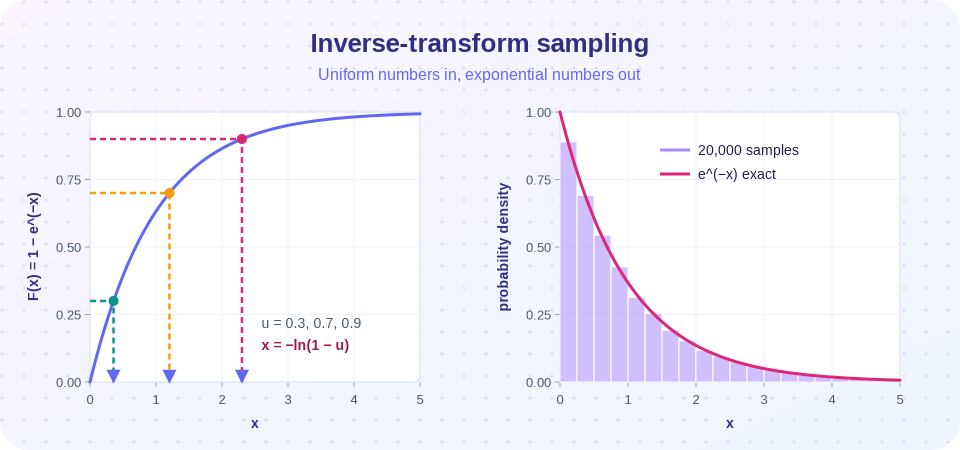
Given a target with CDF F(x), draw u uniformly and return x = F⁻¹(u). Why does it work? The probability that x ≤ a equals the probability that u ≤ F(a), which is F(a): exactly the CDF we wanted.
Example: radioactive decay. A nucleus with mean lifetime τ has the lifetime density f(t) = (1/τ) e^(−t/τ) and CDF F(t) = 1 − e^(−t/τ). Solving F(t) = u gives
t = −τ ln(1 − u)
Since 1 − u is also uniform, many programs use t = −τ ln u. The figure above shows the idea for τ = 1: each uniform u on the vertical axis maps through the curve to a lifetime on the horizontal axis.
Press Run (or Ctrl + Enter) to see the result here.
Program input · what you'd type while the program runs
Type the answers before you press Run, one per line. Each time the program reads a line (with input()), it gets the next line from this box.
Gaussian numbers: Box-Muller
The Gaussian CDF has no elementary inverse, so use a different trick. Take two independent uniforms u₁, u₂:
z₁ = √(−2 ln u₁) cos(2π u₂), z₂ = √(−2 ln u₁) sin(2π u₂)
Both z₁ and z₂ are independent standard normal numbers (mean 0, variance 1). The proof works in polar coordinates: the radius squared of a 2D Gaussian follows an exponential law (which you can sample by inverse transform), and the angle is uniform. To get a Gaussian of mean μ and standard deviation σ, use μ + σ z. In practice, call rng.normal(μ, σ, size); it uses a faster algorithm with the same result.
Rejection sampling
When you can evaluate the density f(x) but cannot invert its CDF, use rejection sampling: pick a simple envelope, throw darts, keep those under the curve.
- Pick
Mwithf(x) ≤ Mon the interval[a, b]. - Draw
xuniformly on[a, b]andyuniformly on[0, M]. - Accept
xify ≤ f(x), otherwise discard it.
The accepted x follow f. The efficiency is the area under f divided by the area of the rectangle, so a tight envelope wastes fewer samples.
Press Run (or Ctrl + Enter) to see the result here.
Program input · what you'd type while the program runs
Type the answers before you press Run, one per line. Each time the program reads a line (with input()), it gets the next line from this box.
Random directions on a sphere
A neutron scatters in a random direction. A tempting recipe, "pick the polar angle θ uniformly in [0, π] and the azimuth φ uniformly in [0, 2π]", is wrong: it piles points near the poles, because the ring at polar angle θ has circumference 2π sin θ. The correct recipe draws cos θ uniformly in [−1, 1] (this is Archimedes' hat-box theorem: equal heights cut equal areas on a sphere).
Press Run (or Ctrl + Enter) to see the result here.
Program input · what you'd type while the program runs
Type the answers before you press Run, one per line. Each time the program reads a line (with input()), it gets the next line from this box.
Common misconceptions
"If the numbers look random, any transformation of them is fine." The θ-uniform sphere example shows that a plausible recipe can be biased. Verify distributions with a histogram and known moments.
"Seed with the clock to be safe." For research, record the seed so the result can be reproduced.
"rng.random() can return 1.0." It returns values in [0, 1): never exactly 1. That matters for log(1 − u) (safe) versus log(u) (could be log(0), though the chance is negligible).
Check your understanding
Quick check · 5 questions
of 5 answered You scored / 5 · perfect!
-
1. What does the inverse-transform method compute?
Solve F(x) = u for x. The resulting x has CDF F. -
2. For exponential lifetimes with mean tau, a sample is
Inverting F(t) = 1 - exp(-t/tau) gives t = -tau ln(1 - u). -
3. Why is picking theta uniformly in [0, pi] wrong for directions on a sphere?
A ring at polar angle theta has circumference 2 pi sin(theta). Draw cos(theta) uniformly instead. -
4. In rejection sampling, what does the acceptance rate depend on?
A tight envelope rejects fewer points. -
5. How should you generate independent random streams for parallel workers?
spawn produces statistically independent child streams.
Summary
- PRNGs are deterministic; seed them for reproducibility and use
np.random.default_rng. - Inverse transform:
x = F⁻¹(u); for decay,t = −τ ln(1 − u). - Box-Muller turns two uniforms into two Gaussians; rejection sampling needs only the density.
- Uniform directions need
cos θuniform, notθ. - Always check a sampler with a histogram and known moments.
Next: Monte Carlo Integration
Theo dõi tiến độ của bạn
Tạo tài khoản miễn phí để đánh dấu bài đã học và tiếp tục từ chỗ bạn dừng lại trên mọi thiết bị.