
























Ders 9 · The Atmosphere and Flight Basics
Chapter 2 review: The atmosphere and flight basics
Review the standard atmosphere, the ideal gas law, density altitude, dynamic pressure and the four airspeeds, with a recap table, calculators and a 9-question quiz.
Chapter 2 gave you a model of the air and a way to measure how fast you move through it. Those tools appear in every later calculation: lift needs ρ and V, drag needs ρ and V, Mach number needs T and V. Use this page to check you can compute with them.
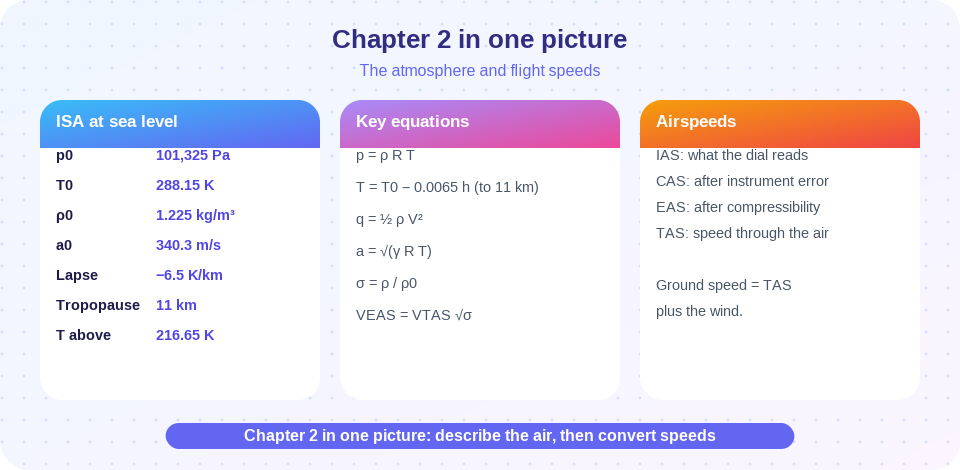
Recap table
| Idea | Key statement | Lesson |
|---|---|---|
| ISA | 288.15 K, 101,325 Pa, 1.225 kg/m³ at sea level; 6.5 K/km to 11 km | The standard atmosphere |
| Pressure | p = p₀ (T/T₀)^5.2559 below 11 km; exponential above |
The standard atmosphere |
| Gas law | p = ρRT, R = 287.053 J/(kg·K) |
Air density and the gas law |
| Density altitude | ISA altitude with the same density | Air density and the gas law |
| Dynamic pressure | q = ½ρV² = pt − p |
Airspeeds and dynamic pressure |
| Airspeeds | EAS = TAS·√σ; M = TAS/a | Airspeeds and dynamic pressure |
Try it
Press Run (or Ctrl + Enter) to see the result here.
Program input · what you'd type while the program runs
Type the answers before you press Run, one per line. Each time the program reads a line (with input()), it gets the next line from this box.
Press Run (or Ctrl + Enter) to see the result here.
Program input · what you'd type while the program runs
Type the answers before you press Run, one per line. Each time the program reads a line (with input()), it gets the next line from this box.
Check your understanding
Quick check · 9 questions
of 9 answered You scored / 9 · perfect!
-
1. What is the ISA temperature at 6 km?
288.15 − 0.0065 × 6000 = 249.15 K. -
2. Which law gives air density from pressure and temperature?
Solving p = ρRT for ρ gives ρ = p/(RT). -
3. On a hot day the density altitude is usually:
Hot air is less dense, which is equivalent to being higher in the standard atmosphere. -
4. What is dynamic pressure at 100 m/s at sea level?
q = 0.5 × 1.225 × 100² = 6,125 Pa. -
5. σ = 0.5 and EAS = 100 m/s. What is TAS?
TAS = EAS/√σ = 100/0.707 = 141 m/s. -
6. Which altitude range is isothermal in ISA?
The layer from 11 to 20 km has constant temperature 216.65 K. -
7. Which instrument reading depends on a blocked static port?
Both the altimeter and the airspeed indicator use static pressure. -
8. A flow has pt = 34,495 Pa and p = 22,632 Pa. The Mach number is about:
pt/p = 1.524, which equals (1 + 0.2M²)^3.5 at M = 0.8. -
9. Which quantity does the airspeed indicator display when set to sea-level density assumptions?
The dial is graduated from q = pt − p assuming ρ0, so it reflects dynamic pressure.
Summary
- The ISA gives reference T, p, ρ and a; real days differ by a temperature offset.
p = ρRTexplains why heat and altitude thin the air; density altitude captures the effect.q = ½ρV²is the pressure scale for forces; EAS preserves q, TAS is the real speed.- You now have every input the lift and drag equations need.
İlerlemeni takip et
Dersleri işaretlemek ve herhangi bir cihazda kaldığın yerden devam etmek için ücretsiz bir hesap oluştur.