
























Bài 16 · S-Parameters and Microwave Networks
Chapter 4 Overview: S-Parameters and Microwave Networks
A map of chapter 4: why microwave engineers use S-parameters instead of voltages and currents, what a vector network analyzer measures, and how two-port networks are described.
At low frequency you describe a network by the voltage and current at its terminals and measure them with a voltmeter and an ammeter. At microwave frequencies that approach breaks down. You cannot reliably measure the current in a wire that is a large fraction of a wavelength long, and to measure an open circuit or a short circuit you must place them exactly at the reference plane, which is both difficult and, for an active device, dangerous: many transistors oscillate when left open.
Scattering parameters, or S-parameters, solve both problems. They describe a network in terms of waves going in and coming out of each port, measured with the ports terminated in a matched load. They are what a vector network analyzer (VNA) measures, what datasheets for amplifiers, filters, switches and antennas publish and what circuit simulators consume.
What you will learn
- Why waves replace voltages and currents at high frequency.
- How the four two-port S-parameters are defined and what each one means.
- How S-parameters relate to gain, loss, return loss and isolation.
- Which network tools this chapter adds: ABCD matrices and passive components.
Why S-parameters?
Measure what is easy and robust.
The four numbers
Each is a ratio of waves.
This chapter
Then amplifiers in chapter 5.
The idea in one paragraph
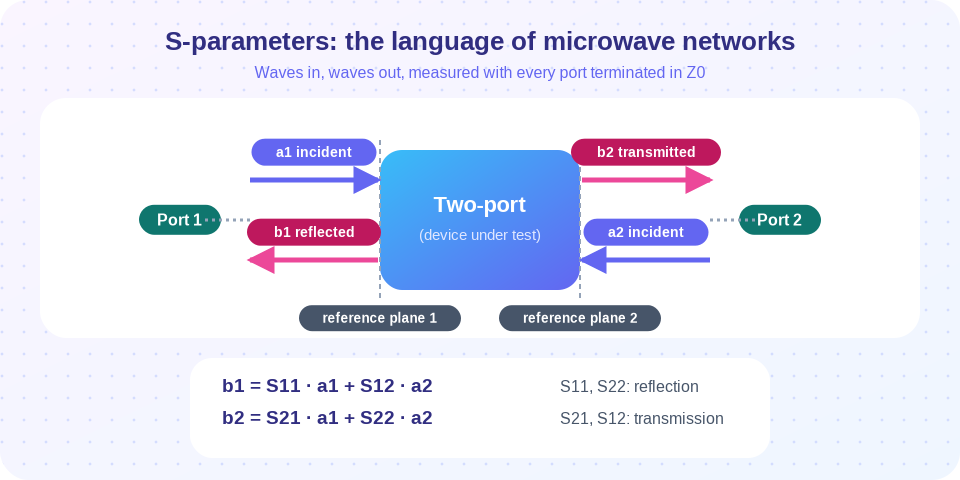
Terminate every port of the network except one in a perfectly matched load (Z0, so the wave leaves and nothing returns). Send a wave into port j and measure the waves that come out of each port i. The ratio Sij = b_i / a_j is an S-parameter. It is a complex number: magnitude says how large, angle says how delayed. Because the other ports are matched, you never need an ideal open or short.
For a two-port: S11 is the reflection at the input, S21 is the forward transmission (gain of an amplifier, loss of a filter), S12 is reverse transmission (isolation) and S22 is the reflection at the output.
What each lesson covers
- S-parameter basics: definitions from voltages and currents, properties (reciprocal, lossless, passive), dB forms, shifting reference planes.
- ABCD matrices and cascaded networks: building blocks, multiplication, conversion to S and a filter example.
- Passive microwave components: attenuators, Wilkinson dividers, couplers.
- Chapter 4 review: summary and quiz.
Try it
This tool makes the definition concrete. It takes a network described by an ABCD matrix, drives port 1 with a unit wave, terminates port 2 in 50 Ω and computes the waves from voltages and currents. You can see that the result is S11 and S21.
Press Run (or Ctrl + Enter) to see the result here.
Program input · what you'd type while the program runs
Type the answers before you press Run, one per line. Each time the program reads a line (with input()), it gets the next line from this box.
The second tool shows what the S-parameters of a passive network mean for power. Enter |S11|, |S21| and the incident power; the tool reports reflected, transmitted and absorbed power and warns if the numbers would break energy conservation.
Check your understanding
Quick check · 4 questions
of 4 answered You scored / 4 · perfect!
-
1. What do S-parameters relate?
Sij = b_i / a_j: the ratio of the wave leaving port i to the wave entering port j. -
2. S21 of an amplifier represents its
S21 is the forward transmission; for an amplifier its magnitude in dB is the gain. -
3. When measuring S11, the other port should be
The definition assumes a2 = 0, i.e. no wave entering port 2, which a matched load guarantees. -
4. Why is a matched termination preferred to an open or short at microwave frequencies?
Parasitic inductance and capacitance spoil ideal opens and shorts, and an unstable device may oscillate with reactive terminations.
Summary
- S-parameters describe a network through waves, not terminal voltages and currents.
- Each
Sijis a complex ratio measured with all other ports terminated inZ0. - For a two-port: S11 and S22 are reflections, S21 and S12 are transmissions.
- A VNA measures them directly; datasheets and simulators use them.
- This chapter adds the definitions, the ABCD cascade method and three passive components.
Next: S-Parameter Basics
Theo dõi tiến độ của bạn
Tạo tài khoản miễn phí để đánh dấu bài đã học và tiếp tục từ chỗ bạn dừng lại trên mọi thiết bị.