
























Bài 10 · Waves and Transmission Lines
Chapter 2 Review: Waves and Transmission Lines
Review chapter 2: the line model, characteristic impedance, reflection coefficient, VSWR, input impedance, stubs and quarter-wave transformers, with practice code and a ten-question quiz.
Chapter 2 introduced one big idea: at RF a cable is not a connection but a medium that carries waves. Once you accept that, a handful of equations explain reflections, standing waves and the strange way a line changes the impedance you see. This review gathers them and checks that you can use them without looking back.
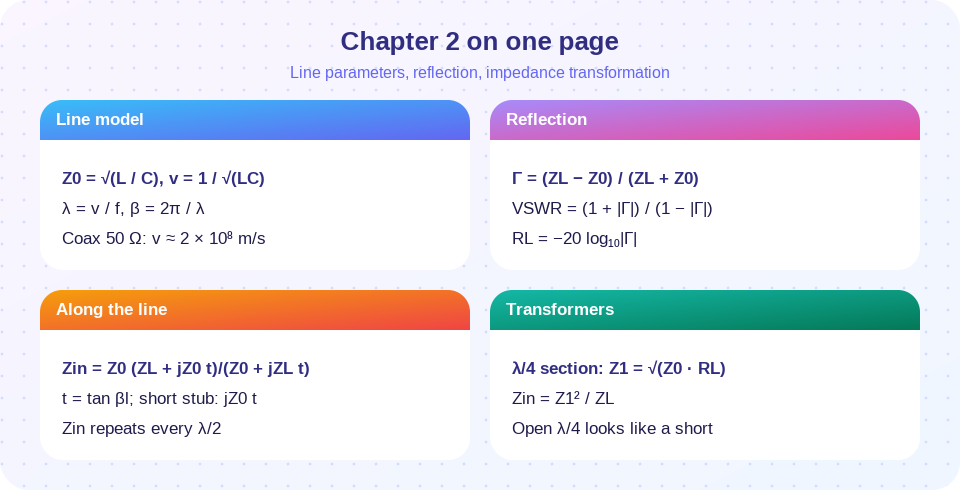
The chapter in a table
| Concept | Formula | Typical numbers |
|---|---|---|
| Characteristic impedance | Z0 = √(L/C) |
50 Ω coax: 250 nH/m, 100 pF/m |
| Velocity | v = 1/√(LC) = c/√εr |
2×10⁸ m/s in solid-PE coax |
| Wavelength in line | λ = v/f |
20 cm at 1 GHz |
| Reflection coefficient | Γ = (ZL − Z0)/(ZL + Z0) |
100 Ω on 50 Ω: 1/3 |
| VSWR | (1 + |Γ|)/(1 − |Γ|) |
|Γ| = 0.5 gives 3 |
| Return loss | −20 log₁₀|Γ| |
VSWR 2 gives 9.5 dB |
| Mismatch loss | −10 log₁₀(1 − |Γ|²) |
|Γ| = 0.2 gives 0.18 dB |
| Input impedance | Zin = Z0 (ZL + jZ0 t)/(Z0 + jZL t) |
t = tan βl |
| Quarter-wave | Zin = Z0²/ZL, Z1 = √(Z0 RL) |
70.7 Ω for 50 → 100 |
| Stubs | short: jZ0 tan βl, open: −jZ0 cot βl |
λ/8 gives ±j50 on 50 Ω |
How to think about a line problem
- Find the wavelength in the line. Use velocity factor, not the free-space value.
- Compute the electrical length
βl = 360° · l/λ. - Normalize impedances by
Z0if you plan to use the Smith chart. - Compute Γ at the load, then VSWR, RL and ML as needed.
- Move along the line with the
Zinformula or by rotating Γ by−2βl. - Check units and sanity:
|Γ| ≤ 1,VSWR ≥ 1, and for a lossless line Re(Zin) stays positive for a passive load.
If you get a negative real part of Zin for a passive load on a lossless line, you have made an algebra mistake, usually a sign or a conjugate error.
Try it
These practice problems are solved with code. Try each by hand first, then compare.
Press Run (or Ctrl + Enter) to see the result here.
Program input · what you'd type while the program runs
Type the answers before you press Run, one per line. Each time the program reads a line (with input()), it gets the next line from this box.
Next, a quick visual check that ties the chapter together: sweep the load resistance and plot VSWR and mismatch loss on the same chart.
Press Run (or Ctrl + Enter) to see the result here.
Program input · what you'd type while the program runs
Type the answers before you press Run, one per line. Each time the program reads a line (with input()), it gets the next line from this box.
Check your understanding
Quick check · 10 questions
of 10 answered You scored / 10 · perfect!
-
1. A coax has L = 200 nH/m and C = 80 pF/m. What is Z0?
Z0 = √(200×10⁻⁹/80×10⁻¹²) = √2500 = 50 Ω. -
2. A cable has a velocity factor of 0.66. What is the wavelength inside it at 500 MHz?
λ in air = 60 cm; times 0.66 gives 39.6 cm. -
3. A 50 Ω line is terminated in 200 Ω. What is |Γ|?
Γ = (200 − 50)/(200 + 50) = 150/250 = 0.6. -
4. VSWR 1.5 corresponds to what return loss?
|Γ| = 0.2, RL = 14 dB. -
5. A 50 Ω λ/4 line is terminated in 100 Ω. What impedance appears at the input?
Zin = 50²/100 = 25 Ω. -
6. What is the input impedance of an open-circuited λ/4 line?
The quarter-wave line inverts the open circuit into a short. -
7. Which statement is true for a lossless line terminated in a mismatched load?
Maxima repeat every λ/2 and are separated from minima by λ/4. VSWR is set by |Γ|, which does not change on a lossless line. -
8. A load has Γ = 0.25. How much power is reflected?
Reflected power fraction = |Γ|² = 0.0625. -
9. A shorted 50 Ω stub is λ/8 long. Its input impedance is
Zin = jZ0 tan(45°) = +j50 Ω. -
10. What does the VSWR number NOT tell you?
VSWR is a scalar built from |Γ|; the sign of the reactance is lost.
Summary
- A line is a distributed circuit with
Z0 = √(L/C)and velocity1/√(LC). - Mismatch creates
Γ, VSWR, return loss and mismatch loss: all four describe the same reflection. - On a lossless line
|Γ|is constant and the phase rotates with distance;Zinrepeats everyλ/2. - Quarter-wave lines invert impedance; stubs act as reactances.
- Chapter 3 turns these into a graphical tool, the Smith chart.
Theo dõi tiến độ của bạn
Tạo tài khoản miễn phí để đánh dấu bài đã học và tiếp tục từ chỗ bạn dừng lại trên mọi thiết bị.