
























Bài 45 · Projects and Practice
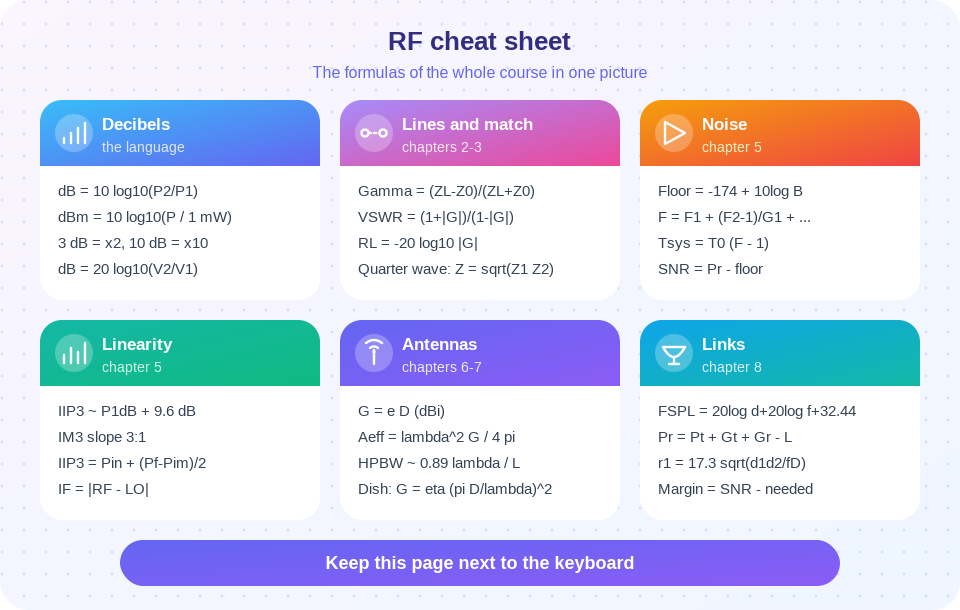
RF and Antennas Cheat Sheet
One-page recap of the key RF and antenna formulas: decibels, matching, noise, linearity, antennas and link budgets, with a calculator for the most used ones.
Everything you need most often, on one page. Keep it beside your keyboard while you design or study.
What you will learn
- Which formula to reach for in each situation.
- The typical numbers worth remembering.
Formulas and numbers
| Topic | Formula | Remember |
|---|---|---|
| Decibels | dB = 10 log10(P2/P1) |
3 dB = x2, 10 dB = x10 |
| dBm | 10 log10(P / 1 mW) |
0 dBm = 1 mW, 30 dBm = 1 W |
| Reflection | Γ = (ZL - Z0)/(ZL + Z0) |
VSWR 2 = return loss 9.54 dB |
| Noise floor | -174 + 10 log10(B) + NF |
1 MHz: -114 dBm before NF |
| Friis cascade | F = F1 + (F2-1)/G1 + ... |
LNA first |
| IM3 | 3 Pout - 2 OIP3 |
IIP3 about P1dB + 9.6 dB |
| Mixer | IF = abs(RF - LO) |
image = RF ∓ 2 IF |
| Gain | G = e D, D = 4π/Ω |
Half-wave dipole 2.15 dBi |
| Aperture | Aeff = λ²G/4π |
Dish: G = η(πD/λ)², η about 0.6 |
| FSPL | 20 log10 d_km + 20 log10 f_MHz + 32.44 |
+6 dB per doubling |
| Friis link | Pr = Pt + Gt + Gr - FSPL |
Add margin |
| Fresnel | r1 = 17.3 sqrt(d1 d2/(f D)) m |
keep 60 percent clear |
| Horizon | 4.12 (√h1 + √h2) km |
4/3 earth |
| Fading | Rayleigh margin 20 dB = 99 % | 30 dB = 99.9 % |
| Array | d < λ/(1 + abs(sin θ0)), β = -kd sin θ0 |
N elements, 10 log N dBi |
Try it
Press Run (or Ctrl + Enter) to see the result here.
Program input · what you'd type while the program runs
Type the answers before you press Run, one per line. Each time the program reads a line (with input()), it gets the next line from this box.
Press Run (or Ctrl + Enter) to see the console output here.
No output.
Check your understanding
Quick check · 3 questions
of 3 answered You scored / 3 · perfect!
-
1. Which relation links IM3 to OIP3?
Slope 3 against slope 1 gives IM3 = 3 Pout - 2 OIP3. -
2. Which formula gives the free-space loss in practical units?
That is the standard form. -
3. In a cascade, the first stage should have
Friis: later noise is divided by the first stage gain.
Summary
- Memorize the anchors: 3 dB = x2, 10 dB = x10.
- Link problems use FSPL, Friis and the noise floor; device problems use NF, P1dB and IP3.
- Antenna problems use directivity, gain and aperture.
Next: Further study
Theo dõi tiến độ của bạn
Tạo tài khoản miễn phí để đánh dấu bài đã học và tiếp tục từ chỗ bạn dừng lại trên mọi thiết bị.