
























Bài 16 · Equilibrium of Particles and Bodies
Chapter 3 review: equilibrium
Review particle and rigid-body equilibrium, free-body diagrams, supports, three-force members and 3D equilibrium with a worked boom problem and a nine-question quiz.
This chapter turned pictures into equations. You can now take a structure, draw its free-body diagram, count unknowns against equations and solve for reactions and tensions. Use this page to consolidate before moving on to moments.
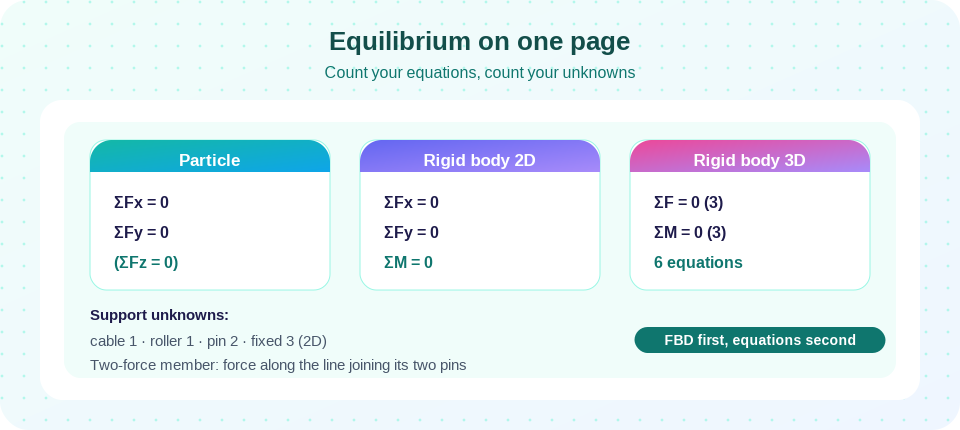
Recap table
| Lesson | Key idea | Remember |
|---|---|---|
| Equilibrium of a particle | ΣFx = 0, ΣFy = 0 at a joint |
Cables pull only; T = W/(2 sin θ) |
| Free-body diagrams and supports | Reaction per blocked motion | Cable 1, roller 1, pin 2, fixed 3 |
| Rigid body in 2D | Three equations, smart moment point | Three-force rule: concurrent lines |
| Three dimensions | Six equations, M = r × F |
Fixed support: 3 forces + 3 moments |
A worked review problem: the boom
A uniform beam AB, 4.0 m long and weighing 400 N, is pinned to a wall at A and held horizontal by a cable attached at B that runs up to the wall at 30° above the horizontal. A 600 N load hangs from B. Find the cable tension and the pin reactions.
- FBD of the beam: weight 400 N at its middle (2.0 m from A), load 600 N at B (4.0 m), cable tension
Tat B (pulling toward the wall and up), pin componentsAxandAyat A. - Moments about A (eliminates
Ax,Ay): the cable's vertical componentT sin 30°acts at 4.0 m and tries to lift the beam:T sin 30° × 4.0 − 400 × 2.0 − 600 × 4.0 = 0, so2.0 T = 3200andT = 1600 N. - Horizontal: the cable pulls toward the wall with
T cos 30° = 1385.6 N, so the pin pushes away from the wall:Ax = 1386 N. - Vertical:
Ay + T sin 30° − 400 − 600 = 0, soAy = 1000 − 800 = 200 N(upward). - Check with moments about B:
−Ay × 4.0 + 400 × 2.0 = −800 + 800 = 0. ✓
Notice the cable carries 1600 N, far more than the 1000 N of total weight, because it works at a shallow angle and a short lever arm compared with the weights.
Press Run (or Ctrl + Enter) to see the result here.
Program input · what you'd type while the program runs
Type the answers before you press Run, one per line. Each time the program reads a line (with input()), it gets the next line from this box.
(The 2D support counts in the calculator apply to 2D problems; use the 3D support table when you pick "Rigid body in 3D".)
Check your understanding
Quick check · 9 questions
of 9 answered You scored / 9 · perfect!
-
1. A particle has three forces: 100 N east, 100 N north and a third force F. For equilibrium, F must be
The sum of the first two is 141 N toward the north-east, so F is the opposite. -
2. Which support has three unknowns in 2D?
A fixed support supplies two force components and a moment. -
3. In the boom problem, why were moments taken about A?
Forces through A have zero moment about A. -
4. A beam is supported only by two vertical rollers. What is wrong?
Both reaction lines are parallel and vertical, so a horizontal force would make the beam slide. -
5. How many equations does 3D rigid body equilibrium offer?
Three force and three moment equations. -
6. A 600 N weight hangs from the midpoint of a cable and each half makes 10° with the horizontal. Tension in each half is about
T = W/(2 sin 10°) = 600 / (2 × 0.1736) = 1728 N. -
7. A force on a rigid body can be moved along its line of action without changing equilibrium. This is
Transmissibility was introduced in Chapter 1. -
8. Three non-parallel forces keep a body in equilibrium. Two of their lines meet at P. The third line must
Otherwise the third force would have a moment about P and nothing could cancel it. -
9. A spring with k = 400 N/m is stretched 0.25 m. The force is
F = k s = 400 × 0.25 = 100 N.
Summary
- Particle:
ΣF = 0; rigid body:ΣF = 0andΣM = 0; 3D doubles the equations. - Draw the FBD with every support reaction before writing equations.
- Take moments where unknowns cross; check with another point.
- Count unknowns; reject improper or redundant constraints.
Theo dõi tiến độ của bạn
Tạo tài khoản miễn phí để đánh dấu bài đã học và tiếp tục từ chỗ bạn dừng lại trên mọi thiết bị.