
























Bài 32 · Centroids and Distributed Loads
Review: Centroids and Distributed Loads
Chapter 6 in one picture: centroid formulas, standard shapes, composite tables, load resultants and hydrostatic force, with a recap table and a 9-question quiz.
This review gathers the formulas of chapter 6 on a single page. The standard centroids and the load rules are worth knowing by heart: they come up in almost every later chapter, from beam diagrams to strength of materials.
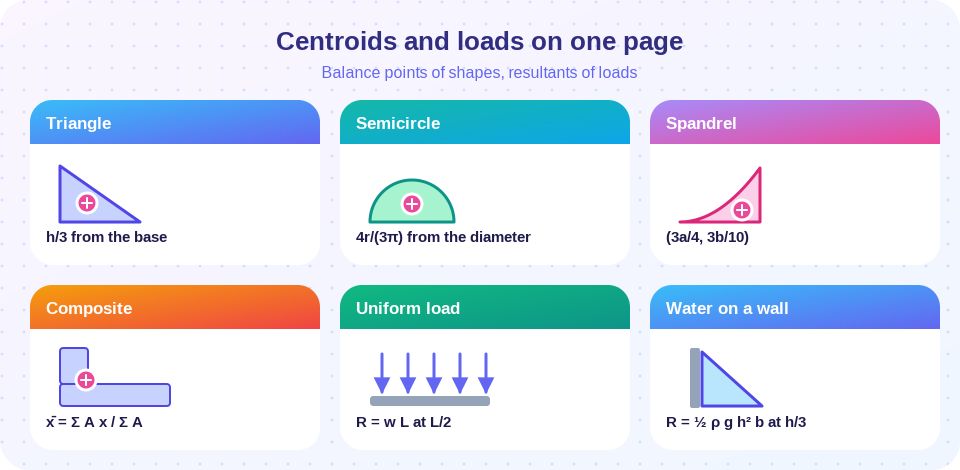
Recap table
| Topic | Result |
|---|---|
| Centroid definition | x̄ = ∫ x_c dA / A |
Triangle (height h) |
h/3 from the base |
Semicircle (radius r) |
4r/(3π) from the diameter |
Spandrel y = b(x/a)² |
x̄ = 3a/4, ȳ = 3b/10, A = ab/3 |
| Composite | x̄ = Σ A_i x_i / Σ A_i, holes negative |
| Uniform load | R = w L at the middle |
| Triangular load | R = w_max L / 2 at L/3 from the big end |
| Hydrostatic pressure | p = ρ g h |
| Force on a vertical wall | R = ½ ρ g h² b at h/3 above the base |
Press Run (or Ctrl + Enter) to see the result here.
Program input · what you'd type while the program runs
Type the answers before you press Run, one per line. Each time the program reads a line (with input()), it gets the next line from this box.
Press Run (or Ctrl + Enter) to see the result here.
Program input · what you'd type while the program runs
Type the answers before you press Run, one per line. Each time the program reads a line (with input()), it gets the next line from this box.
Check your understanding
Quick check · 9 questions
of 9 answered You scored / 9 · perfect!
-
1. A right triangle has legs of 6 m (horizontal) and 3 m (vertical). The centroid is at:
A triangle's centroid is one third along each leg from the right-angle corner: (6/3, 3/3) = (2, 1). -
2. A semicircular area (a half disk) has r = 3 m. How far from its straight edge is its centroid?
4r/(3π) = 12/(3π) = 1.27 m. -
3. A composite part has A = 400 mm² at x = 10 mm and a hole of 100 mm² at x = 10 mm. The combined x̄ is:
Both centroids are at the same x, so the weighted average is that x, whatever the areas. -
4. A uniform load of 3 kN/m over 8 m has a moment about the left end of:
R = 24 kN acts at 4 m, so the moment is 24 × 4 = 96 kN·m. -
5. Water pressure at 3 m depth is about:
p = 1000 × 9.81 × 3 = 29,430 Pa ≈ 29.4 kPa. -
6. A vertical dam wall 5 m high holds water 5 m deep. Where does the resultant act?
The pressure diagram is a triangle, so the resultant is at h/3 = 1.67 m above the base. -
7. A trapezoidal load from 0 to 6 kN/m over 4 m is really a:
0 to 6 over 4 m is a triangle: R = ½ × 4 × 6 = 12 kN, at one third of 4 m from the big end. -
8. Which is true for the centroid of a solid rectangle?
A rectangle has two axes of symmetry; the centroid is where they cross, which is also where the diagonals meet. -
9. Doubling the width of a wall holding water of the same depth multiplies the force by:
R = ½ ρ g h² b is linear in the width b.
Summary
- A centroid is an area-weighted average position; use symmetry, tables and standard shapes.
- A distributed load's resultant is the area of its diagram, at the diagram's centroid.
- Hydrostatic pressure is a triangular load:
R = ½ ρ g h² bath/3.
Theo dõi tiến độ của bạn
Tạo tài khoản miễn phí để đánh dấu bài đã học và tiếp tục từ chỗ bạn dừng lại trên mọi thiết bị.