
























Bài 15 · Lattice Vibrations and Phonons
Chapter 3 review: Lattice vibrations and phonons
Review the monatomic and diatomic chains, acoustic and optical branches, phonons, Dulong-Petit, Einstein and Debye heat capacities, with a formula table and a ten-question quiz.
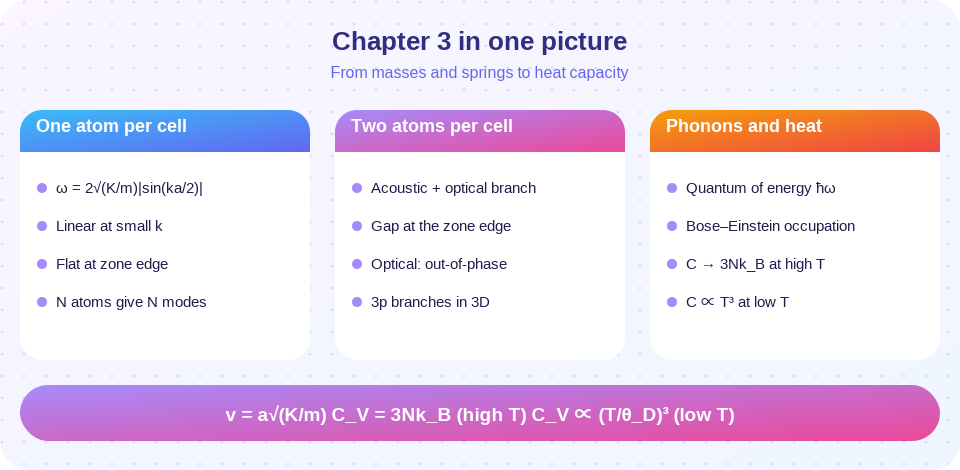
This chapter turned the frozen lattice of Chapter 2 into a living one. You solved a chain of masses and springs, saw that two atoms per cell create acoustic and optical branches with a gap, quantized the modes into phonons and explained why heat capacity changes with temperature. These ideas return in Chapter 7 (superconductivity relies on phonons) and in every discussion of thermal conductivity.
What you will learn
- A compact recap of Chapter 3 with all key formulas.
- A calculator that links Debye temperature to sound speed and atomic density.
- Which parts of the chapter to revisit based on the quiz.
The chapter in a table
| Concept | Result | Lesson |
|---|---|---|
| Monatomic chain | ω = 2√(K/m)|sin(ka/2)|; v = a√(K/m); N modes | Chain |
| Brillouin zone | −π/a < k ≤ π/a; ω(k+G) = ω(k) | Chain |
| Group velocity | v_g = dω/dk, zero at the zone edge | Chain |
| Diatomic chain | ω² = K(1/m+1/M) ± K√[…]; gap √(2K/M) to √(2K/m) | Branches |
| Branch count | 3 acoustic + 3(p−1) optical | Branches |
| Phonon occupation | ⟨n⟩ = 1/(e^{ħω/k_BT} − 1) | Phonons |
| Dulong-Petit | C_V = 3Nk_B = 24.9 J/(mol·K) | Phonons |
| Debye | θ_D = ħv(6π²N/V)^(1/3)/k_B; C ∝ T³ at low T | Phonons |
Key terms
Dispersion relation: ω as a function of k.
Acoustic and optical branches: in-phase and out-of-phase motions of the atoms in a cell.
Phonon: quantum of a lattice vibration.
Debye temperature: sets the scale where quantum freeze-out of phonons begins.
Common mistakes
Counting modes wrongly. N atoms in 3D have 3N modes, not N.
Using the Debye T³ law at room temperature. It holds only for T below roughly θ_D/50.
Confusing phase and group velocity. Sound is v = dω/dk at k → 0, but near the zone edge only the group velocity (not ω/k) describes energy flow.
Try it
Press Run (or Ctrl + Enter) to see the result here.
Program input · what you'd type while the program runs
Type the answers before you press Run, one per line. Each time the program reads a line (with input()), it gets the next line from this box.
Check your understanding
Quick check · 10 questions
of 10 answered You scored / 10 · perfect!
-
1. A chain of N atoms with periodic boundary conditions has how many allowed k values in the first Brillouin zone?
k = 2πj/(Na) with N distinct values inside the zone. -
2. The speed of sound in the monatomic chain is
From ω ≈ a√(K/m) k at small k. -
3. The maximum frequency of the monatomic chain is
sin(ka/2) = 1 at the zone edge, so ω_max = 2√(K/m). -
4. A 3D crystal has 5 atoms per primitive cell. How many acoustic branches does it have?
There are always three acoustic branches; the other 3p − 3 = 12 are optical. -
5. The Einstein model fails at low temperature because it predicts
A single frequency gives e^(−θ_E/T); Debye's continuum of low-frequency modes gives the observed T³. -
6. Dulong-Petit predicts the molar heat capacity of a solid to be about
3R = 24.94 J/(mol·K). -
7. At the zone edge of the monatomic chain the wave is
Group velocity vanishes; neighboring atoms move in opposition and the wave is Bragg reflected. -
8. What opens the gap between acoustic and optical branches?
When m = M the gap closes. -
9. The mean phonon number at ħω = 5 k_BT is approximately
1/(e⁵ − 1) = 1/147.4 = 0.0068, so the mode is nearly empty. -
10. Which is a property of Umklapp scattering?
Umklapp collisions make phonon momentum non-conserved and give finite lattice thermal resistance.
Summary
- The monatomic chain: ω = 2√(K/m)|sin(ka/2)|, N modes, sound speed a√(K/m), group velocity zero at the zone edge.
- Two atoms per cell: an acoustic and an optical branch separated by a gap; 3p branches in 3D.
- Phonons obey Bose-Einstein statistics; heat capacity goes from Dulong-Petit (3Nk_B) at high T to T³ at low T.
- Debye temperature measures lattice stiffness; Umklapp scattering sets thermal resistance.
Theo dõi tiến độ của bạn
Tạo tài khoản miễn phí để đánh dấu bài đã học và tiếp tục từ chỗ bạn dừng lại trên mọi thiết bị.