
























Bài 10 · Crystal Structure and Diffraction
Chapter 2 review: Crystal structure and diffraction
Review lattices, unit cells, cubic packing, Miller indices, Bragg's law and the reciprocal lattice, with a formula table, a Bragg calculator and a ten-question quiz.
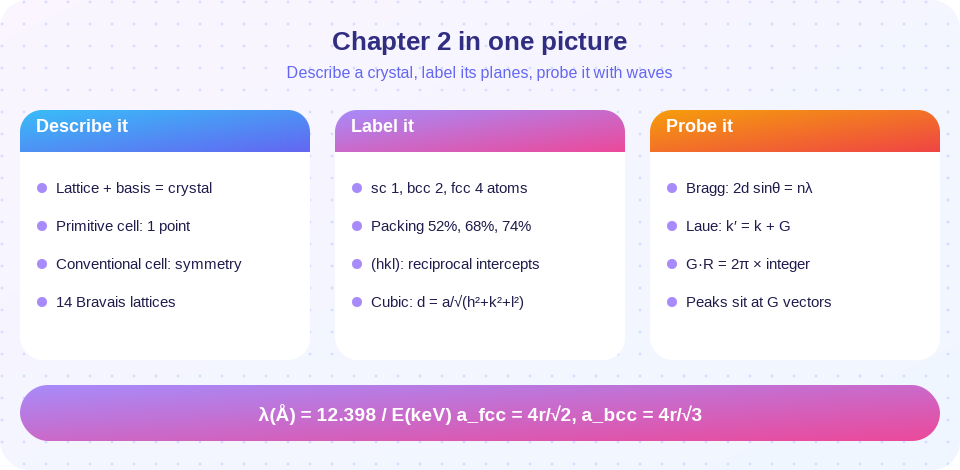
Chapter 2 gave you the language of crystals and the main tool for examining them. If you can take a crystal structure, say how many atoms it has per cell, how its planes are labeled and where its diffraction peaks fall, you are ready for the dynamics of Chapter 3 and the electrons of Chapter 4.
What you will learn
- A one-page recap of Chapter 2 with every key formula.
- How to use Bragg's law as a calculator for angles and spacings.
- Which topics to revisit if the quiz shows a gap.
The chapter in a table
| Topic | Formula or rule | Lesson |
|---|---|---|
| Lattice | R = n₁a₁ + n₂a₂ + n₃a₃; V = | a₁·(a₂×a₃) |
| Atoms per cubic cell | sc 1, bcc 2, fcc 4, diamond 8 | Cubic |
| Packing fraction | 0.524, 0.680, 0.740, 0.340 | Cubic |
| Density | ρ = Z M/(N_A a³) | Cubic |
| Miller indices | Reciprocal intercepts, cleared to integers | Miller |
| Cubic plane spacing | d = a/√(h²+k²+l²) | Miller |
| Bragg's law | 2d sin θ = nλ | Diffraction |
| Reciprocal lattice | aᵢ·bⱼ = 2πδᵢⱼ; | G |
| Structure factor | bcc: h+k+l even; fcc: all odd or all even | Diffraction |
Key terms
Primitive cell: smallest cell with one lattice point.
Coordination number: number of nearest neighbors.
Miller indices: integers (hkl) labeling a plane family.
Reciprocal lattice: the set of wave vectors G that satisfy the Laue condition.
Common mistakes
Mixing up θ and 2θ. Bragg's equation uses θ; instruments report 2θ.
Forgetting the basis. NaCl and diamond are both fcc lattices; they differ in their bases and thus in their structure factors.
Using intercepts instead of reciprocals. A plane parallel to an axis has an intercept of infinity and an index of zero.
Try it
Press Run (or Ctrl + Enter) to see the result here.
Program input · what you'd type while the program runs
Type the answers before you press Run, one per line. Each time the program reads a line (with input()), it gets the next line from this box.
Check your understanding
Quick check · 10 questions
of 10 answered You scored / 10 · perfect!
-
1. The primitive cell of bcc (cubic side a) has volume
The conventional bcc cube holds 2 lattice points, so each point owns a³/2. -
2. Which structure has the highest packing fraction of the four listed?
fcc fills 74.0% of space, bcc 68.0%, sc 52.4% and diamond 34.0%. -
3. A plane cuts the axes at 2, 2 and 2 lattice constants. Its Miller indices are
Reciprocals are 1/2, 1/2, 1/2. Multiplying by 2 gives (111). Miller indices are always the smallest integers. -
4. d for (200) planes in a cubic crystal with a = 0.4 nm is
d = a/√(4+0+0) = 0.4/2 = 0.2 nm. -
5. Why does Bragg's law require λ ≤ 2d?
nλ = 2d sin θ ≤ 2d, so even first-order diffraction needs λ ≤ 2d. -
6. Which pair of (hkl) is both allowed for fcc?
fcc allows all-odd (111) or all-even (200), not mixed parity such as (100) or (110). -
7. The reciprocal lattice of simple cubic (constant a) is
For sc, b = 2π/a along each axis. -
8. Diffraction measures the length of G as
|G_hkl| = 2π/d_hkl: large spacing in real space means a short reciprocal vector. -
9. Why is graphene not a Bravais lattice?
The honeycomb is a triangular lattice with a two-atom basis. -
10. Cu Kα X-rays have energy about
λ = 12.398/E(keV) = 1.54 Å gives E = 8.05 keV.
Summary
- A crystal = lattice + basis; the 14 Bravais lattices cover all possible lattices.
- sc, bcc, fcc and diamond have 1, 2, 4 and 8 atoms per cell and packing fractions 52.4%, 68.0%, 74.0% and 34.0%.
- Miller indices label planes; cubic d = a/√(h²+k²+l²).
- Bragg's law and the Laue condition locate diffraction peaks; the structure factor decides which peaks survive.
Theo dõi tiến độ của bạn
Tạo tài khoản miễn phí để đánh dấu bài đã học và tiếp tục từ chỗ bạn dừng lại trên mọi thiết bị.