
























Bài 30 · Semiconductors and Metals
Chapter 6 review: semiconductors and metals
Review chapter 6: intrinsic carriers, doping, the p-n junction, the Hall effect and mobility, with a recap table and ten mixed questions.
Chapter 6 turned the band picture into numbers you can measure: how many carriers, which sign, how fast. This review collects the main formulas and then tests how well you can switch between them.
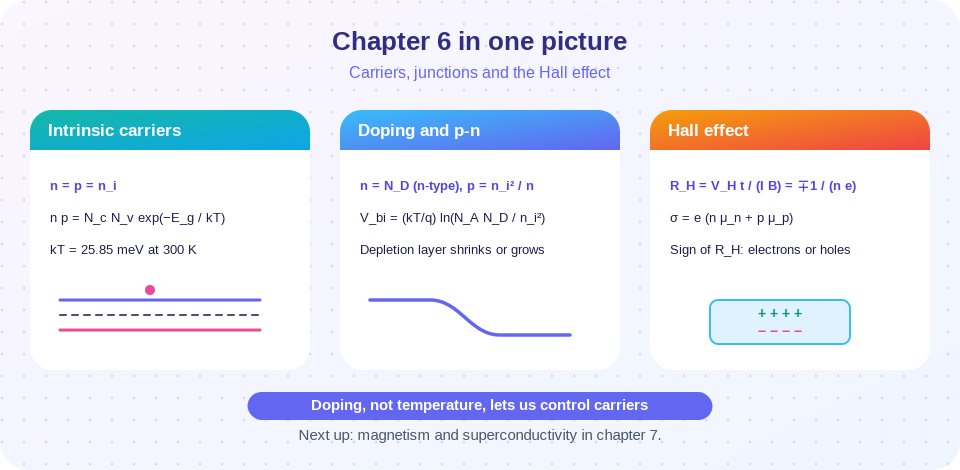
What you should be able to do
- Compute n_i, n and p from N_c, N_v, Eg and doping.
- Locate the Fermi level and compute the built-in voltage and depletion width of a junction.
- Use the Hall voltage to find carrier density, and σ and R_H to find mobility.
- Explain why holes and electrons both matter in an intrinsic or compensated sample.
Recap table
| Quantity | Formula | Typical value (Si, 300 K) |
|---|---|---|
| kT | 8.617 × 10⁻⁵ eV/K × T | 25.85 meV |
| Electron density | n = N_c exp(−(E_c − E_F)/kT) | depends on E_F |
| Intrinsic density | n_i = sqrt(N_c N_v) exp(−Eg/2kT) | about 10¹⁰ cm⁻³ |
| Mass-action law | n p = n_i² | 10²⁰ cm⁻⁶ |
| Doped carriers | n ≈ N_D − N_A (n-type) | 10¹⁶ for N_D = 10¹⁶ |
| Fermi level shift | E_F − E_i = kT ln(n/n_i) | 0.36 eV for n = 10¹⁶ cm⁻³ |
| Built-in voltage | V_bi = (kT/q) ln(N_A N_D/n_i²) | 0.77 V for 10¹⁷ and 10¹⁶ |
| Depletion width | W = sqrt(2ε(V_bi − V)/q × (1/N_A + 1/N_D)) | about 0.33 µm at V = 0 |
| Diode current | I = I_s[exp(qV/kT) − 1] | decade per 60 mV |
| Hall coefficient | R_H = 1/(nq) | sign of the carrier |
| Conductivity | σ = e(nμ_n + pμ_p) | 2.2 S/cm for 10¹⁶ cm⁻³ n-type |
Where students go wrong
Units. Semiconductor tables use cm⁻³ and cm²/(V·s); the Hall formula in SI needs m⁻³. Convert once and check the order of magnitude.
Forgetting the T-dependence of n_i. An intrinsic density that looks negligible at 300 K can dominate at 500 K.
Using n = N_D for lightly doped samples. If N_D is within a factor of 10 of n_i, use the full quadratic formula for n.
Try it
Press Run (or Ctrl + Enter) to see the result here.
Program input · what you'd type while the program runs
Type the answers before you press Run, one per line. Each time the program reads a line (with input()), it gets the next line from this box.
Check your understanding
Quick check · 10 questions
of 10 answered You scored / 10 · perfect!
-
1. n p = n_i² implies that in n-type silicon with n = 10¹⁶ cm⁻³ the hole density is
p = 10²⁰ / 10¹⁶ = 10⁴ cm⁻³ with n_i = 10¹⁰ cm⁻³. -
2. At what energy is the Fermi level of an intrinsic semiconductor?
Equal n and p place E_F near midgap. -
3. A donor in silicon has an ionization energy of about 45 meV. At room temperature (kT = 26 meV) the donors are
At 300 K nearly all shallow donors are ionized; freeze-out needs much lower temperatures. -
4. The built-in voltage of a junction increases if
V_bi = (kT/q) ln(N_A N_D / n_i²) grows with N_A N_D. -
5. Forward bias of 0.12 V (two decades at 60 mV per decade) multiplies the diode current by about
Each 60 mV multiplies by ten, so 120 mV gives a factor of 100. -
6. A measured Hall coefficient is negative. The dominant carriers are
R_H = −1/(ne) for electrons. -
7. A sample has σ = 200 S/m and R_H = −6.2 × 10⁻⁴ m³/C. The Hall mobility is about
μ = |R_H| σ = 6.2 × 10⁻⁴ × 200 = 0.124 m²/(V·s) = 1240 cm²/(V·s). -
8. Doubling the Hall bar thickness t at fixed I and B
V_H = IB/(nqt) is inversely proportional to t. -
9. In an intrinsic semiconductor with μ_n > μ_p, the Hall coefficient is
With n = p, R_H ∝ (μ_p² − μ_n²) < 0: the more mobile electrons dominate. -
10. Which change widens the depletion layer?
Reverse bias raises the voltage across the layer; higher doping would narrow it.
Summary
- Intrinsic densities are exponential in Eg/2kT; doping sets n and p with n p = n_i².
- The Fermi level moves toward the band of the majority carriers and fixes q V_bi at a junction.
- Hall and conductivity measurements together give n, sign and μ.
- Next the story moves from charge to spin: magnetism and superconductivity.
Theo dõi tiến độ của bạn
Tạo tài khoản miễn phí để đánh dấu bài đã học và tiếp tục từ chỗ bạn dừng lại trên mọi thiết bị.