
























Bài 18 · Compact Objects
Chapter 4 overview: compact objects
An overview of chapter 4: how the dead cores of stars become white dwarfs, neutron stars or black holes, what holds them up, and how compactness measures their gravity.
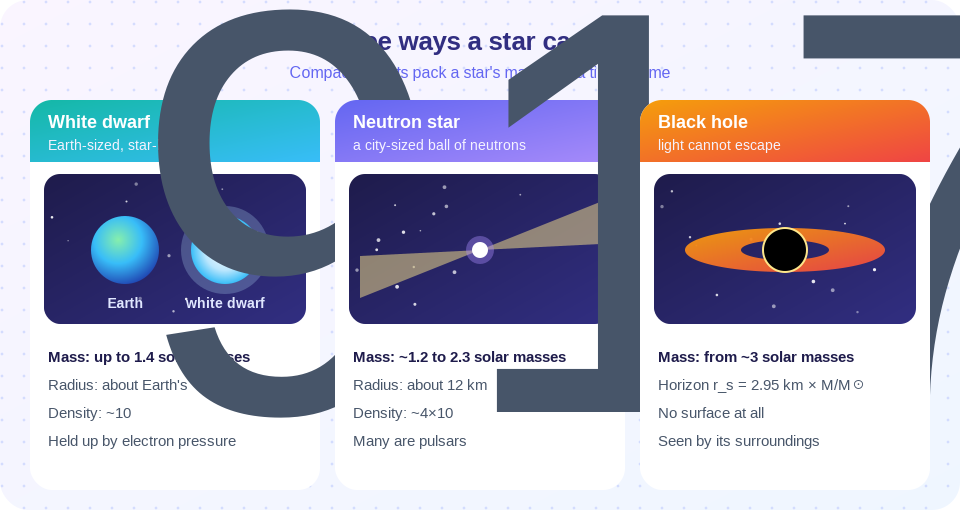
When a star runs out of fuel, thermal pressure can no longer hold it up, and gravity wins. What stops the collapse depends on the mass left behind. A core of about the Sun's mass is halted when electrons refuse to be squeezed any closer: a white dwarf. A heavier core is halted only when neutrons are packed shoulder to shoulder: a neutron star. If even that fails, nothing known stops the collapse, and the result is a black hole. These three objects are the subject of this chapter, and they are the places where gravity, quantum mechanics and relativity meet.
What you will learn
- What halts the collapse in each kind of remnant.
- How to measure how "compact" an object is.
- What each lesson of this chapter covers.
Key terms
Compact object: a stellar remnant much smaller than a normal star of the same mass.
Degeneracy pressure: pressure from the quantum rule that no two identical fermions (electrons, neutrons) can occupy the same state.
Compactness: the ratio 2GM / (R c²), which is 1 for a black hole.
Escape velocity: v = √(2GM/R); at the horizon of a black hole it equals c.
The big picture
White dwarf
Neutron star
Black hole
How we know
The roadmap
- White dwarfs: electron degeneracy, the Chandrasekhar limit and Type Ia supernovae.
- Neutron stars and pulsars: extreme density, magnetic fields, spin-down and what pulsars teach us.
- Black holes: the Schwarzschild radius, how we find them and how they are imaged.
- Chapter 4 review: cheat sheet and quiz.
Compactness: how strong is the gravity?
Compare each object's gravity through the dimensionless ratio 2GM / (R c²), the Schwarzschild radius divided by the actual radius. For the Sun it is 4×10⁻⁶. For a typical white dwarf it is a few times 10⁻⁴. For a neutron star it is about 0.3, so Newtonian physics is no longer good enough. A black hole has a compactness of 1 by definition, so its escape velocity equals the speed of light. The next TryIt computes it.
Common misconceptions
"A black hole is a hole in space." It is a region of spacetime bounded by a horizon, with a real mass that you can orbit just like any other mass.
"A neutron star is a giant atomic nucleus." It resembles one in density, but is held together by gravity, not the strong force, and has a crust, a superfluid interior and a magnetic field.
"White dwarfs are tiny stars still burning." They have no fusion; they only cool.
Try it
First, a table of compactness and escape velocity for the Sun and the three remnants. The masses and radii are typical values.
Press Run (or Ctrl + Enter) to see the console output here.
No output.
Second, a mass-radius map of cosmic objects. The black-hole line marks the radius R = 2GM/c²: nothing can be smaller than its own horizon and still be seen from outside.
Press Run (or Ctrl + Enter) to see the result here.
Program input · what you'd type while the program runs
Type the answers before you press Run, one per line. Each time the program reads a line (with input()), it gets the next line from this box.
Check your understanding
Quick check · 4 questions
of 4 answered You scored / 4 · perfect!
-
1. What supports a white dwarf against gravity?
Fusion has stopped; electrons crowded into a small volume resist further squeezing by the Pauli exclusion principle. -
2. Which of these is the most compact?
A neutron star has 2GM/(Rc^2) of about 0.3, far larger than a white dwarf's few times 10^-4 or the Sun's 4 x 10^-6. -
3. The escape velocity at a black hole's event horizon equals
That is the definition of the horizon: even light cannot escape from inside it. -
4. About how large is a typical neutron star?
Observations give radii of about 10 to 13 km.
Summary
- Stellar cores end as white dwarfs (electron pressure), neutron stars (neutron pressure) or black holes (nothing stops the collapse).
- Compactness
2GM/(Rc²)ranges from 10⁻⁶ for the Sun to 1 for a black hole. - Each lesson studies one remnant and how astronomers detect it.
- Gravity here is strong enough that general relativity is needed.
Next: White dwarfs
Theo dõi tiến độ của bạn
Tạo tài khoản miễn phí để đánh dấu bài đã học và tiếp tục từ chỗ bạn dừng lại trên mọi thiết bị.